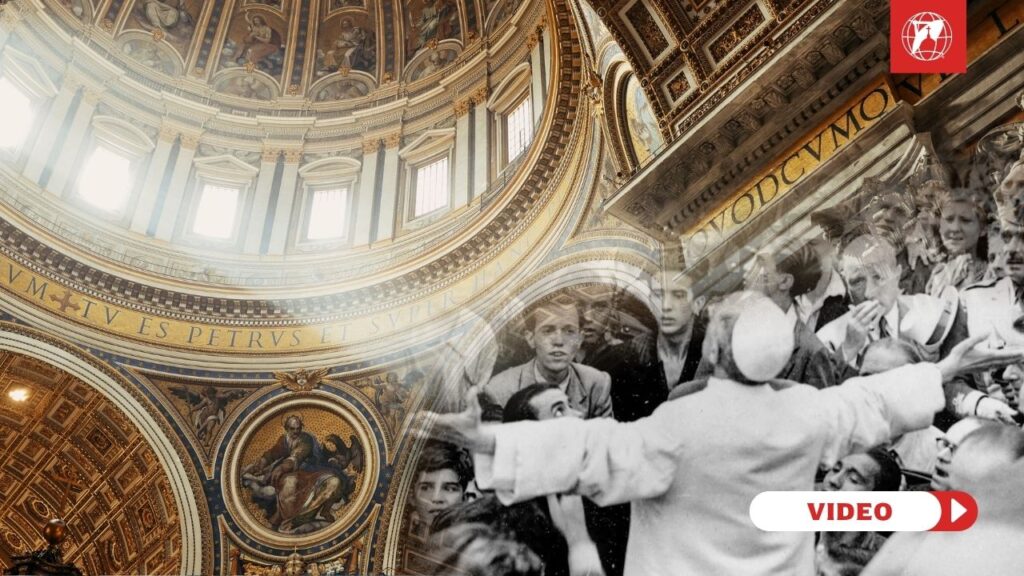
Pope Pius XII remains one of the most debated figures of the Second World War. Known as the “Silent Pope,” he has been criticized by some for failing to publicly confront the Holocaust, while others point to his diplomatic efforts and the assistance provided by the Catholic Church to those fleeing Nazi persecution.
But who was Eugenio Pacelli before his election as Pope? What role did he play as Europe moved toward war, and how did he respond once the conflict began?
Through the testimony of historians and researchers, this report examines Pacelli’s diplomatic career, his appeals for peace, the decisions behind his wartime public statements, and the charitable efforts carried out during his pontificate.
Eugenio Pacelli: A diplomat before becoming Pope
Before becoming Pope Pius XII, Eugenio Pacelli had already built an extensive diplomatic career within the Church. He served as Papal Nuncio to Bavaria and Germany before becoming Vatican Secretary of State.
According to Avv. Emilio Artiglieri, president of the Pope Pacelli Committee and the Pius XII Association, Pacelli’s diplomatic activity began during the earliest years of his priesthood.
“His was one of the defining pontificates of the twentieth century. […] He helped guide civil society into the new century and equip it to face the challenges of a new era. […] In many ways, Eugenio Pacelli’s diplomatic activity began during the earliest years of his priesthood.”
During his time as Secretary of State, Pacelli also helped draft Mit brennender Sorge (“With Burning Concern”), the 1937 encyclical that strongly condemned Nazi ideology.
His opposition to the Nazi regime continued after his election as Pope in March 1939, as Europe moved closer to war.
A final appeal for peace
On Aug. 24, 1939, just days before the outbreak of the Second World War, Pius XII delivered a radio message appealing to world leaders to avoid military conflict.
Artiglieri describes it as one of the Pope’s first significant radio messages, recalling its central appeal:
“Nothing is lost with peace, but everything may be lost with war.”
The Pope’s appeal went unanswered. One week later, Germany invaded Poland, beginning the Second World War.
Belgian researcher and member of FSO (Familia Spiritualis Opus) Deacon Dominiek Oversteyns reflects on Hitler’s refusal to heed the Pope’s warnings.
“Hitler was not listening to Pope Pius XII, he was listening to no one,” he says.
Oversteyns also argues that Pius XII continued to criticize Hitler at moments when the Nazi leader held considerable political and military power.
“Pope Pius XII was criticizing Hitler on the moments when he was on the highest points of political and military power. He was courageous to do that. He was the only one in the whole world to do this.”
The debate over the Pope’s wartime silence
During the war, Pius XII received numerous letters from Jews already in concentration camps, many of whom believed the Pope could intervene on their behalf.
In 2020, the opening of the Vatican Apostolic Archives made thousands of previously inaccessible documents available to researchers. Among the records were reports concerning concentration camps that suggested the Pope had received information about them as early as 1942. The documents renewed debate among historians and in the media about what Pius XII knew and how he responded.
Artiglieri explains that the Pope’s public statements were shaped by concern that speaking more forcefully could provoke further retaliation against those facing persecution.
“He was concerned not to further worsen the fate of the persecuted through statements that might have appeared even more provocative toward the Nazis, the Germans, and Hitler in particular,” he says.
The experience of the Dutch bishops illustrates the concern. After they publicly denounced Nazi actions and the treatment of prisoners, the German regime retaliated, resulting in an increase in arrests and deaths.
The question of whether public denunciation or diplomatic discretion offered greater protection to those in danger remains central to discussions of Pius XII’s wartime decisions.
Charity and assistance during the war
Throughout the conflict, Pius XII remained in Rome, becoming the only resident diplomat and head of state not to flee the city, even after the devastating bombings of San Lorenzo, San Giovanni, and the Vatican itself.
Alongside his diplomatic activity, the Pope undertook extensive charitable efforts to assist those affected by the war, particularly prisoners of war separated from their families.
Artiglieri describes charity as a guiding principle of Pius XII’s pontificate.
“Where diplomacy cannot reach, charity can. This was a very important principle throughout the pontificate of Pius XII.”
He explains that the Pope regularly visited prisoner-of-war camps, bringing practical assistance to those held there.
“He regularly visited prisoner-of-war camps, bringing comfort, medicine, food, clothing, and whatever else was needed by so many imprisoned men, especially those far from their families. Above all, he provided a means of communication between prisoners and their families.”
Religious communities shelter Jews in Rome
During the Nazi occupation of Rome, Catholic religious communities also played a significant role in sheltering people fleeing persecution.
At least 235 convents and religious communities provided refuge to 4,205 Jews. Nearly 80% of Rome’s Jewish population survived the occupation.
Much of this assistance took place away from public view, with religious houses and other Catholic institutions opening their doors to those in danger.
For supporters of Pius XII, these efforts form an important part of the record of the Church’s response to Nazi persecution and the Pope’s wartime leadership.
An ongoing historical debate
The wartime legacy of Pius XII continues to prompt discussion about his public statements, diplomatic decisions, and the assistance provided under his pontificate.
Some argue that his approach of quiet diplomacy helped protect those facing persecution, while others criticize what they consider his failure to speak out publicly against the Holocaust.
Deacon Oversteyns believes the historical evidence allows the accusations against Pius XII to be rejected.
“So we can say at the end that the debate is over and we can almost say that the fundamental, historical discussion on Pope Pius XII ‘is he a friend of Hitler?’, ‘is he silent?’, ‘is he helping the Jews?’, all three accusations can be rejected forever.”
As historians continue to examine the documents and testimonies from the Second World War, the life of Eugenio Pacelli remains an important subject for understanding the Church’s diplomatic and charitable response to one of the darkest periods in modern history.
Adapted by Jacob Stein. Produced by Bénédicte Cedergren; Camera by Alberto Basile, Fabio Gonnella; Video Edited by Ilaria Chimenti.