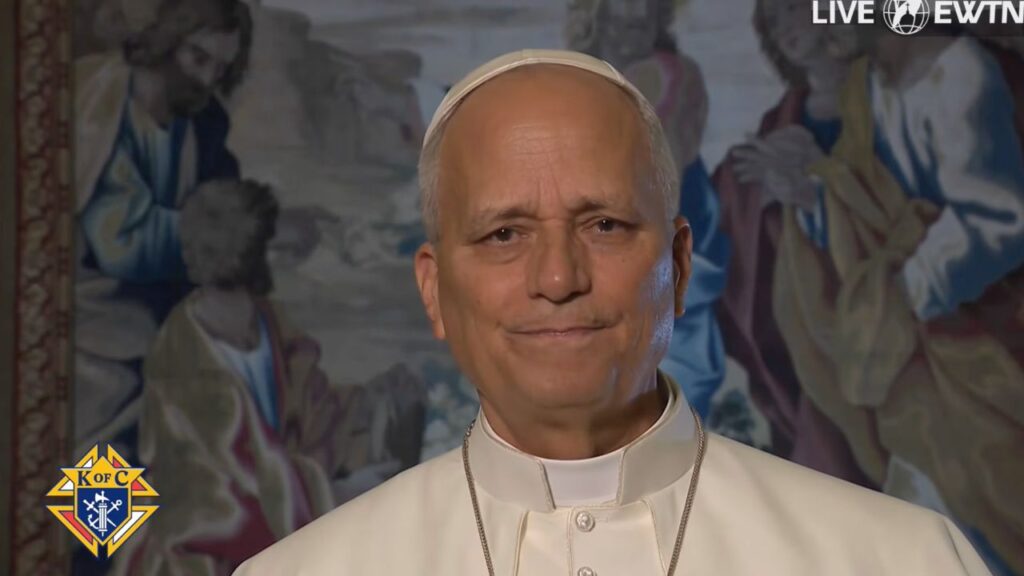
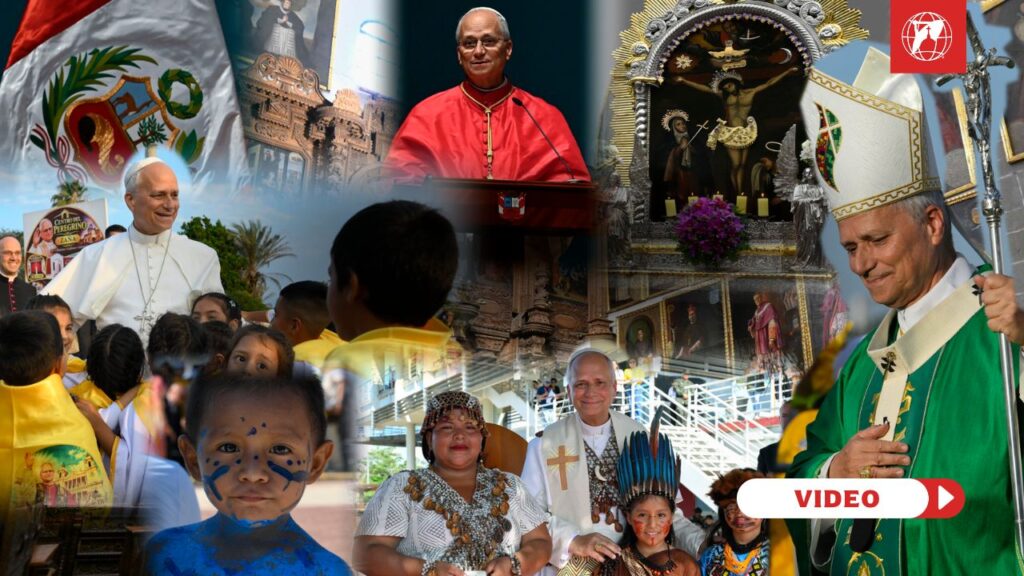
Pope Leo XIV’s historic return to Peru marked the final stage of his apostolic journey to South America and a deeply personal homecoming to the country that helped shape him as a missionary, priest and bishop.
For the first time since his election, the Holy Father returned to the land where he spent years serving the Church, first as an Augustinian missionary and later as Bishop of Chiclayo.
“I return as the Successor of Peter, called to serve the universal Church,” Pope Leo said.
But his return was also rooted in a much longer personal history.
“In light of this responsibility, I recognize in those years a part of the journey through which the Lord was forming me as a shepherd. That is why I can tell you, with deep gratitude, that I am also returning to my homeland.”
His arrival was met with an enormous outpouring of joy and affection. For many Peruvians, and for Pope Leo himself, this was more than a papal visit. It was a homecoming.
Father Alexander Lam, OSA, vicar general of the Order of Saint Augustine, said the Pope had deeply embraced the Latin American and particularly Peruvian understanding of family and belonging.
“He has really embraced that deeply Latin American, and particularly Peruvian, sense and feeling of being a family. You return home to celebrate, to share what you have experienced, to let others rejoice with you and hear about your journey.”
That experience, Father Lam added, is something shared with the wider community.
“Because what you have experienced is not yours alone; it belongs to all of us.”
Father Lam has known Pope Leo XIV for decades. Their paths crossed in Peru, when Lam was a novice and Robert Prevost his formator, and later in Rome, where Lam served as Provincial Prior while Prevost was Prior General, before Prevost eventually became Bishop of Chiclayo.
“It is a blessing to have known him beforehand, to have been able to have this relationship with him,” Father Lam said. “He is still the same, the same good man, the same religious, pastor, and prudent man who accompanies and leads others.”
Returning to his missionary roots
That long relationship with Peru became a recurring theme as Pope Leo reflected on his early years as a missionary during the first public liturgy of the final leg of his apostolic journey.
“I first came to Peru many years ago, sent to serve the People of God and build up his Kingdom, and to promote peace through justice, with particular concern for the weakest,” the Pope recalled.
Now, returning as Successor of Peter, Pope Leo connected those missionary beginnings with the task facing the Church today.
“I return today to encourage you to continue the work of spreading the Gospel, attentive to people’s lives and needs.”
Mission has been a defining part of Pope Leo’s journey.
Before becoming Pope, Robert Prevost spent years serving as an Augustinian missionary in Chulucanas, Peru. He later became Bishop of Chiclayo, a position he held from 2015 until 2023. Those years of pastoral ministry left a profound mark on the future pontiff’s understanding of the Church.
For Father Lam, the young missionary’s time in Peru revealed an understanding of the Church centered not primarily on institutions or buildings, but on a community of believers.
“Father Robert’s experience during that time was extraordinary in terms of his vision of the Church,” he said.
“I vividly remember a moment when the brothers in Chulucanas were discussing how they sought to build the Church, which didn’t mean building the cathedral that would be built later, but rather the Church in the understanding that it is the community of the faithful who praise and serve the Lord.”
A long-awaited return to Chiclayo
Perhaps no stop on Pope Leo’s journey was awaited with greater anticipation than Chiclayo.
Thousands lined the streets of the northern Peruvian city to welcome the man many residents still remember as Father Robert.
It was there that Robert Prevost had served the local Church for almost eight years, first as Apostolic Administrator and later as bishop. Returning now as Pope, he once again placed the missionary vocation of Christians at the center of his message.
“The world is waiting for us and the mission is only beginning,” Pope Leo said.
“Therefore, here in Chiclayo and throughout Peru, I invite you — beginning with this first celebration of our reunion at the Lord’s altar — to commit yourselves to sharing the living hope that is Jesus Christ and to let the Gospel “overflow” from our hamlets, towns and cities, proclaiming to all the “glory of the Lord.””
Father Victor Martínez, rector of the Pontifical Latin American College, said that missionary identity is essential to understanding both the Pope’s ministry and the responsibility of every Christian.
“We are missionary disciples of Jesus Christ, and the Pope, as a missionary, has had no other task than to evangelize. And evangelization takes place through witness. […] The emphasis, then, is that each one of us must be authentic and consistent in the way we are and in the way we act.”
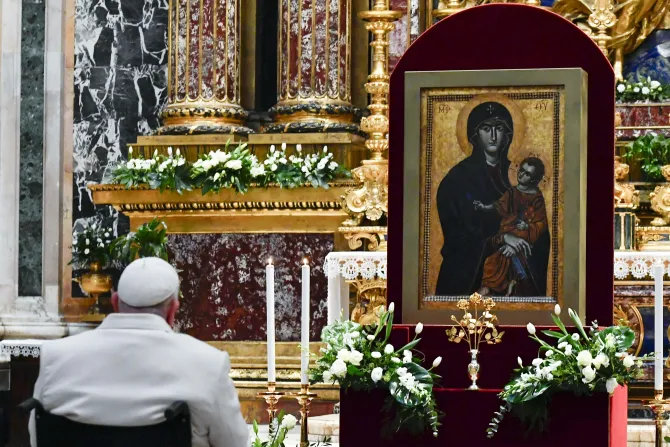
As his journey drew toward its conclusion, Pope Leo crowned the image of the Immaculate Virgin at Chiclayo Cathedral, entrusting his life and ministry to Our Lady in the very place where he began his episcopal ministry.
“How beautiful it is to be a missionary disciple”
From Chiclayo, Pope Leo continued through Peru, visiting Andean and Amazonian communities in Cajamarca, Cusco and Pucallpa before returning to the Peruvian capital, Lima.
There, greeting the faithful and thanking them for their welcome, the Pope returned once more to the theme running throughout his journey: the vocation of every Christian to become a missionary disciple.
“How beautiful it is to be a missionary disciple, to give one’s life to Jesus Christ, to proclaim the Good News of the Gospel,” Pope Leo said.
“By your presence here, you are saying that you, too, want to be united in the Church and united with Christ.”
The call to unity also reflected the Pope’s chosen motto, “In the One, we are one,” rooted in the Augustinian spirituality that has accompanied him throughout his religious and pastoral life.
For Father Martínez, that unity does not erase differences within the Church. Rather, it allows the universality of the Church to emerge through them.
“The Pope’s visit, of course, fosters greater unity centered on the catholicity and universality of the Church,” he said.
“A Catholic Church, a universal Church, does not imply uniformity; rather, it means that the Church is built up amidst diversity, as it takes shape as the People of God.”
That sense of communion ultimately captured the meaning of Pope Leo’s return: a missionary returning to the people who helped form him, now entrusted with shepherding the universal Church.
For Father Lam, seeing the former missionary and bishop return to Peru as Pope was above all a moment of gratitude and joy.
“Seeing him again, and seeing us all together celebrating, is a joy—truly a joy. We rejoice in him, we rejoice in the Church, and we hope that, with humility, we may become channels of Grace—ensuring that it is not frustrated, but rather that it bears fruit.”
Adapted by Jacob Stein. Camera by Alberto Basile and Fabio Gonella. Special thanks to the Order of St. Augustine.