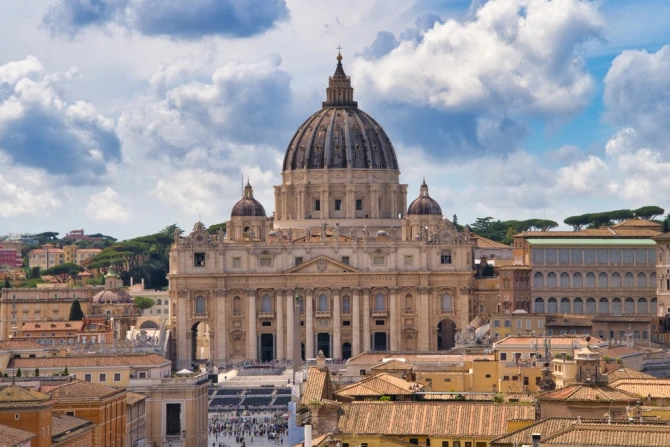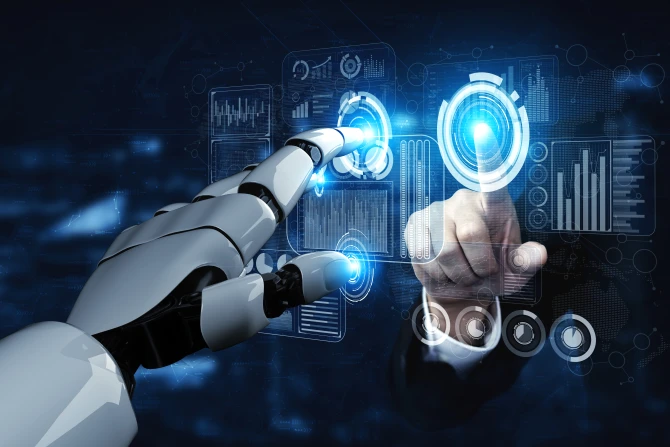
The Vatican on Tuesday released a new “note” addressing the ethical and anthropological implications of artificial intelligence (AI), highlighting distinctions between human and artificial intelligence and offering guidelines meant to ensure that the development and use of AI serve humanity and uphold human dignity.
Titled Antiqua et Nova (Latin for “ancient and new”), the roughly 30-page Jan. 28 document is signed by Cardinal Víctor Fernández, prefect of the Dicastery for the Doctrine of the Faith (DDF), the Vatican’s teaching office; and Cardinal José Tolentino de Mendonça, prefect of the Dicastery for Culture and Education.
The document begins by establishing a Christian framework for understanding human intelligence as a gift from God, emphasizing humanity’s relational and truth-seeking nature within an embodied existence. Christian tradition considers the gift of intelligence an essential aspect of the creation of human beings “in the image of God,” the document notes.
In contrast, modern AI systems work largely through pattern recognition, and most are limited to certain tasks — though the document notes that AGI, or “artificial general intelligence,” is a stated goal of many AI developers and may be achieved soon. Such a system would be capable of “operating across all cognitive domains and performing any task within the scope of human intelligence,” perhaps even exceeding human intelligence.
Even in its most advanced forms, however, AI still operates based on algorithms and computational logic, the document notes, meaning it lacks the creative, spiritual, and moral dimensions of human thought.
In contrast, “human intelligence is not primarily about completing functional tasks but about understanding and actively engaging with reality in all its dimensions; it is also capable of surprising insights. Since AI lacks the richness of corporeality, relationality, and the openness of the human heart to truth and goodness, its capacities — though seemingly limitless — are incomparable with the human ability to grasp reality.”
AI is itself a product of human intelligence, not an equal or superior form of intelligence, the document stresses.
AI and society
The document points out several potential pitfalls of AI development, such as a possibility of disruption to the labor force; a weakening of face-to-face human relationships; a degrading of privacy as new AI surveillance systems are developed; an introduction of inaccurate or biased information in the context of education, media, or society at large; and even, as the Vatican has repeatedly warned, the possibility of the deployment of AI in warfare that has the power to directly take lives.
In the face of these potential challenges, the document calls for a strong ethical framework to guide the development and deployment of AI, guided by the principles of Catholic social teaching. Overarchingly, AI development must always respect and promote the intrinsic dignity of every human being.
The document stresses that in contrast to a “functionalist” viewing of AI that is heavily focused on the AI’s abilities, the worth and dignity of a person, in contrast, are based on their being created in the image of God, not on their cognitive abilities or technological achievements. AI development must respect this fact and promote the intrinsic dignity of every human being, regardless of their condition, the prefects wrote.
Further, the perfects note that AI should be used to serve the common good, promote integral human development, and not just be used for individual or corporate gain. It should as much as possible be used to reduce inequality and not reinforce existing power imbalances, they wrote.
The prefects continued by saying that AI systems cannot be allowed to run amok without human oversight; humans, as moral agents, bear responsibility for the design, purpose, and consequences of AI systems. And in keeping with the Catholic concept of subsidiarity, decision-making related to AI should be decentralized and involve various levels of society, allowing for a broad spectrum of input, the prefects wrote.
The development of AI should spur us to “a renewed appreciation of all that is human,” perhaps by a renewed interest in the study of the humanities, the document continues.
True wisdom
The document concludes by discussing what Pope Francis recently called the “wisdom of the heart” — the insight that true wisdom isn’t just about learning knowledge or mastering technical skills but rather about integrating human intellect with our God-given capacity to appreciate the values of truth, goodness, and beauty.
“Wisdom of the heart” is presented as a counter to the dangers of a purely technological mindset — what Pope Francis has called the “technocratic paradigm” — that emphasizes efficiency and control over human dignity and relationships, pushing back against the idea that technology alone can solve all problems.
“Since a ‘person’s perfection is measured not by the information or knowledge they possess but by the depth of their charity,’ how we incorporate AI ‘to include the least of our brothers and sisters, the vulnerable, and those most in need will be the true measure of our humanity,’” the prefects conclude.
“The ‘wisdom of the heart’ can illuminate and guide the human-centered use of this technology to help promote the common good, care for our ‘common home,’ advance the search for the truth, foster integral human development, favor human solidarity and fraternity, and lead humanity to its ultimate goal: happiness and full communion with God.”
The Vatican under Pope Francis has engaged with AI development on numerous occasions; the pope has spoken frequently about the importance of developing and using AI in an ethical manner, and the Vatican has sponsored conferences on AI in recent years.
The release of the DDF document follows new “Guidelines on Artificial Intelligence” for the Vatican City State that Pope Francis issued earlier this month establishing ethical guidelines for artificial intelligence use within the Vatican state.
Catholic experts both clerical and lay have weighed in on both the potential dangers of AI, such as the possibility of human extinction due to malicious or accidental misuse, as well as the opportunities for its ethical development and use within the Church.
This article was originally published on Catholic News Agency.