Nestled in the heart of Rome stands the Papal Basilica of Saint Mary Major, a monumental testament to Christian faith, artistry, and history. Often referred to as “Bethlehem in Rome,” this basilica is not just an architectural marvel but also a sanctuary preserving some of the most sacred relics and artworks of Christendom. From its inception in the 5th century to its present-day significance, Saint Mary Major continues to be a focal point of devotion, artistry, and ecclesiastical heritage.
Historical Roots of Santa Maria Maggiore
The origins of Saint Mary Major are steeped in legend and divine intervention. According to tradition, Pope Liberius, in the 4th century, received a vision from the Virgin Mary instructing him to build a church in her honor. The following day, on August 5th—a date now annually commemorated—a miraculous snowfall blanketed the Esquiline Hill, indicating the chosen site for the basilica. This event is celebrated every year with a symbolic “snowfall” of white rose petals within the basilica.
Over the centuries, the basilica underwent numerous transformations, each adding layers of spiritual and artistic significance. Notably, Pope Nicholas IV, the first Franciscan Pope, commissioned the intricate mosaics in the apse during the 13th century and chose to reside within the basilica rather than the Papal Palace.
Mosaics: A Visual Testament to Faith
One of the basilica’s crowning glories is its extensive mosaic decoration, serving as both a monument and a manifesto of Franciscan devotion to Mary. At the heart of these mosaics is the depiction of Christ crowning His mother, both seated majestically on a throne. Intriguingly, the mosaic places the sun at Christ’s feet and the moon at Mary’s, crafted from the purest silver tesserae.
The triumphal arch preceding the grand apse showcases episodes from the Old Testament, featuring mosaics dating back to the 5th century—some of the oldest Christian mosaics in Rome. The nave walls are adorned with scenes from both the Old and New Testaments, all rendered in vibrant mosaics, highlighting pivotal moments in Christian lore.
Sacred Relics: The Beating Heart of the Basilica
Beneath the main altar lies the “confession,” a chapel housing some of the most treasured relics of the Christian world. Central among these is the relic of the Holy Cradle, believed to have held the baby Jesus. Comprising five sycamore wood planks, this relic arrived from Bethlehem in the 7th century and is encased in a crystal, silver, and gold reliquary crafted by Giuseppe Valadier in 1802.
Adjacent to this sacred space rests an altar made from imperial red marble and porphyry, safeguarding other significant relics, including those of St. Jerome and the Apostle Matthew. Overarching this spiritual epicenter is a magnificent baldachin, designed by architect Ferdinando Fuga in 1750, echoing the grandeur of Bernini’s baldachin at St. Peter’s but with its unique 18th-century flair.
The Sistine Chapel of Santa Maria Maggiore
Distinct from its Vatican namesake, the Sistine Chapel within Saint Mary Major is a marvel in its own right. Commissioned by Pope Sixtus V and designed by architect Domenico Fontana, this chapel was constructed to house the relics of the Nativity and the first-ever nativity scene. Remarkably, to preserve the medieval chapel containing these relics, Fontana ingeniously encased it within a protective structure and relocated it beneath the new chapel.
Central to this chapel is an opulent tabernacle, aligning the themes of Christ’s incarnation, passion, and resurrection. Crafted from the most precious materials of the 16th century, including porphyry and imperial marble, the tabernacle features gilded bronze scenes of the Passion of Christ, with at least three designed by Michelangelo. This vertical alignment—from the Holy Cradle below to the depiction of God the Father in the dome—symbolizes the journey from Christ’s earthly birth to divine glory.
The Pauline Chapel and Salus Populi Romani
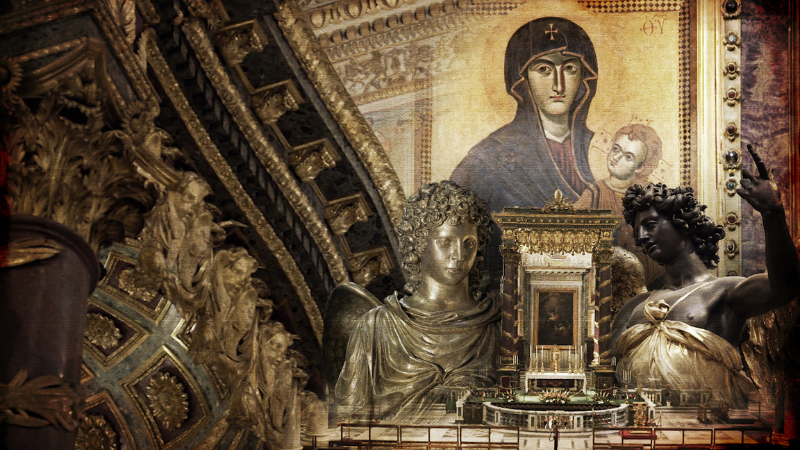
One of the most revered treasures within Saint Mary Major is the icon Salus Populi Romani, meaning “Protectress of the Roman People.” This ancient Marian icon, believed by tradition to have been painted by St. Luke the Evangelist, has been a focal point of devotion for centuries.
In 1613, Pope Paul V Borghese consecrated the Pauline Chapel within the basilica to house this revered icon. The chapel, designed by Pietro Bernini, the father of the legendary sculptor Gian Lorenzo Bernini, is a masterpiece of Baroque artistry. Adorned with the finest marbles and gilded decorations, the chapel reflects the profound devotion of the Roman people to the Virgin Mary.
Pope Francis, in particular, has a deep personal devotion to Salus Populi Romani. On the first day of his pontificate, he visited the chapel early in the morning to offer flowers to the icon. His reverence for this image is further emphasized by his wish to be buried within Saint Mary Major, joining the ranks of other Popes who chose this basilica as their final resting place.
The Basilica of Saint Mary Major is more than just an architectural marvel; it is a living chronicle of Christian faith, artistry, and history. From its miraculous foundation to its role in the Counter-Reformation, from housing sacred relics to pioneering Baroque art, the basilica stands as a beacon of devotion and cultural heritage. As pilgrims and visitors traverse its hallowed halls, they are invited to journey through centuries of faith, marvel at unparalleled artistry, and find solace in the enduring presence of the divine.