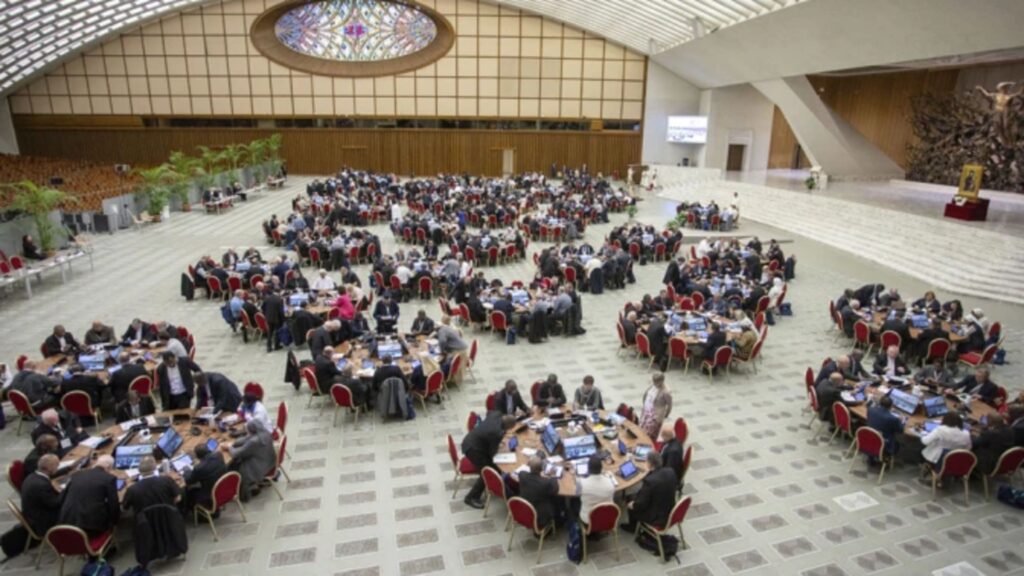
A new Vatican document outlines four stages for local Churches, bishops’ conferences, and continental bodies to assess how synodality is taking root after the 2021–2024 Synod on Synodality.
VATICAN CITY — The General Secretariat of the Synod has published a new document to guide the “path of implementation of the Synod” through an ecclesial assembly in October 2028 at the Vatican.
The 18-page document, titled “The Path of Implementation of the Synod: Towards the Assemblies 2027–2028 — Stages, Criteria, and Tools for Preparation,” establishes a four-stage process and a common method for local Churches, episcopal conferences, and continental bodies.
The new text follows a letter sent last year to bishops, eparchs, patriarchs, and major archbishops of the Eastern Catholic Churches defining the process of accompaniment in the implementation phase of the Synod on Synodality, which concluded in 2024 after a three-year process.
The Synod’s implementation path will unfold in four progressive stages: Recollecting, in the first half of 2027; Interpreting, in the second half of 2027; Orienting, in the first four months of 2028; and Celebrating, in October 2028.
Each stage will culminate in an assembly and the drafting of materials meant to feed ecclesial discernment ahead of the final assembly.
According to the document, the unity of the process will be guided by a common question at every level: “In light of the journey undertaken after the conclusion of the 2021–2024 Synod, and with a view to offering its fruits as a gift to the other Churches and to the Holy Father: What concrete form of a missionary synodal Church, and what new paths of synodality, are emerging in your community?”
The document says the process is not meant to repeat the consultation stage of the Synod but to help the Churches learn from what has already been lived, recognize fruits and difficulties, recalibrate priorities and processes “in the light of careful discernment,” strengthen co-responsibility, and foster an “authentic exchange of gifts among the Churches.”
The Synod office also stresses that the implementation phase “does not introduce additional tasks alongside the ordinary life of communities; rather, it orients and renews that life from within.”
Cardinal Mario Grech, secretary-general of the Synod, said the proposal should be understood as a time of ecclesial discernment rather than as another administrative burden.
“What we are proposing to the local Churches,” Grech said, “is not an additional task but rather a time of shared discernment and thanksgiving in which to reread together what the Spirit is causing to grow in the Church and to recognize the steps we are called to take.”
“The assemblies do not coincide with a sociological consultation or a deliberative process, nor are they a technical assessment,” he continued. “Rather, they are a profound ecclesial and spiritual experience of discernment: a moment of synthesis and renewed impetus for the journey, so that the exchange of gifts among the Churches may become a concrete experience and synodality may increasingly take shape as the ordinary style of ecclesial life at the service of mission.”
Where this has not already been done, the document says it is “essential to reactivate and support diocesan, national, and continental synodal teams,” whose composition is to be communicated to the General Secretariat of the Synod.
The document calls for assemblies with broad participation, including men and women of different generations, priests, deacons, consecrated men and women, members of movements and associations, and faithful not belonging to organized structures. It also asks for attention to the presence of “persons living in situations of fragility or marginality.”
The text adds that it is important “to value voices not directly traceable to ecclesial structures” and, where appropriate, to provide for the participation of representatives of other Churches and Christian communions or of other religions.
At the diocesan and eparchial level, each local Church will prepare a narrative report before its assembly and a letter to other local Churches during the assembly. National or regional assemblies will prepare a theological-pastoral report and a letter to other Churches.
Continental assemblies will prepare a “perspective report” to help shape the Instrumentum Laboris, the working document for the 2028 meetings at the Vatican.
All materials must be sent to the General Secretariat of the Synod by specific deadlines: June 30, 2027, for the local stage; Dec. 31, 2027, for the national or regional stage; and April 30, 2028, for the continental stage.
The document proposes conversation in the Spirit as the privileged method for community discernment while allowing adaptations for the needs of each context.
The implementation phase began after Pope Francis received the Synod’s Final Document in 2024. The new stage, according to the document, was “subsequently confirmed and promoted by Pope Leo XIV” with the aim of helping synodality become an ordinary style of ecclesial life at the service of mission.
This story was first published by ACI Prensa, the Spanish-language sister service of EWTN News. It has been translated and adapted by EWTN News English.