The Cuban government’s announcement of the release of 553 prisoners has been described by an analyst and the opposition as “a swap” by the regime to obtain economic benefits from the United States, including removing the island from the list of countries sponsoring terrorism.
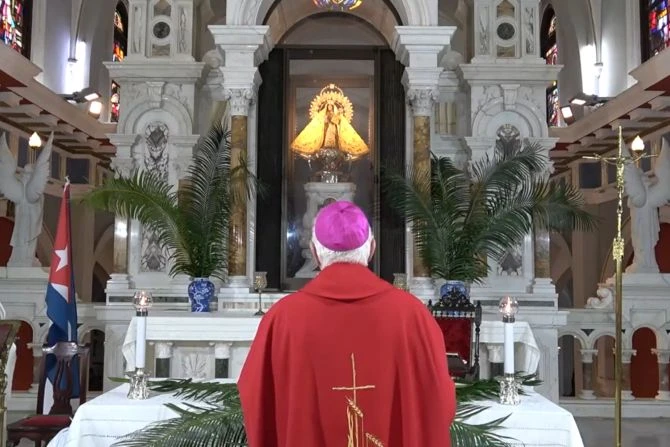
The government of President Miguel Díaz-Canel reported on Monday, Jan. 14, that it was releasing the prisoners “in the spirit of the Ordinary Jubilee of 2025” and that the decision had been communicated to Pope Francis in a letter sent at the beginning of January.
In its statement, the Cuban regime did not indicate how many of those released were political prisoners but noted that “the releases are carried out on the basis of a careful analysis based on the different modalities envisioned by the legislation” and that “these people will receive their respective benefits gradually.”
The announcement was welcomed by the Holy See, whose secretary of state, Cardinal Pietro Parolin, said “it is a sign of great hope at the beginning of the jubilee.” Vatican News reported Jan. 15 that the releases were carried out “within the framework of mediation with the Catholic Church that has been going on for years.”
However, geopolitical expert Alberto Fernández, a Cuban-American who spoke with the Spanish-language edition of EWTN News in Washington, D.C., pointed out that, although the communist regime “has given its announcement a religious disguise,” it’s “an exchange of hostages for economic and political reasons with the [President Joe] Biden administration.”
The Democratic administration of Biden, which will hand over power to Republican Donald Trump on Jan. 20, announced that it will remove Cuba from the list of state sponsors of terrorism that also includes North Korea, Syria, and Iran.
According to the White House, this decision was facilitated with the help of the Vatican to secure the release of political prisoners on the island.
The island was on this list from 1982–2015, when President Barack Obama removed it as part of his policy of “thawing” relations with Raúl Castro. However, it was included on the list again on Jan. 11, 2021, in the final days of the first Trump administration.
The Republican administration said its goal was to “deny the Castro regime the resources it uses to oppress its people at home and to counter its malign interference in Venezuela and the rest of the Western Hemisphere.”
Robert L. Muse, a lawyer specializing in U.S. sanctions on Cuba, told the Spanish-language edition of BBC World News that now, by leaving the list, the island could benefit in areas such as tourism, key to its economy, since travelers from the European Union, Chile, South Korea, or Japan could visit the Caribbean country without fear of losing a U.S. tourist visa exemption.
Cuba could also now access financing from foreign entities, although this is not certain, as it is a technically bankrupt country that has defaulted on its payments.
However, all this could come to nought if Trump again includes Cuba in the group of countries sponsoring terrorism.
Fernández highlighted the mediation of the Catholic Church to seek the release of political prisoners, especially “those who were arrested after the demonstrations of July 11, 2021.”
That Sunday, thousands of Cubans protested in dozens of cities over food and medicine shortages, power outages, and to demand freedom. It was the largest demonstration under the communist regime, which reacted by imprisoning an undetermined number of protesters, many of them young.
In this regard, Fernández said that “if the regime wanted to honor the jubilee, the first thing it should do is resign, that is, end the regime, because this is a regime that is the complete opposite of what faith is, what the jubilee is, what liberation is.”
Prisoners must be released ‘without conditions’
The Christian Liberation Movement (MCL by its Spanish acronym) said that “Cuban political prisoners should not be the object of bartering and/or negotiations regarding the policies of other states toward Cuba.”
The MCL, which throughout its history has suffered persecution, imprisonment, and exile of several of its members, added that political prisoners “must have their dignity respected as human beings and all of them should be released and without conditions.”
“Not only for humanitarian reasons but essentially as a matter of justice, since they are innocent of the charges that have been fabricated against them,” MCL continued in a statement titled “Another Day of Infamy.”
The pro-democracy organization also pointed out that the “policy of appeasement” of the United States government “only encourages and emboldens dictators and empowers the forces of repression and terrorists by giving them the feeling, and more than that, the certainty, that they can act with total impunity.”
“We deplore that the Democratic administration is trying to clean up the image of a bloody dictatorship, perhaps as revenge for the broad political support of the Cuban exile community [in the U.S.] for its adversary from the Republican Party in the last presidential election,” MCL said.
The advocacy organization pointed out that “freedom and democracy in Cuba should be the goal of the two main political parties in the United States and not a political campaign issue.”
Getting out of prison in Cuba doesn’t mean you’re free
On its website the nongovernmental organization Prisoners Defenders, which monitors the situation of political prisoners in Cuba, also spoke out, calling attention to the terms under which the regime is releasing the 553 people, because “according to the official statement … their sentences would remain intact” and therefore it would be necessary to “talk about releases with reduced sentences under certain conditions” such as good conduct and working.
“If this were confirmed, the news would not be as positive as the Cuban regime wants to make it seem. In Cuba, releasing prisoners doesn’t mean they’re free.”
Prisoners Defenders explained that if this were the case, “some would be granted parole, others perhaps for humanitarian reasons, and others a series of reduced sentences under certain conditions that, if not complied with, the person goes back to prison, which is far from having your full freedom restored.”
Martí Noticias posted the audio testimony of Liván Hernández Sosa, one of the first political prisoners released “on parole.”
“They explained to us the conditions under which I was going to be released: I have to work, I can’t be on social media, I can’t protest, much less against the regime. I am very happy, and even though it is under unjust conditions, I am happy to be here, in my house, with my wife, with my children,” he said.
Among the hundreds of other released prisoners are José Daniel Ferrer, founder of the Patriotic Union of Cuba; Donaida Pérez, a 53-year-old woman imprisoned for protesting on July 11, 2021; and Yandier García Labrada, an MCL activist sentenced four years ago for having “publicly protested against the disorganization and irregularities in the distribution of supplies.”
Pérez told Martí Noticias: “I know that this has been nothing more than the result of the international campaign that has been carried out in favor of us political prisoners, which has nothing to do with what the Cuban regime has done. The Cuban regime simply uses us as its bargaining chip to get Cuba removed from the list of terrorist countries.”
This story was first published by ACI Prensa, CNA’s Spanish-language news partner. It has been translated and adapted by CNA.