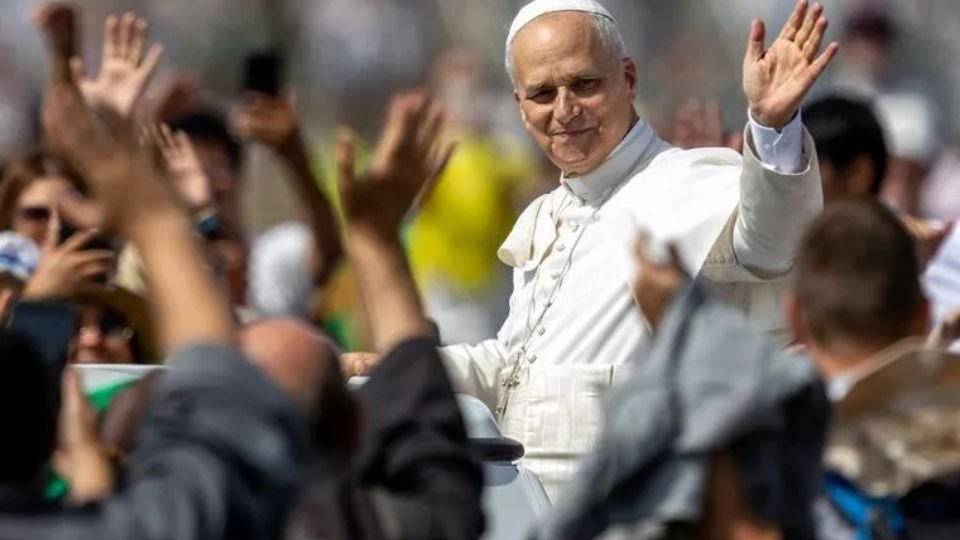
Pope Francis delivered his annual “state of the world” address on Thursday, asking ambassadors accredited to the Holy See to pursue a “diplomacy of hope” in the 2025 Jubilee Year, and decrying a polarization that he said led to the assassination attempt of former president Donald Trump.
“We see increasingly polarized societies marked by a general sense of fear and distrust of others and of the future, which is aggravated by the continuous creation and spread of ‘fake news,’ which not only distorts facts but also perceptions,” the pope said.
“This phenomenon generates false images of reality, a climate of suspicion that foments hate, undermines people’s sense of security, and compromises civil coexistence and the stability of entire nations. Tragic examples of this are the attacks on the chairman of the government of the Slovak Republic and the president-elect of the United States of America,” he continued.
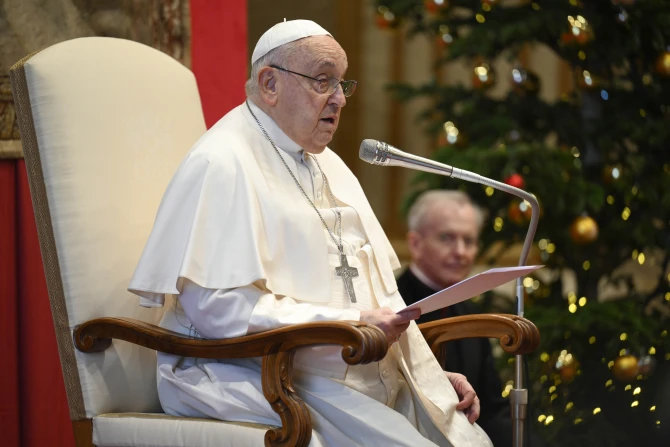
Unable to read his full address due to a persistent cold, the 88-year-old pontiff asked an aide to deliver his prepared remarks to the diplomats at the Hall of Blessings in Vatican City on Jan. 9.
Describing the gathering with the diplomatic corps in the Vatican as “a family event,” the Holy Father commenced his speech urging government leaders and representatives to “serve the common good” and to work toward the “integral human development” of all peoples.
“My prayerful hope for this new year is that the jubilee may represent for everyone, Christians and non-Christians alike, an opportunity also to rethink the relationships that bind us to one another, as human beings and political communities,” the pope said in his prepared speech to the diplomatic corps.
Referring to diplomacy as a “vocation” to “foster dialogue with all parties,” the pope said political leaders are called to be heralds of peace, truth, forgiveness, freedom, and justice.
During his speech, the Holy Father cited Chapter 61 of the Book of Isaiah as the root of his proposed “diplomacy of hope” for 2025: “Christ came ‘to bring good news to the oppressed, to bind up the brokenhearted, to proclaim liberty to the captives, and release to the prisoners; to proclaim the year of the Lord’s favor (cf. Is 61:1-2a).’”
“Only in this way is it possible to break the chains of hatred and vengeance that bind and to defuse the explosive power of human selfishness, pride, and arrogance, which are the root of every destructive determination to wage war,” the pope told diplomats on Thursday morning.
Bringing peace to regions, countries at war
Circling the globe in his yearly address, the Holy Father raised his concerns about the growing social and political tensions in different parts of the world, particularly in Ukraine and the Holy Land.
“My wish for the year 2025 is that the entire international community will work above all to end the conflict that, for almost three years now, has caused so much bloodshed in war-torn Ukraine and has taken an enormous toll of lives, including those of many civilians,” he said.
For the Holy Land, the pope renewed his call for a ceasefire and the release of all hostages in Gaza. He also prayed that Jerusalem be the “city of encounter” for Christians, Jews, and Muslims.
“My prayerful hope is that Israelis and Palestinians can rebuild the bridges of dialogue and mutual trust, starting with the smallest, so that future generations can live side by side in the two states, in peace and security,” he said.
The cancellation of oppressive economic, environmental debt
The Holy Father also expressed concern for Global South countries burdened by debts imposed upon them by Global North nations and international corporations.
“I ask the wealthier nations to forgive the debts of countries that will never be able to repay them. This is not simply an act of solidarity or generosity but above all an act of justice,” he implored.
Threats to true peace and justice
Though Francis recognized the “undoubted benefits” of advances in communications technology and artificial intelligence in his speech, he also highlighted its potential to threaten pathways of peace in society.
“They can be misused to manipulate minds for economic, political, and ideological ends,” he stated. “Its limitations and dangers cannot be overlooked, since it often contributes to polarization, a narrowing of intellectual perspectives, a simplification of reality, misuse, anxiety, and, ironically, isolation.”
The pope also spoke of the dangers of an unbridled consumerism that “threatens to subvert the order of values inherent in the creation of relationships, education, and the transmission of social mores.”
Emphasizing the duty to care for society’s “weakest and most vulnerable,” the Holy Father reiterated the need to protect life “at every moment, from conception to natural death.”
“No child is a mistake or guilty of existing, just as no elderly or sick person may be deprived of hope and discarded,” he stated.
This article was originally published on Catholic News Agency.