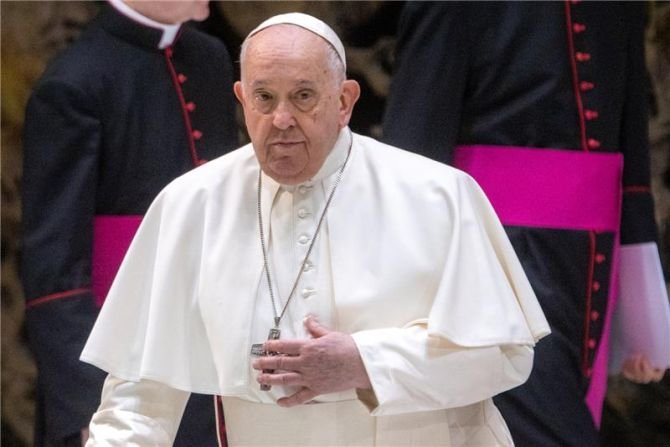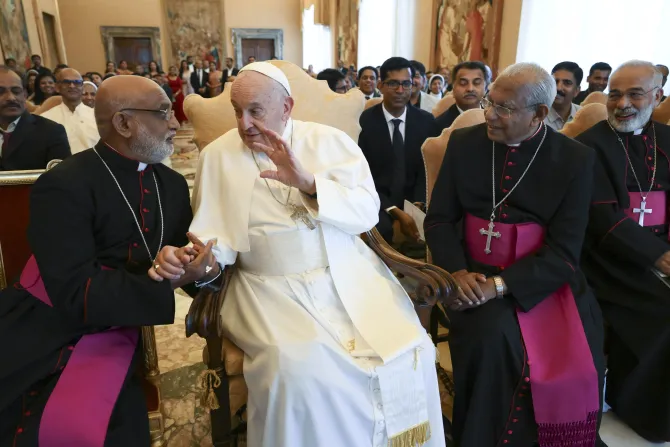
In a meeting with Major Archbishop Raphael Thattil and members of the Syro-Malabar Catholic Church at the Vatican on Monday, Pope Francis urged unity and obedience amid a long-simmering liturgical conflict that continues to rock the Eastern church.
As some fear an imminent schism in the ancient Eastern-rite church, the pope stressed the importance of unity, saying: “Apart from Peter, apart from the major archbishop, there is no Church.”
He urged the faithful present at the Vatican’s Consistory Hall to “press forward” in obedience to the Church, saying: “You are obedient, and where obedience is present, there is the Church. Where there is disobedience, there is schism.”
What is going on in the Syro-Malabar Church?
The Syro-Malabar Church is an Eastern Catholic rite in full communion with the Roman Catholic Church. Members of the rite are often referred to as “St. Thomas Christians,” as its origins are believed to date back to the missionary preaching of St. Thomas the Apostle.
Today there are more than 5 million Syro-Malabar Catholics across the world in dioceses — or eparchies, as they are called — in India, the U.S., the U.K., Canada, Australia, New Zealand, and the Middle East.
For decades Catholics in the rite have been bitterly divided over whether priests should face the altar (“ad orientem”) or toward the people (“versus populum”) during the celebration of the Mass, which Syro-Malabar Catholics call “the Holy Qurbana.”
In 1999 the Synod of Bishops of the Syro-Malabar Archiepiscopal Church attempted to resolve the conflict by decreeing that all priests in the rite should uniformly face the people during the Liturgy of the Word and then face the altar during the Liturgy of the Eucharist.
This decree did not end the dispute, however, as several dioceses have continued refusing to implement the change, preferring to celebrate Mass facing the people.
Finally, the pope himself got involved when he set a hard deadline on eparchies to implement the decree by Christmas Day 2023.
Reportedly, most of the parishes in the rite complied with the pope’s deadline, but protests, Mass disruptions, and tensions persist.
Controversy over that question resulted in violence, caused hundreds of Syro-Malabar priests to defy their bishops, and led to fears of a new schism.
Pope addresses controversy
The pope condemned the division emphatically on Monday, saying that such arguments over the Mass are “incompatible with the Christian faith” and show a “grave lack of respect for the Blessed Sacrament.”
He called the rampant division within the rite the work of “the devil, the divider,” who he said “creeps in and thwarts the most heartfelt desire that the Lord expressed before dying for us: that we, his disciples, be ‘one,’ without division and without breaking communion.”
“The guiding criterion, the truly spiritual one that derives from the Holy Spirit, is communion: This requires us to do a self-examination of our dedication to unity and our faithful, humble, respectful, and obedient care for the gifts we have received,” he said.
Francis called on Thattil and other bishops and priests in the rite to foster discussion with dissenting forces, saying that “guarding unity is not a pious exhortation but a duty.”
“Let us meet and discuss without fear, that is fine, but above all, let us pray, so that the light of the Spirit, which reconciles differences and brings tensions back into unity, may resolve disputes,” he said, adding that the “dangerous temptation to focus on one detail, and an unwillingness to let it go, even to the detriment of the good of the Church … stems from a self-referentiality, which leads to listening to no other way of thinking but one’s own.”
In the same vein, he condemned previous efforts by “some members of the faith” to Westernize — or Latinize — the Syro-Malabar Church, which he called one of the “indispensable treasures in the life of the Church.”
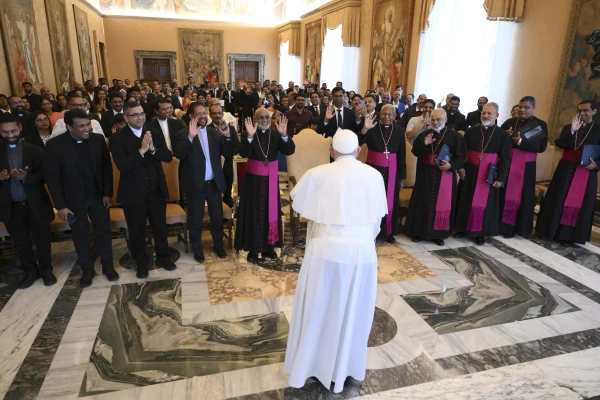
“The Christian East allows us to draw from ancient and ever-new sources of spirituality; these become fresh springs that bring vitality to the Church,” he said, urging Syro-Malabar Christians to retain their self-identity as a “sui iuris” — self-autonomous — rite, “so that your great liturgical, theological, spiritual, and cultural heritage may shine ever more brightly.”
The pope also announced that he is officially granting the rite jurisdiction over Syro-Malabar immigrant Christians living in the Middle East.
“I wish to help you, not supersede you,” the pope said before going on to add that “because the nature of your Church sui iuris empowers you not only to examine carefully the situations and challenges that you face but also to take appropriate steps to address them, with responsibility and evangelical courage.”
This article was originally published on Catholic News Agency.