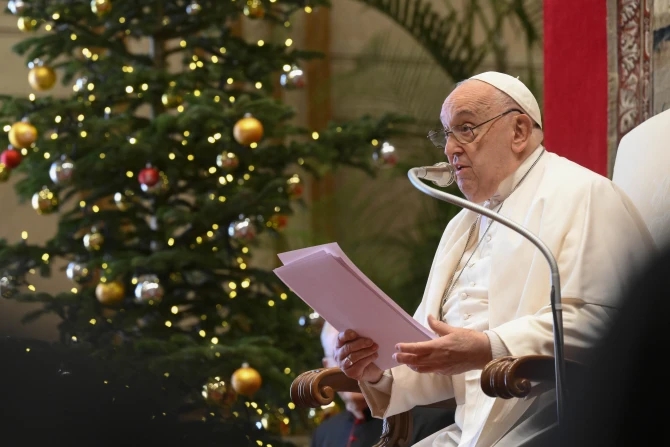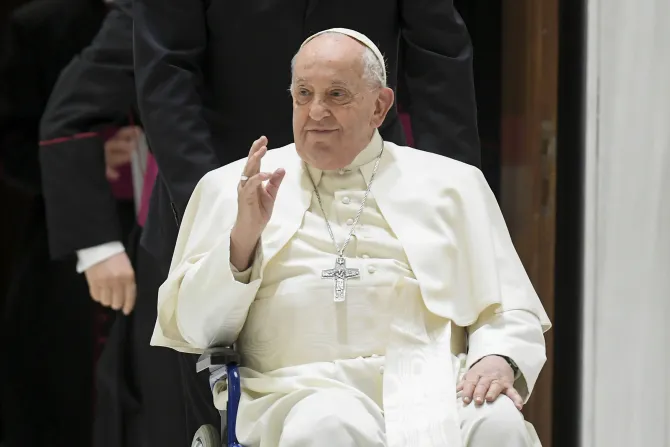
Pope Francis this week used his general audience to focus on the vice of pride, with the Holy Father for the second consecutive week relying on an aide to read his remarks.
“Today’s catechesis will be read by a monsignor,” the pope said on Wednesday, “because I still have a cold and can’t read well.”
The pope delivered the Angelus address from the window of the Apostolic Palace the prior two Sundays. He has relied on aides to read his public addresses since the Vatican announced he was suffering from “mild flu” symptoms in late February.
The pope’s catechesis on Wednesday focused on the vice of pride, which the Holy Father argued was the “great queen” of all the vices.
“Those who give in to this vice are far from God, and the correction of this evil requires time and effort, more than any other battle to which the Christian is called.”
Pope Francis related the vice of pride to that of vainglory, the topic of last week’s general audience, cautioning: “If vainglory is a disease of the human self, it is still a childish disease when compared to the havoc pride is capable of.”
Pride is “evil,” the Holy Father said, and is of a greater magnitude than vainglory, as it arises from “the absurd claim to be like God.”
Referencing the monastic tradition of antiquity and Dante Alighieri’s epic “The Divine Comedy,” the pope noted that there is a “sequence of evils,” or hierarchy, of vices, starting with gluttony and culminating in pride.
Highlighting the effects of pride in everyday life, the pope noted it “ruins human relationships” and foments division instead of promoting fraternal solidarity.
The pope profiled the “proud man” as one who has an inflated sense of self and his place in the world, adding that he is “one who frets about being recognized as greater than others, always wants to see his own merits recognized, and despises others, deeming them inferior to himself.”
Building upon this characterization, Pope Francis outlined what he saw as the characteristics of the person who has succumbed to pride, noting that the prideful person is “stiff,” or inflexible, and one who is “easily led to scornful judgment.”
“With no reason, he passes irrevocable judgments on others, who seem to him hopelessly inept and incapable. In his haughtiness, he forgets that Jesus in the Gospels assigned us very few moral precepts, but on one of them he was uncompromising: never judge,” the pope observed.
“There is little one can do with a person suffering from pride. It is impossible to talk to them, much less correct them, because ultimately they are no longer present to themself. One just has to be patient with them, because one day their edifice will collapse,” the pope continued.
At the end of his address, the Holy Father urged the faithful to “take advantage of this Lent to fight against our pride,” adding “salvation comes through humility, the true remedy for every act of pride.”
Francis himself read the appeal at the end of the address in which he renewed his call for peace in war-torn regions, imploring: “Let us ask the Lord for the gift of peace.”