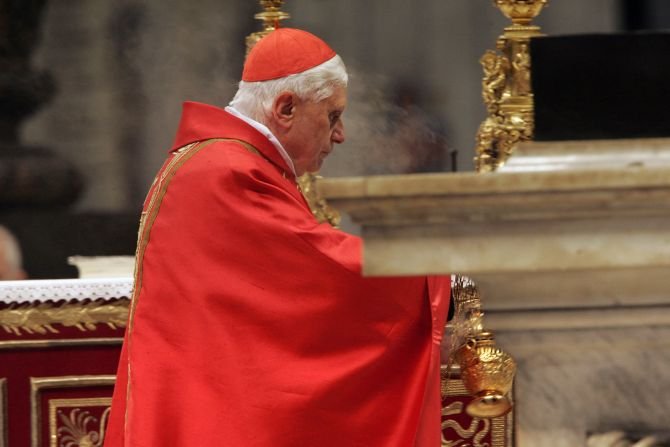
Pope Francis said he was “used” in the 2005 conclave in an effort to block the election of Cardinal Joseph Ratzinger, though he supported the candidacy of the man who soon became Pope Benedict XVI.
“He was my candidate,” Francis said of his predecessor in excerpts from the forthcoming book “The Successor,” published by the Spanish newspaper ABC on Easter Sunday.
In the book, Pope Francis told Spanish journalist Javier Martínez-Brocal that his name, then-Cardinal Jose Mario Bergoglio of Buenos Aires, was put forward as part of a “complete maneuver” by an unnamed group of cardinals to manipulate the conclave’s outcome.
“The idea was to block the election of [Ratzinger],” he explained. “They were using me, but behind them they were already thinking about proposing another cardinal. They still couldn’t agree on who, but they were already on the verge of throwing out a name.”
Francis said that at one point of the conclave, which began on April 18, 2005, he was receiving 40 of the 115 total votes. If cardinals continued to support him, Ratzinger would not have reached the necessary two-thirds threshold to be elected, likely prompting a search for an alternative candidate.
Francis said that he realized the “operation” was afoot on the second day of voting and told the Colombian Cardinal Dario Castrillón to not “joke with my candidacy” and cease supporting him, “because I’m not going to accept” being elected.
Austen Ivereigh, the pope’s English-speaking biographer, has previously written that Bergoglio, “almost in tears,” had begged not to be elected.
Ratzinger, who had been the longtime prefect of the Congregation for the Doctrine of the Faith under Pope John Paul II, was elected that same day.
Pope Francis did not say who this group of conclave manipulators consisted of nor who they planned to introduce as a third candidate, but the Argentinian prelate said that the group of cardinals “did not want a ‘foreign’ pope.”
Several accounts from the time have claimed that a group of liberal European cardinals, known as the Saint Gallen Group, attempted to manipulate the outcome of the 2005 conclave. Three members of the group, German Cardinals Walter Kasper and Karl Lehmann and Belgian Cardinal Godfried Danneels, also participated in the 2013 conclave that elected Francis. According to Ivereigh, they advocated for Bergoglio after first securing his assent, a claim the cardinals have denied.
According to Universi Dominici Gregis, an apostolic constitution governing papal conclaves, cardinal electors must refrain from “any form of pact, agreement, promise, or other commitment of any kind which could oblige them to give or deny their vote to a person or persons” under threat of automatic excommunication.
Conclave proceedings are, by definition, secretive, as the term is derived from a Latin word that means a “locked room.” But in “The Successor,” Francis said that while cardinals are sworn to secrecy regarding conclave proceedings, “the popes have license to tell it.”
Pope Francis also revealed that while others were putting his name forward in the hopes of forcing a stalemate, he believed Ratzinger “was the only one at that time [who] could be pope.”
“After the revolution of John Paul II, who had been a dynamic pontiff, very active, with initiative who traveled … there was a need for a pope who maintained a healthy balance, a transitional pope,” the Holy Father said of his predecessor, who served from 2005 to 2013.
Francis also said that he left Rome happy that Ratzinger had been elected and not himself.
“If they had chosen someone like me, who makes a lot of trouble, I wouldn’t have been able to do anything,” he said. “At that time, it would not have been possible.”
Nonetheless, Pope Francis added that the papacy “wasn’t easy” for Benedict XVI, who “encountered a lot of resistance within the Vatican.”
Pope Francis was also asked what the Holy Spirit was saying to the Church through the election of Benedict XVI.
“’I am in charge here,’” Francis said of the Spirit’s response. “’There is no room for maneuver.’”
“The Successor” is part of a flurry of Francis-focused books being released in the 87-year-old Jesuit’s 11th year as pontiff, which also includes “Life: My Story Through History,” the pope’s first autobiography.
The new book, which focuses on the relationship between Pope Francis and Benedict XVI, is set to be published in Spanish on Wednesday, April 3, with no details yet available on an English edition.
This article was originally published on Catholic News Agency.