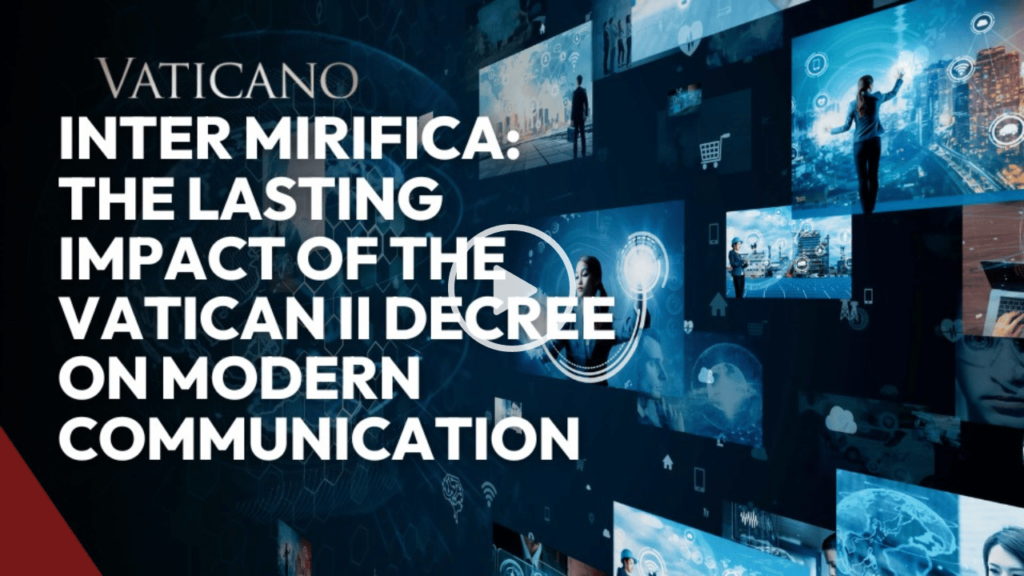
December 4, 2023 marks the sixtieth anniversary of the promulgation of Inter Mirifica, the Decree of the Second Vatican Council that revolutionized the Catholic Church’s approach to social communication media. This historic document opened the doors to a modern and systematic reflection on ecclesiastical communication, and its impact endures in our world today, marked by rapid technological evolution. To celebrate this anniversary, a three-day conference has been organized to explore the past, present, and future of institutional communication.
Co-organized by three prominent Pontifical academic institutions, the Faculty of Institutional Social Communication at the Pontifical University of the Holy Cross opened the conference with a historical analysis and an examination of the institutional context of the document.
We spoke with Fr. Johannes Grohe, the Editor-in-chief of the Annuarium Historiae Conciliorum, the most significant international forum for publications in the field of Council history. Considering the changes in communication and social media, Fr. Grohe explained the significance of this Decree. He said, “Communication at that time,” at the time of the Second Vatican Council, “primarily, consisted of radio, print, and television. Therefore, this also makes the document from that time seem somewhat distant today. But why are we still interested in this document sixty years later? Because the anthropological foundations remain the same, people are still the same.”
While social communication media has evolved significantly since the decree was promulgated, the principles emphasized remain universal and highly relevant. The Church, in its commitment to bring salvation to all people, already recognized in that challenging communication period the need to use these tools to spread the Gospel message and promote the common good.
Fr. Grohe further pointed out, “Morality, even in communication, remains the same, and the challenges are the same. On one hand, there must be freedom of communication, and on the other hand, the rights of the individual must be respected. Therefore, this document deduces a Christian anthropology that still constitutes a valid foundation today. Subsequently, of course, in the decades that followed, it has further developed. The Church’s action in relation to the mass media is one of the things that this document calls for, and in the last paragraph, there is mention of the need for a pastoral approach to the media, which will be implemented almost 10 years later. Hence, we can see that there are more in-depth elements of Church teaching in this context.”
Although Inter Mirifica was promulgated in 1963, its principles remain relevant today in an era where social and digital media dominate the communication landscape.
EWTN Vatican also spoke with Fr. Jose Maria La Porte of the Pontifical University of the Holy Cross. Speaking of the legacy of the Decree of Inter Mirifica, he said, “The connection of Inter Mirifica with the previous documents and those that followoi is very interesting; it serves as a kind of dividing line. On one hand, it picks up many essential themes. It is a very concise document because the previous papal documents and encyclicals focused more on cinema, radio, and television, with a greater emphasis on specific aspects of the media. As the centuries progress, it becomes apparent that with the explosion of Mass Media, the focus should be more on content and the education of individuals, the users. So, it transitions to something much more restricted, from an essential perspective, so to speak.”
The Church, therefore, has recognized the significant potential of social communication tools to enrich the human spirit and spread the kingdom of God since the Second Vatican Council. However, it is equally aware of the risks that their misuse poses to humanity.
Fr. Jose Maria explains that the document, “helps to synthesize the essential elements. And now that we are in a process of synthesis because more than twenty years have passed, with the development of the Internet, we realize that the synthesis that intermediation had done related to previous means is now relevant to the Internet, to the technological explosion that has occurred now.”
Applying this document to the present day, this conference, sponsored by the Dicastery for Communication, provided a multidisciplinary approach that allowed the analysis of Inter Mirifica from both a historical and historiographical perspective, as well as from a future outlook, highlighting its relevance in the evolution of media and technology, revealing its continued significance and impact in the contemporary world of media and communication.
(Adapted by Jacob Stein)