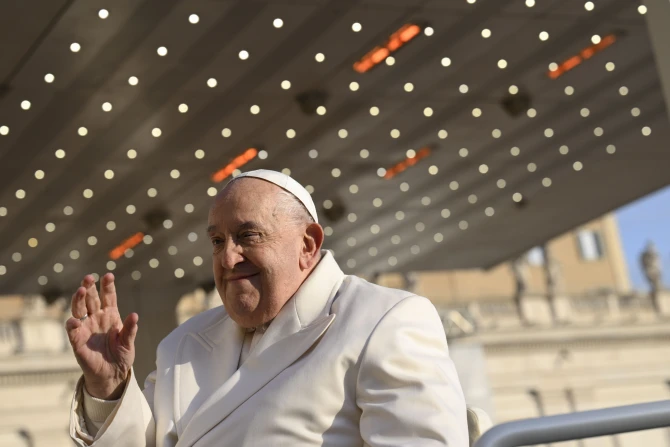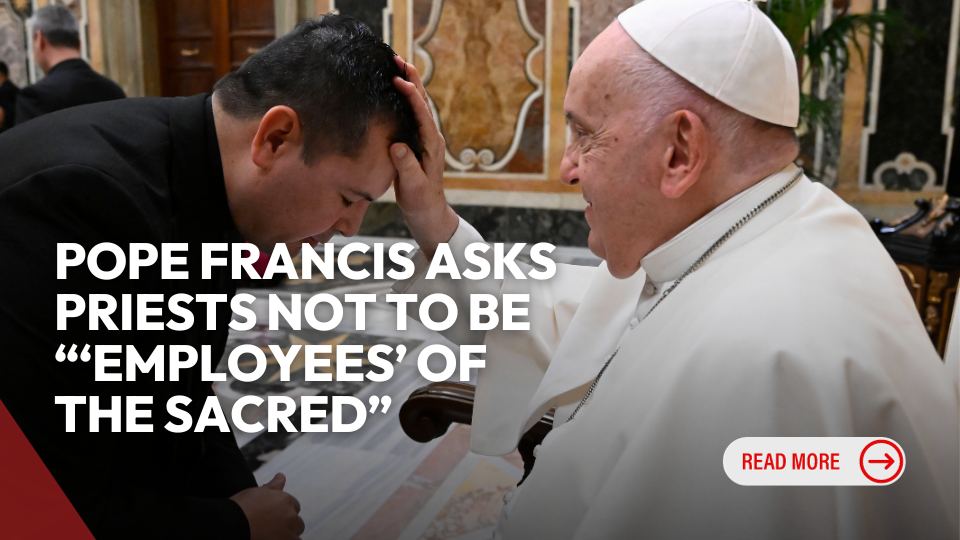
This Thursday, November 16, Pope Francis held a private meeting with the participants of the annual convention of Hispanic priests in the United States, whom he asked to beware of “ecclesiastical refinement” and to dedicate themselves to serving the faithful and not to be “‘employees’ of the sacred.”
In his speech to this group of priests who have traveled to Rome from the United States to participate in the annual convention, the Holy Father affirmed that the Church “is a house with open doors” and warned that “when we want to make the Church refined, it is a house with closed doors, and this is not good. Beware of ecclesiastical refinement.”
Next, as on previous occasions, he lamented that “we have lost the sense of adoration a little” and reiterated that “we must find the Lord in the silence of adoration.”
Along these lines, the Pontiff recalled that in the United States, a National Eucharistic Congress is being prepared for next year, for which Blessed Carlo Acutis and Saint Manuel González have been chosen as patrons.
Taking these two figures as an example, Pope Francis asked priests not to abandon “those who suffer” and not to abandon “the Lord of the Tabernacle.”
“Convince yourselves that you cannot do anything with your hands if you do not do it with your knees. Adoration, Eucharistic silence, and intercession before the Tabernacle. And then, yes, service,” the Holy Father remarked.
Later, Pope Francis asked them not to become “‘employees’ of the sacred,” which he defined as “the danger of this culture.”
In this sense, he invited them to review their “dedication to people, [their] openness of heart.” “Simple prayer, close word, fraternal welcome, and persevering work. Do not spare yourselves!” Pope Francis urged them.
In this sense, he encouraged them to be “priests for the people” and to “always return to Jesus’ call to serve, at the disposal of others.”
Likewise, he advised them “not to climb” and not to put their trust “only in big ideas, nor in well-designed pastoral proposals.”
“People scare me when they come with all those pastoral programs. For others to implement them, ‘not me.’ Do not look for culprits,” Pope Francis asked.
“Surrender yourselves to the One who has called you to give yourselves and only asks you for fidelity and constancy, with the certainty that it will be He who will complete the work and make your efforts bear good fruit,” he concluded.
(Translated and Adapted by Jacob Stein)