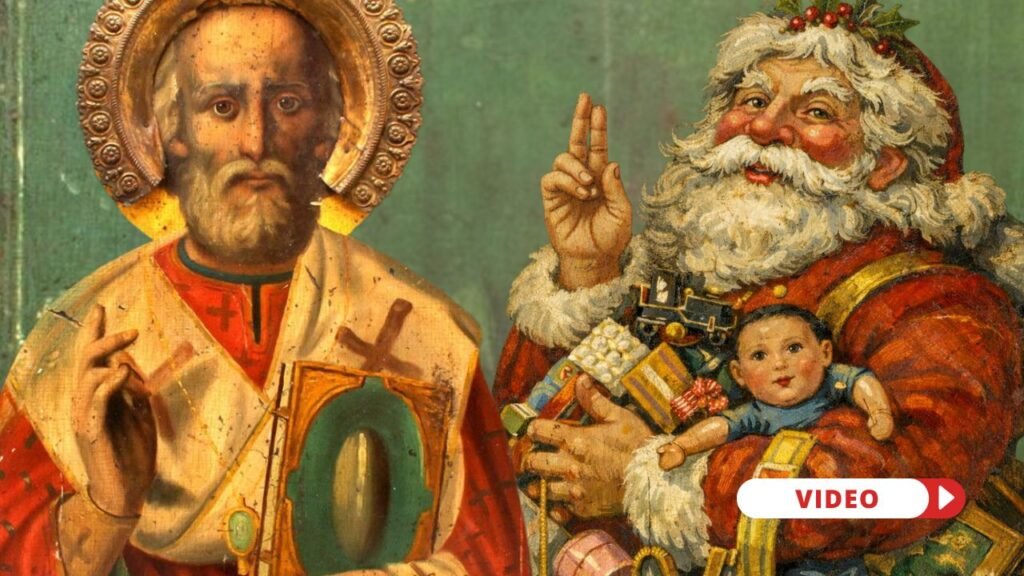
Everyone knows Santa Claus—the jolly, gift-bearing figure who arrives on Christmas Eve to delight children around the world. Yet behind the red suit and sleigh stands a real historical figure: Saint Nicholas, a fourth-century bishop whose legacy is deeply rooted in faith, generosity, and courage.
In Bari, the vibrant capital of Italy’s Puglia region, Saint Nicholas is far more than a legend. His name echoes through streets, alleyways, and along the seaside, uniting believers and skeptics alike in a devotion that blends religious faith with cultural identity. At the heart of this devotion stands the Pontifical Basilica of Saint Nicholas, where the saint’s relics have been preserved for centuries.
Explaining how the basilica came to be, Father Giovanni Distante, Rector of the Pontifical Basilica of Saint Nicholas, recounts the dramatic events that brought the saint to Bari.
“The Basilica was built following the arrival of Saint Nicholas’ relics in Bari in 1087,” he said. “What began as a commercial expedition eventually took on a sacred purpose. The Bari sailors, who had traveled to Antioch on a trading mission, learned that Venetian rivals planned to steal the saint’s bones. They arrived before the Venetians, went to Myra, and took the relics of Saint Nicholas, one of the most venerated saints in both the East and the West. When they returned to Bari, they decided to build this magnificent Basilica, which would naturally house the relics of the saint.”
A City Shaped by Miracles and Pilgrimage
From the moment Saint Nicholas’ relics arrived, Bari became a destination of pilgrimage. According to historians, miracles followed almost immediately, sealing the bond between the saint and the city.
Author and historian Antonio Di Fazio, a leading expert on Saint Nicholas, describes the extraordinary impact of the relics’ arrival.
“From the very day Saint Nicholas’ bones arrived in Bari, pilgrims began to come immediately,” he explained. “According to historical accounts, as soon as some pilgrims arrived, four or five miracles occurred involving people who had been blind—they regained their sight upon entering the Bari area. And this was just the beginning, as from that moment on, pilgrims of all ages and social classes came in a continuous flow. Popes came, kings came, knights passing through during the Crusades came—everyone came through here…”
This devotion continues to be renewed each year through two major celebrations. On December 6, the city commemorates the saint’s death, while on May 8–9, Bari marks the daring transfer of his relics from Myra. During the latter celebration, the statue of Saint Nicholas is carried in a solemn procession across the sea, honoring the sailors whose courage forever shaped the city’s spiritual identity.
The Gift That Gave Birth to Christmas
Saint Nicholas is also inseparably linked to Christmas itself. His acts of hidden charity inspired the figure who would later become Santa Claus—a connection rooted in one remarkable act of mercy.
Antonio Di Fazio recounts the miracle that would define the saint’s legacy of giving.
“He learned that a family had fallen into poverty, into misfortune, a terrible financial distress,” Di Fazio said, “so that the three daughters of this family, not having a dowry to marry, were destined for prostitution, and the father had already begun to make arrangements in this sense. Saint Nicholas learned of this. So, at night, without being seen by anyone, he went near the house of this family and, with a leather bag full of gold coins, he placed gold coins and threw them through the window of this [family].”
Di Fazio continued, explaining how the saint repeated the act twice more, saving all three daughters. “And the symbol that characterizes the figure of Saint Nicholas in all his iconography is the three balls,” he added, referring to the three bags of gold that remain his enduring symbol.
This spirit of anonymous generosity still shapes Bari today, especially in service to the city’s most vulnerable.
Saint Nicholas Lives On in the Streets of Bari
That same spirit of giving lives on through organizations like the In.Con.Tra Bari Association, which supports the homeless and those living in precarious conditions. Each morning and evening, volunteers distribute food, clothing, blankets, and hot drinks—often from a camper that transforms Bari’s cold streets into places of warmth and dignity.
Describing the nightly outreach, Michele Tataranni, President of the In.Con.Tra Association, explains how the street unit operates.
“Tonight, as has become tradition for the In.Con.Tra Association, we set out with the street unit,” he said. “The street unit departs each day from different points across the city, from the outskirts to the center. Today, we start from the city center, as we aim to reach as many people as possible at different times with the camper.”
He added that the service, founded in 2007, has continued to grow. “This year marks 18 years of the service, which continues to evolve year after year…”
The volunteers know the people they serve personally, adapting their care to individual needs.
“We know all the places where they sleep, where they take shelter at night—whether it’s raining, hot, or windy,” Tataranni said. “What will we do tonight? We’ll bring warm milk, herbal teas, because we know who is lactose intolerant, who only drinks teas, and who prefers just plain tea.”
The work does not stop during the holidays. “We’re especially active during the holiday season—on the Feast of the Immaculate Conception and from December 24–26,” he explained. “On Christmas Eve, volunteers hit the streets in the camper dressed as Santa Claus…”
A Legacy Carried Forward by the Young
Many of the volunteers are young people, drawn by a desire to give meaningfully to others’ lives. Gaia, an In.Con.Tra volunteer, reflects on what keeps her coming back.
“I think about the gratitude of all those people who thank you, who call you an ‘angel,’” she said. “I believe that means far more than a night out—it’s something you can carry with you forever, something that no one else can give you…”
For Francesca, volunteering is also deeply personal. As the daughter of the association’s president, she credits her father’s example.
“I am the daughter of the President, and my father’s example has been very important and meaningful to me,” she said. “He introduced me to the world of volunteering at an early age, giving me many opportunities to learn about the networks of volunteers, the entire world behind it, and all the different ways volunteering can be expressed and people can be helped.”
Through the hands of Michele, Gaia, Francesca, and countless others, Saint Nicholas continues to walk the streets of Bari—offering warmth, dignity, and hope to men and women for whom Christmas might otherwise pass unnoticed.
Adapted by Jacob Stein. Produced by Alexey Gotovskiy; Camera by Ilaria Chimenti, Andrea Manna; Video edited by Ilaria Chimenti; Special thanks & Credits to InConTra Association, Pontifical Basilica of Saint Nicholas of Bari