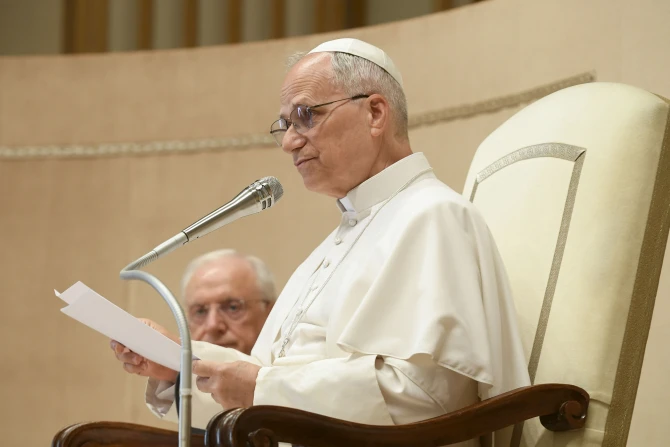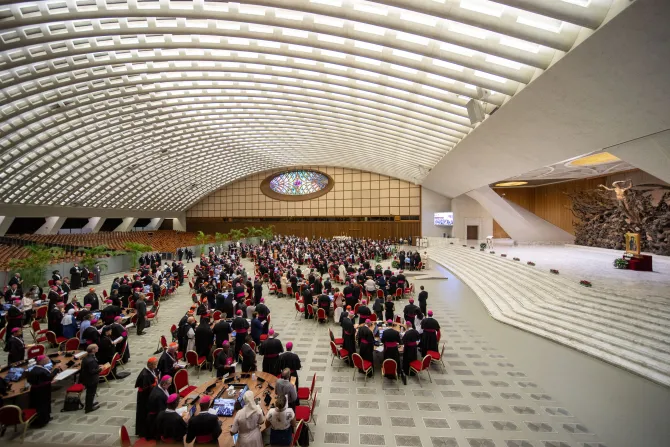
More than 400 people gathered at the Vatican on Wednesday to officially begin the Synod on Synodality.
During the first full day of work Oct. 5, participants met in small groups of about 12 people to discuss the first part of the Instrumentum Laboris, a document that will guide discussions over the nearly monthlong assembly.
The first section, which will form the basis of synod discussions Oct. 4–7, is titled “For a Synodal Church: An Integral Experience” and has two subpoints: “The characteristic signs of a synodal Church” and “A way forward for the synodal Church: conversation in the Spirit.”
According to Cristiane Murray, the vice director of the Holy See Press Office, synod members were given “a kind of task of answering” several reflection questions based on these themes on Oct. 4.
The president of the information commission for the synod, who is also the head of Vatican communications, Paolo Ruffini, said participants “were asked to pray with these [questions] yesterday evening, night, this morning before speaking at the synod.”
The main question for discernment was: “Starting from the journey of the local Churches to which we each belong and from the contents of the Instrumentum Laboris, which distinctive signs of a synodal Church emerge with greater clarity and which deserve greater recognition or should be particularly highlighted or deepened?”
The following questions were listed as “suggestions for prayer and preparatory reflection”:
1) Reflecting on how the synod course unfolded in the Church where I come from, what is the prevailing spiritual tone that characterizes it? What emotions and feelings did it arouse in those who took part? What desires did it arouse in the Christian community? What concerns emerged?
2) How can we grow in a synodal style of liturgical celebration, which highlights the distinctive contribution of all participants, starting from the variety of vocations, charisms, and ministries they bear?
3) In my local Church, how have we used and adapted the method of conversation in the Spirit? What are the main fruits it has enabled us to reap? How can it continue to help us grow as a missionary synodal Church?
4) What have we learned about listening as a characteristic of a synodal Church? What resources have we discovered we possess in this regard? Where do we perceive shortcomings? What do we need to address them? How can the ability to listen become an increasingly recognized and recognizable feature of our communities?
5) “A synodal Church promotes the passage from ‘I’ to ‘we’” (IL, No. 25). How has the synodal process promoted the cohesion of the local Church where I come from? How has it helped us to experience “the spiritual savor of being a people” (cf. Evangelii Gaudium, Nos. 268–274)? How do we feel we can grow in this dimension?
6) Did we meet with members of other Churches or ecclesial communities during the synod journey? Did we meet with believers from other religions? What was the spiritual tone of these meetings? What did we learn in order to grow in our desire and ability to walk together with them?
7) In my local Church, which tensions have emerged most strongly? How did we try to manage them so they did not become explosive? How do we evaluate this experience? What have we learned from this to help us grow in the ability to manage tensions without being crushed by them, which is proper to a synodal Church?
8) What experiences of discernment in common have we had in my local Church context? What have they enabled us to discover? In what direction do we need to continue growing?
After a day off on Sunday, Oct. 8, the Synod on Synodality will reconvene Oct. 9–12 to discuss the first question under section “B” of the Instrumentum Laboris: “A communion that radiates: How can we be more fully a sign and instrument of union with God and of the unity of all humanity?”
Section B is on “Communion, participation, mission: Three priority issues for the synodal Church.”
This article was originally published on Catholic News Agency.