Among the many devotions that have shaped Catholic spirituality, few have spread as widely as devotion to the Sacred Heart of Jesus. Rooted in Christ’s love for humanity and closely linked to the Eucharist, the devotion is now observed throughout the world, especially during the month of June.
The Revelations That Sparked a Global Devotion
Its origins, however, can be traced to a small town in eastern France: Paray-le-Monial. There, in the seventeenth century, Jesus appeared to a Visitation nun, Saint Margaret Mary Alacoque, revealing His Sacred Heart and inviting the Church to respond to His love.
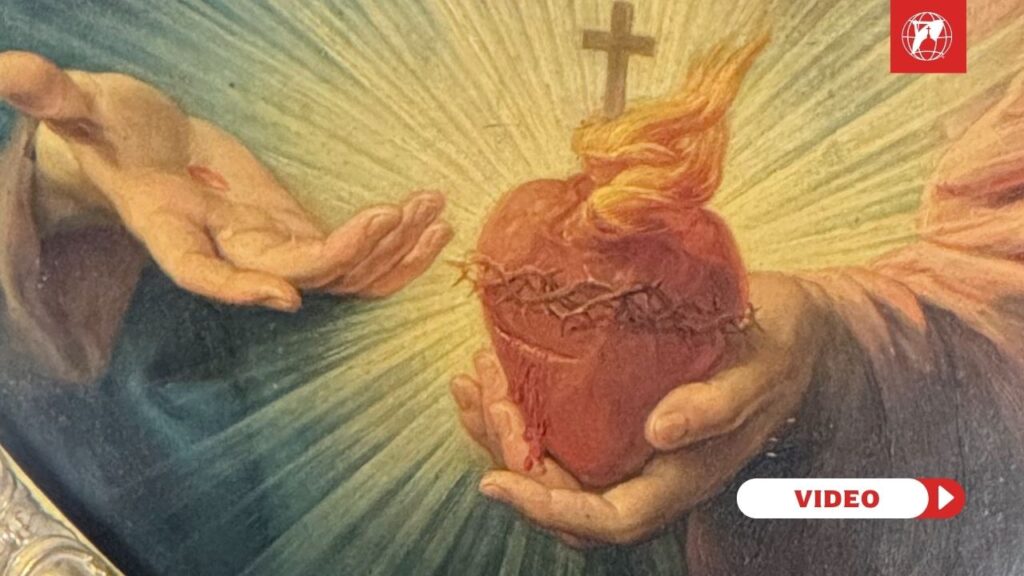
Father Étienne Kern, Rector of the Sanctuary of the Sacred Heart in Paray-le-Monial, explained that the first apparition occurred on December 27, 1673. During this encounter, “the Lord shows her His Heart, and she rests for a long time upon the Heart of Jesus.” He described how Christ “takes her heart, immerses it in His own, and gives her a new heart, one that is burning, aflame.”
A second apparition followed in 1674. According to Father Kern, Jesus appeared “not with a bleeding heart, but with a burning heart,” surrounded not by wounds but by “five suns.” Once again, Christ revealed His love while lamenting humanity’s “ingratitude and indifference.”
The apparitions took place in the chapel that today forms part of the sanctuary basilica, where Saint Margaret Mary is buried. There, Christ also asked her to receive Holy Communion frequently, particularly on the First Friday of each month, and to spend an hour in prayer on Thursday nights in remembrance of His agony in the Garden of Gethsemane.
“Behold This Heart Which Has So Loved Men”
The most famous of the apparitions came in June 1675.
Father Kern explained that during this encounter, “the Lord appears to her again before the Blessed Sacrament and says, ‘Behold this Heart which has so loved men.'” Christ then asked that a feast in honor of His Sacred Heart be established in the Church as an act of love and reparation.
Despite the significance of these revelations, Saint Margaret Mary initially encountered skepticism and disbelief. The devotion might never have spread beyond the convent walls were it not for the support of Saint Claude La Colombière, a Jesuit priest who served as her confessor and spiritual director.
Father Aaron Pidel, SJ, professor of theology at the Pontifical Gregorian University, explained that Saint Claude “very quickly, how would I say, believed the authenticity of these and became her tireless defender and promoter.”
Father Pidel noted that Margaret Mary later received another vision in which Jesus appeared alongside Saint Claude. During that vision, she was told that he would be the one through whom “the society of Jesus, would become the organization to diffuse and spread this devotion.”
With the support of Jesuits, bishops, and lay confraternities dedicated to the Sacred Heart, devotion gradually spread throughout Europe and eventually throughout the Catholic world.
Rome and the Universal Spread of the Sacred Heart
The devotion received a major boost in the nineteenth century when Pope Pius IX formally established the Feast of the Sacred Heart for the universal Church in 1856.
As devotion expanded, churches and shrines dedicated to the Sacred Heart were erected throughout the world. Among the most significant was the Basilica of the Sacred Heart in Rome, the first international shrine dedicated to the devotion.
Father Javier Ortiz Rodriguez, SDB, parish priest of the basilica, explained the vision behind its construction. “With this devotion, the first church to the Sacred Heart of Jesus in Rome was built with the intention that, from here, the center of Christianity, this devotion could be spread throughout the whole world.”
Following the death of Pope Pius IX, Pope Leo XIII continued the project and became one of the devotion’s greatest promoters. During his pontificate, he elevated the Feast of the Sacred Heart to the rank of solemnity, approved the Litany of the Sacred Heart, and in 1899 consecrated the entire Church and the whole human family to the Sacred Heart of Jesus.
Father Pidel reflected on the significance of that historic act. Pope Leo XIII, he explained, understood consecration as “the offering and the binding of oneself to Christ.” By entrusting oneself to Christ, believers “give God permission to act more powerfully in our lives.” When that act is undertaken collectively by the Church, he said, “we give God permission to act more powerfully.”
A Devotion Centered on Transformation
The promises associated with devotion to the Sacred Heart have inspired generations of Catholics. Among them are peace within families, strength during trials, consolation in suffering, and the grace of final perseverance for those who faithfully practice the First Fridays devotion.
Yet beyond specific promises, the devotion points believers toward a deeper encounter with the love of Christ.
For Father Kern, this remains the defining experience of Paray-le-Monial today. Pilgrims continue to travel there seeking not merely historical knowledge but a personal encounter with God’s mercy.
“Here, in Paray-le-Monial, we experience that the Lord loves us,” he said. Through Eucharistic adoration and the sacrament of reconciliation, visitors discover Christ’s merciful love and the possibility of inner renewal.
Reflecting on Saint Margaret Mary’s experience, Father Kern observed that while most believers will not receive extraordinary mystical graces, the Lord continues to transform hearts. “The Lord takes our heart of stone, immerses it in His Heart, and gives us a new heart.”
More than three centuries after the apparitions in Paray-le-Monial, devotion to the Sacred Heart remains a living expression of the Gospel message: that Christ’s love endures, invites a response, and continues to transform those who entrust themselves to Him.
Adapted by Jacob Stein.