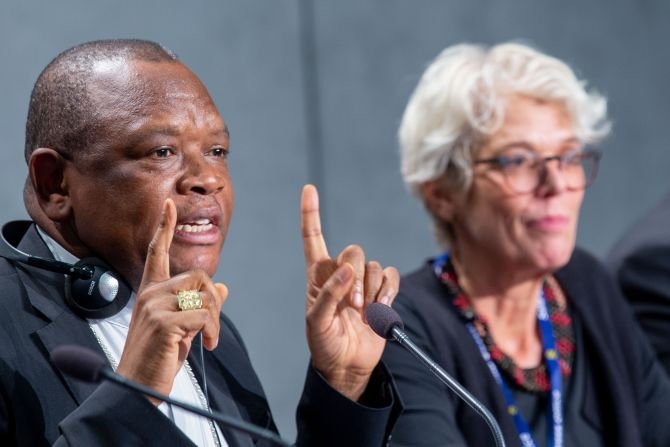
A leading African prelate participating in the Synod on Synodality expressed confidence Saturday that the process’ outcome will be “welcomed by everyone as the will of God.”
Congolese Cardinal Fridolin Ambongo Besungu also sought to counter what he called “excessive expectations” by some in the Church that the Synod would “bring solutions to all their problems.” Instead, he argued that the initiative is about providing “new ways to address problems, whatever they are” with “a spirit of synodality.”
“I don’t think the Synod’s goals consist in facing this way or that, but in a new way of being a Church, a new spirit,” said Besungu, who is the archbishop of Kinshasa as well as the president of the Symposium of Episcopal Conferences of Africa and Madagascar.
His comments, delivered during an afternoon press conference held by the Synod’s organizers, sparked questions about the actual authority of the Synod on its own to set a course for the Church — an issue that loomed large in a recent exchange between Pope Francis and a group of five senior cardinals who went public on the eve of the Synod with their grave reservations about the process that’s now well-underway at the Vatican.
Among the questions Besungu was asked was how the Synod’s outcome could be considered an authoritative expression of God’s will given that it lacks the special status of an ecumenical council, as the Second Vatican Council had.
The cardinal pointed to the “method of discernment” animating the synodal process and the authority he said participants have by virtue of their baptism. For the first time ever at a Synod of Bishops, 27% of the voting members are non-bishops, and discussion will be guided by a “conversations in the spirit” method of speaking, listening, and discerning.
“It is by virtue of baptism that we have the same responsibility before the Church, and I think all those present have the authority to speak on behalf of the Church,” the cardinal said.
Asked by the National Catholic Register’s Edward Pentin if he would accept a Synod outcome that expressed support for the blessing of same-sex unions as the will of God, Besungu demurred, explaining that he did not want to express his own opinion on LGBTQ issues because “the Lord himself through collective discernment will tell us” what direction the Church needs to take.
“No one has come here with his or her own agenda,” he said. “We are all brothers and sisters listening to the will of God for his Church.”
The cardinal’s comments came after five cardinals went public on Oct. 2 with questions they had submitted to Pope Francis, one of which addressed the authority of the Synod. Later that same day, the Vatican published the pope’s responses to the cardinal’s initial questions.
In response to a question about whether “synodality can be the supreme regulative criterion of the permanent government of the Church” without conflicting with the Church’s hierarchical nature, Pope Francis said that the Church’s status as a “mystery of missionary communion” “necessarily implies real participation: that not only the hierarchy but all the people of God in different ways and at different levels can make their voice heard and feel part of the Church’s journey.”
Canon law maintains that the Synod is a consultative body, and that its function is not “to settle matters or to draw up decrees, unless the Roman Pontiff has given it deliberative power in certain cases; in this event, it rests with the Roman Pontiff to ratify the decisions of the synod.”
Cardinal Besungu was joined at the press conference by synod member Sister Leticia Salazar, the chancellor of the Diocese of San Bernadino, California. Paolo Ruffini and Sheila Pires, the president and the secretary, respectively, of the Synod’s Commission for Information, also took part.
“The global identity of the Catholic Church is amazing to see and experience,” said Sister Salazar, who underscored the need to “embrace any learning you can do.”
On to the next step
Saturday’s press conference marked the conclusion of the first “module” of the month-long Synod gathering, during which the 365 delegates discussed the topic “A synodal Church.” The discussions so far have focused on “the characteristic signs of a synodal Church” and “a way forward for the synodal Church: conversation in the Spirit.”
The Synod participants also spoke about the experience of the first module. Ruffini said that many of the public speeches by Synod members expressed gratitude for “the grace of this moment which is allowing us to experience the greatness of the Church.”
The first phase of the synod concluded with each of the 35 circuli minores, or “small circles,” submitting their final reports to the Synod secretariat, which will be responsible for producing a synthesis document to be approved by the assembly in the final phase of the Synod.
Prior to submitting their reports, each table had gone through a multi-step process, in which all 12 members seated expressed their views on the topic, gave feedback on the contributions of others, and heard the initial reports of other tables. Each table elected a “rapporteur” who was responsible for preparing the final summary report, which was approved upon receiving the support of a simple majority of table members.
Some of the emphases of the first module included the co-responsibility of the baptized, seminary formation, and “giving energy to think about new forms and places of participation.”
Ruffini said that some of the words that most frequently appeared in the table reports included “Jesus,” “Church,” “communion,” “family,” “listening,” “community,” “the poor,” and “love.”
With module A of the Instrumentum Laboris, the Synod’s working document, now complete, Synod participants will begin their discussion on Monday of the next module, “A communion that radiates.” The topics up for discussion under that theme include walking with migrants and the poor, taking concrete steps to include LGBTQ+-identifying people, and overcoming the exclusion of persons with disabilities.
This article was originally published on Catholic News Agency.