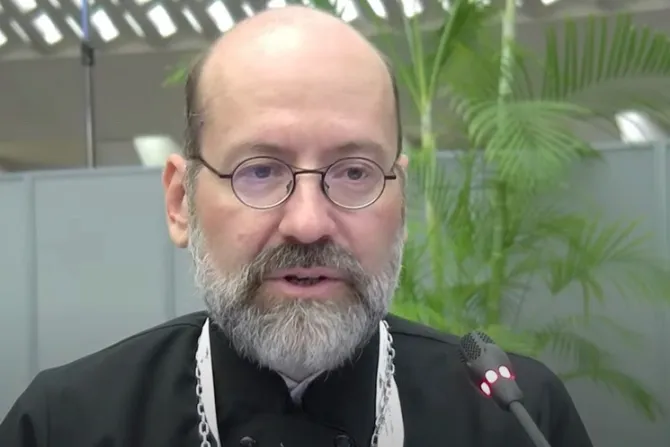
Speaking to the Synod on Synodality on Monday, an Eastern Orthodox bishop said the definition of synodality of the October assembly “differs greatly” from the Orthodox understanding.
Metropolitan Job of Pisidia referenced the first ecumenical council, the Council of Nicea in 325, and quoted from the Apostolic Canons, a fourth-century Christian text on the government and discipline of the early Christian Church.
Drawing from this text, he said, “a synod is a deliberative meeting of bishops, not a consultative clergy-laity assembly.”
“In light of this, we could say that the understanding of synodality in the Orthodox Church differs greatly from the definition of synodality given by your present assembly of the Synod of Bishops,” he added. The current synod now underway at the Vatican is the first of its kind to include laypeople as full voting members.
Metropolitan Job, the Eastern Orthodox bishop of Pisidia and the permanent representative of the Ecumenical Patriarchate to the World Council of Churches, is attending the Synod on Synodality as a fraternal delegate.
Fraternal delegates are non-Catholic representatives of Christian Churches. They participate in the synod assembly without the right to vote.
Job was one of four participants to give short speeches during the general congregation held on the morning of Oct. 9.
The metropolitan said he was grateful to be representing the Orthodox Church at the Synod of Bishops and to be able “to bear witness to the practice of synodality in the Orthodox Church.”
He quoted Apostolic Canon 34, reading that: “The bishops of the people of a province or region [ethnos] must recognize the one who is first [protos] amongst them, and consider him to be their head [kephale], and not do anything important without his consent [gnome]; each bishop may only do what concerns his own diocese [paroikia] and its dependent territories. But the first [protos] cannot do anything without the consent of all. For in this way concord [homonoia] will prevail, and God will be praised through the Lord in the Holy Spirit.”
The Eastern Orthodox bishop then said the following four points, “in light of this text”:
“A synod is a deliberative meeting of bishops, not a consultative clergy-laity assembly.”
“There cannot be a synod without a primate/protos, and there cannot be a primate/protos without a synod.”
“The primate/protos is part of the synod; he does not have superior authority to the synod, nor is he excluded from it.”
“The concord/homonoia which is expressed through the synodal consensus reflects the Trinitarian mystery of the divine life.”
“It is through this practice of synodality, as described by the Apostolic Canons and the canons of the First Ecumenical Council, that the Orthodox Church has been administered over the centuries until the present day, although the frequency and constitution of the synods may vary from one local autocephalous Church to another,” he said.
Job went on to admit that there have been “certain historical circumstances” in which the Orthodox Church has diverged from this formula, including the involvement of the laity in synodal decision-making on several specific occasions, which he listed.
Another exception, he said, is in the Church of Cyprus, where laity are involved in the first stage of the election of bishops.
“Nevertheless, the case of the Church of Cyprus constitutes an exceptional case in contemporary Orthodoxy, where, otherwise, the practice of synodality implies exclusively an assembly of bishops,” he said, noting that during a synod of the Orthodox Church in Crete in 2016, the 62 advisers made up of clergy, monks, and laity did not have the right to speak or vote.
Job’s presentation and those by the three other participants followed a speech by Cardinal Jean-Claude Hollerich introducing the synod’s next round of discussions.
The morning also included a spiritual reflection from Father Timothy Radcliffe, OP, and a theological reflection from British theologian Anna Rowlands.
This article was originally published on Catholic News Agency.