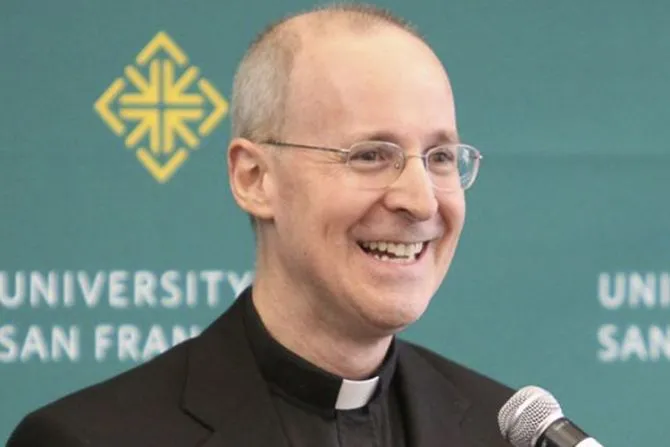
Jesuit Father James Martin, who will attend the first session of the Synod on Synodality as a participant appointed by Pope Francis, said that “without a doubt, there are many chaste and celibate gay priests in the Church. It’s important that that be said.”
In an Oct. 1 interview with the Spanish newspaper El Periódico, Martin stressed that “it is crucial to point out that these priests lead a chaste and celibate life, like their heterosexual colleagues, and dedicate their lives to service in the Church. It’s probably always been this way.”
In his opinion, “it is impossible” to know their number “due to the stigma that still exists” for which “many have suffered in silence due to ridicule.”
The priest, known for his pro-LGBTQ activism within the Catholic Church, said that those who prepared the Instrumentum Laboris for the Synod on Synodality have told him that “half of the dioceses around the world have mentioned the need for greater welcoming and inclusion” of these persons.
“This is not limited to the West,” Martin added, “but is spread throughout the world. However, it’s not surprising either. As more people identify as LGBTQ, more families, parishes, and dioceses are affected. Therefore, there is a natural and growing interest in understanding how to provide pastoral care to the LGBTQ community.”
Asked if his goal is “mission impossible” because of the presence at the synod of very conservative Catholics, some of them high-ranking, Martin commented: “My goal is to listen to the Holy Spirit, and I think that should be everyone’s goal.”
‘I don’t know what to expect’
Regarding the possibility of tensions within the first session of the Synod on Synodality, Martin said “it’s probably inevitable, but we should not fear tensions” because, for example, “the first synod in the history of the Church was the Council of Jerusalem, which took place around the year 50 A.D. There was a lot of tension at that time, but the Holy Spirit was still able to act.”
Regarding the possibility that some of his postulates will be accepted in this first session of the Synod of Synodality, Martin said: “To be honest, I really don’t know what to expect. I think that at this first meeting we will focus on how to dialogue with each other and listen to each other.”
As for why he thought that some of the more conservative voices in the Church are in the American clergy, Martin replied: “Perhaps it’s because many people admired Pope John Paul II and Benedict XVI, as is also the case with me. However, now Pope Francis has taken a different approach. Fundamentally speaking, there has been no change, but some people may be confused.”
“What I find truly disconcerting,” Martin continued, “is that in the United States, some of the same people who argued that a pope should never be criticized during the pontificates of John Paul II and Benedict, now do so every day under the pontificate of Francis.”
Asked how he views the criticism by some U.S. clergy of the German Synodal Way, the Jesuit priest replied: “I don’t see it as a fight. Both churches are responding to what they see as the needs of their people. It’s true that some German Church leaders may have a more progressive approach in some respects, but fundamentally there is no difference. After all, we all recite the same Creed on Sundays.”
This article was originally published on CNA.