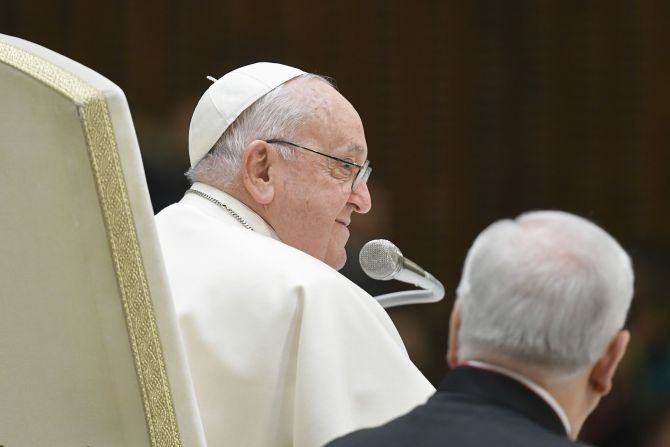
Pope Francis dedicated his Jan. 31 general audience to the subject of wrath, characterizing it as a vice that is “pervasive” and “particularly dark.”
In his opening remarks, the Holy Father observed that wrath is an inherently physical vice, as it is “perhaps the easiest to detect from a physical point of view” because “one who is consumed by wrath” has a particular difficulty in “hid[ing] this impulse.”
“You can recognize it from the movements of his body, his aggressiveness, his labored breathing, his grim and frowning expression. In its most acute manifestation, wrath is a vice that concedes no respite,” the pope said to the faithful gathered in the Paul VI Audience Hall on Wednesday morning.
Aside from its physical manifestations, Francis noted that the vice stems from a perceived “injustice suffered,” which, in turn, permits it to be “unleashed not against the offender but against the first unfortunate victim,” making it something that “destroys human relationships.”
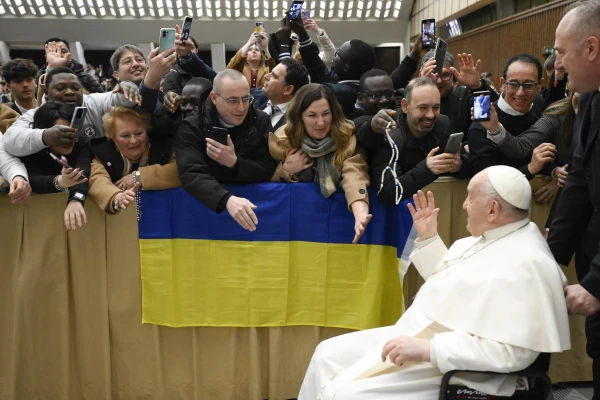
Pope Francis greets pilgrims at his general audience on Wednesday, Jan. 31, 2024. Credit: Vatican Media
“It expresses the incapacity to accept the diversity of others, especially when their life choices diverge from our own,” the Holy Father continued.
An antidote to this vice can be found in the Letter of St. Paul to the Ephesians, where Paul “recommends to Christians to face up to the problem straight away and to attempt reconciliation.”
“Do not let the sun go down on your anger,” the pope said, quoting from the epistle (Eph 4:26).
Francis underscored this point by urging that the faithful seek reconciliation and not let anger consume us or let it become a rumination.
“If some misunderstanding arises during the day, and two people can no longer understand each other, perceiving themselves as far apart, the night cannot be handed over to the devil,” the Holy Father said. “The vice would keep us awake at night, brooding over our reasons and the unaccountable mistakes that are never ours and always the other’s.”
Expanding on how vice factors into the the nexus of human relations, the pope presented the Lord’s Prayer as a testament to not only the supreme power of forgiveness but also one where Jesus “makes us pray for our human relations, which are a minefield: a plane that is never in perfect equilibrium.”
The pope said: “Men do not stay together if they do not also practice the art of forgiveness, as far as this is humanly possible.”
“Wrath is countered by benevolence, openness of heart, meekness, and patience,” he argued.
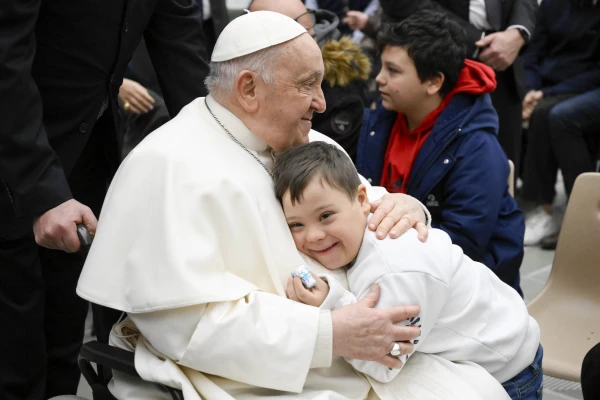
Pope Francis receives a hug during his general audience on Wednesday, Jan. 31, 2024. Credit: Vatican Media
However, the Holy Father also noted that anger reflects a basic humanity, noting that “the passions are to some extent unconscious, they happen, they are life experiences.”
While acknowledging that “we are not responsible for the onset of wrath,” the pope said we are, however, responsible “for its development.”
The pope further acknowledged the existence of righteous, or “holy” indignation.
“If a person were never to anger, if he did not become indignant at an injustice, if he did not feel something quivering in his gut at the oppression of the weak, it would mean he was not human, much less a Christian,” the pope observed.
Jesus, in fact, showcased this justifiable indignation when he cast the merchants out of the Temple, though he “never responded to evil with evil.”
“He performed a strong and prophetic action, dictated not by wrath but by zeal for the house of the Lord.”
This article was originally published by the Catholic News Agency.