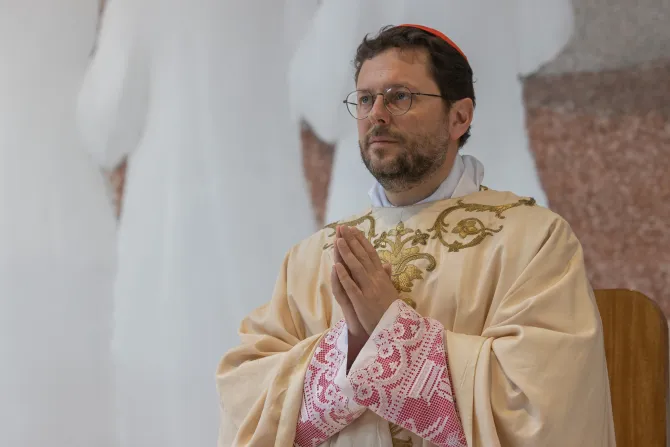
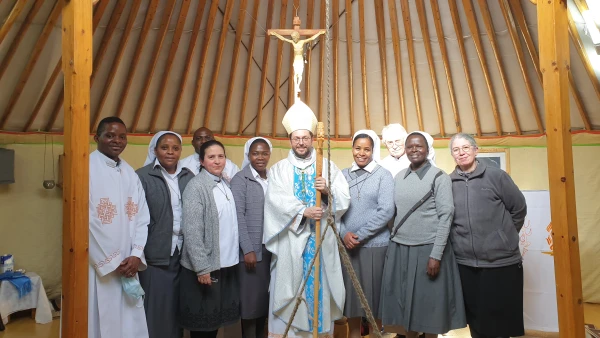
When Italian Cardinal Giorgio Marengo first arrived as a missionary priest in Mongolia 20 years ago, his mission set up two yurts (round tents) in the steppe — one for activities and one for offering Mass.
“We were sent to a faraway area where the Church had never been before,” the cardinal recalled. “After a long process of getting the necessary permissions, we finally got a piece of land — empty, nothing.”
The Catholic missionaries, who had each spent three years studying the Mongolian language in preparation, asked themselves: “Where do we start?” They decided to begin by praying.
“We were praying, celebrating the holy Eucharist in Mongolian, so the people in the neighborhood started entering the ger [Mongolian word for yurt] and watching these funny foreigners who were praying,” Marengo said.
“They told us, ‘We felt there was something special in this ger, this yurt.’”
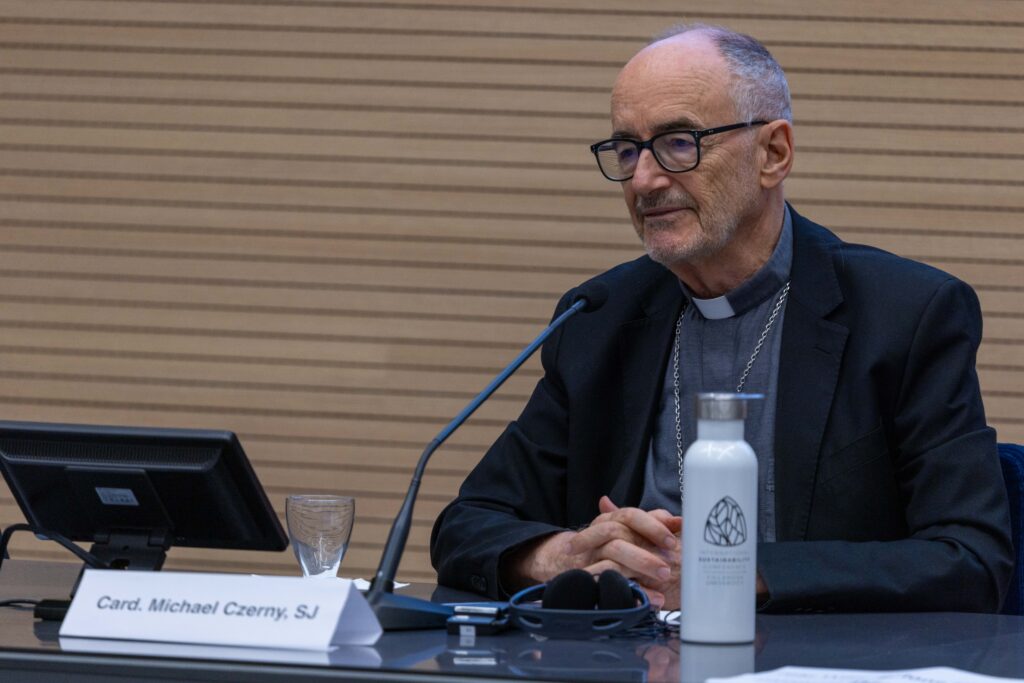
Evangelization begins with prayer, Marengo explained in a lecture in Rome this week organized by The Lay Centre, and Mongolia, which contains some of the most remote places in the world, lends itself to contemplative prayer.
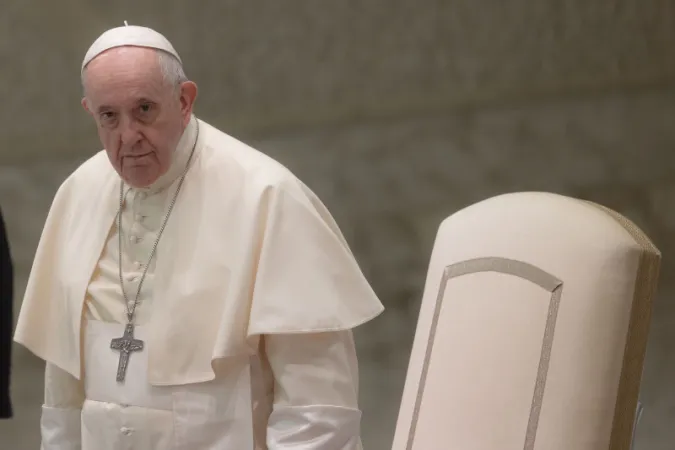
Pope Francis will become the first pope to visit Mongolia when he travels to the Asian country’s capital Ulaanbaatar from Aug. 31 to Sept. 4.
With only 1,450 Catholics, Mongolia has “one of the tiniest Catholic communities in the world,” according to Marengo.
The cardinal, who leads Mongolia’s apostolic prefecture, told journalists after his lecture that Pope Francis’ desire to visit such a small Catholic community shows that the pope’s “heart burns with love for the universal Church, and especially the Church where she lives in a minority context.”
The dream of a Catholic monastery
The religious landscape of Mongolia — once a heartland of Tibetan Buddhism — was dramatically changed by Communist rule.
At the turn of the century, there were an estimated 110,000 Buddhist monks and 700 monasteries in Mongolia.
Marengo recalled how a French Catholic missionary who visited what is today Mongolia at the end of the 19th century saw the succession of Buddhist monasteries in Mongolia and said: “‘One day this country will have to have a Catholic monastery here.’”
Under the Mongolian People’s Republic’s one-party rule, many monasteries were destroyed and closed and about 17,000 Buddhist monks were killed, while many others renounced religious life.
While a movement after the fall of the Soviet Union sought to rebuild destroyed monasteries, roughly 40% of Mongolia’s population remains atheist or without a religion.
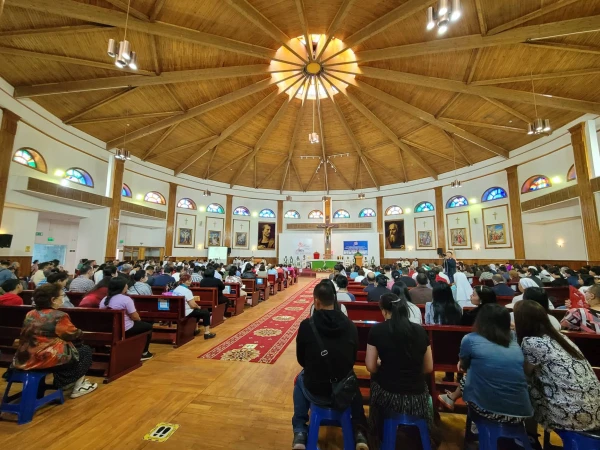
Amid the country’s modest religious revival, Marengo shares his missionary predecessor’s dream and thinks that the establishment of the first contemplative Catholic monastery in Mongolia “would be the way to evangelize more effectively.”
“And this is one of the prayers that we ask for that one day we will also have a Catholic monastery where Catholic contemplative prayer is seen, is experienced, is offered. And I think it will make a difference in the evangelization,” he said.
‘Whispering the Gospel’
Marengo, who at 49 is the world’s youngest cardinal, took painstaking efforts to immerse himself in Mongolian culture, including years of intensive language study, before he began his mission.
Now after more than 20 years as a missionary in Mongolia and as the head of the Apostolic Prefecture of Ulaanbaatar, which has jurisdiction over the entirety of the country, the cardinal is able to speak to the unique aspects of Mongolian culture that influences how Catholic missionaries approach evangelization.
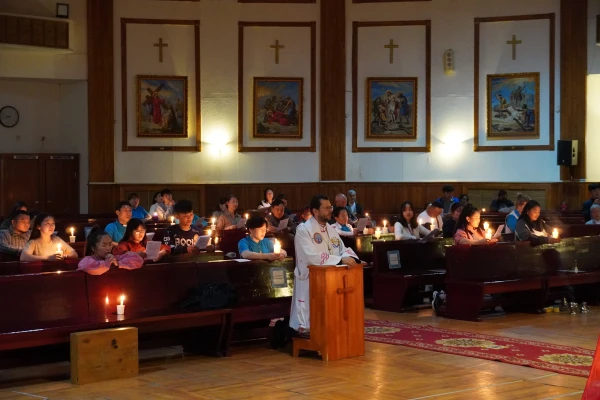
“It is quite evident that in the Mongolian context, special importance is given to whisper and more generally to speak at a low tone of voice, not only as a part of local etiquette but even as a distinct way of transmitting values — and imagine how difficult for an Italian to speak with a lower tone of voice and not using his hands,” he joked.
Marengo added that when a baby is born in Mongolia, there is a special naming ritual in which the weeks-old newborn is washed with a mutton broth inside the yurt and the mother takes the baby into her arms and whispers for the first time his or her name three times.
“I have attended this ritual several times and it is very touching,” the cardinal said.
Through his life and work in Mongolia, Marengo has come to understand “whispering the Gospel” as a type of communication that occurs only in the context of a relationship or friendship and with confidentiality and discretion.
“It requires a lot of time to plunge into a culture to the point where this vital relationship has been built. There is already an open channel through which you can share what is most important and precious to you, the Gospel of Jesus,” he said.
Marengo noted that the process of inculturation of the Gospel takes centuries and is a process led by the local people “who have welcomed the faith in Christ and who have reinterpreted their own lives in the light of the Gospel.”
“The Gospel has to be proclaimed because it is an element of empowering cultures and helping them to open to new dimensions. And if evangelization doesn’t reach at the heart of the culture, it is destined to be like superficial paint that cracks and fades away,” he said.
In his lecture in Rome, the missionary cardinal underlined that it is “fundamental that the Gospel is proclaimed” today.
Pope Paul VI reiterated this need in his encyclical on evangelization, Evangelii Nuntiandi, in 1975 in response to “some prominent schools of thinking based on relativism, for which any attempt to propose the Gospel would have been seen as potentially disturbing,” the cardinal explained. He noted that the previous century’s intellectual rebellion against the idea of missionary evangelization “today has given way to a humbler quest for authenticity and depth.”
He pointed to the example of St. Paul, who embodies “how a disciple can become a true missionary, since his entire life had been transfigured by the encounter with Christ.”
“The Gospel, which is the center of the evangelizing mission of the Church, cannot be hidden,” Marengo said. “It has to be offered freely, even taking into account that it might be misunderstood, that it can create some problems.”
“The Gospel has to be lived and to be shown by the witness of those who live it out,” he said.
This article was originally issued on CNA.