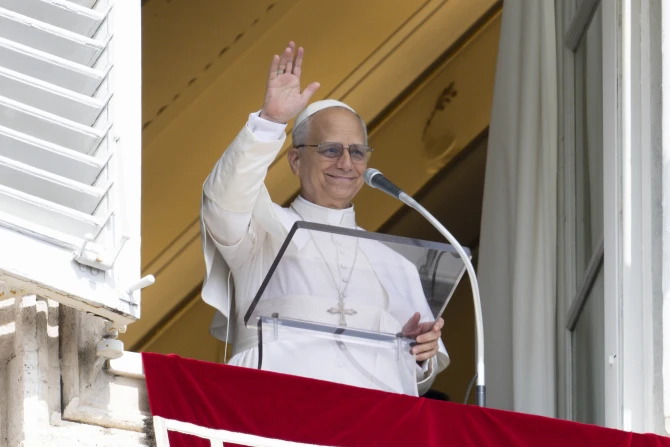
While the world today can view sickness and suffering as meaningless, Pope Francis wants everyone to remember that Christ has the power to transform suffering into love.
Suffering places a person at a crossroads, the pope said Thursday during an audience with the Pontifical Biblical Institute. “He can allow suffering to lead him to withdrawal into self-doubt, to the point of despair and rebellion; or he can welcome it as an opportunity for growth and discernment about what really matters in life, to the point of encounter with God.”
“The latter is the vision of faith that we find in sacred Scripture,” he added.
The Pontifical Biblical Institute has been studying “illness and suffering in the Bible,” a topic Pope Francis said is particularly close to his heart.
He commented on how the Old Testament is filled with examples of people trusting in God in moments of tears (Ps 38), calling out to him for the healing of infirmity (Ps 6:3; Is 38), and returning to him in moments of trial with movements toward conversion (Ps 38:5, 12; 39:9; Is 53:11).
In the New Testament, Jesus “reveals the Father’s love, mercy, forgiveness, and his constant search for sinful, lost, and wounded men,” he added.
“It is no coincidence that Christ’s public activity is largely marked by his contact with the sick,” Pope Francis said.
“Miraculous healings are one of the main characteristics of his ministry (Mt 9:35; 4:23): He heals lepers and paralytics (Mk 1:40–42; 2:10–12); he heals Simon’s mother-in-law and the centurion’s servant (Mt 8:5–15); and he frees the possessed and cures all the sick who entrust themselves to him (Mk 6:56).”
Jesus’ numerous healings reveal his divine identity, his mission, and his love for the weak to the point of identifying with them when he says: ‘I was sick and you visited me,’” the pope explained.
“The culmination of this identification occurs in the Passion, so that the cross of Christ becomes the sign par excellence of God’s solidarity with us and, at the same time, the possibility for us to unite with him in the saving work (Col 1:24),” he added.
“Thus in Christ even suffering is transformed into love and the end of the things of this world becomes hope of resurrection and salvation, as the author of the Book of Revelation reminds us,” Pope Francis said.
“In essence, for the Christian, even infirmity is a great gift of communion, with which God makes him share in his goodness precisely through the experience of his weakness.”
The pope pointed to John Paul II’s encyclical on redemptive suffering, Salvifici Doloris, as a witness to how the path of suffering can be a way to open oneself up to a greater love.
Pope Francis noted how “in modern thought illness and finitude are often considered as a loss, a non-value, a nuisance that must be minimized, opposed, and canceled at any cost.”
“We do not want to question their meaning, perhaps because we fear their moral and existential implications. Yet no one can escape the search for this ‘why,’” he added, citing paragraph 9 of Salvifici Doloris.
“In reality, the way we experience pain speaks to us of our possibility of loving and of letting ourselves be loved, of our ability to give meaning to the events of existence in the light of charity, and of our willingness to accept limitations as an opportunity for growth and of redemption,” Pope Francis said.