The Holy See and Oman have established full diplomatic relations, leaving only six countries worldwide without any diplomatic connection to the Vatican.
The announcement on Feb. 23 did not come as a surprise because in November, during Pope Francis’ trip to Bahrain, there had been contact between the Vatican and Oman’s Foreign Ministry.
The joint communiqué of the Holy See and the Sultanate of Oman said the action is aimed at “promoting mutual understanding and further strengthening friendship and cooperation” following “the principles of sovereign equality, independence, territorial integrity, and noninterference.”
Establishing an apostolic nunciature in Oman means that diplomatic relations will be conducted at the highest levels.
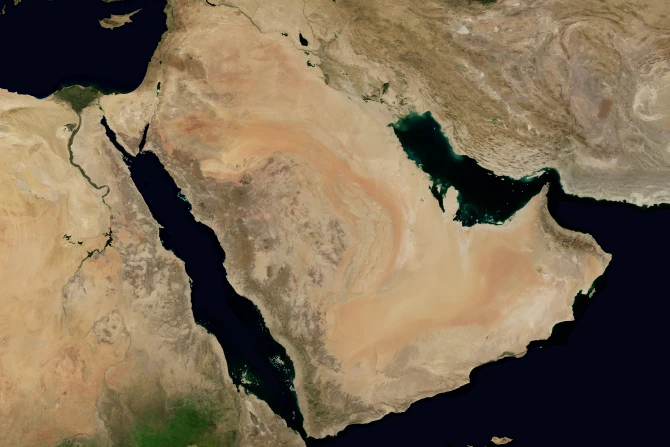
Oman is a sultanate in the Arabian Peninsula. The sultan is both head of state and the absolute ruler of the government. There are no official figures about the religious composition of the population, though an estimated 75% of its people are Muslim. There are four Catholic parishes and a dozen priests in the country, according to Vatican News.
Other religions are tolerated there; Catholics in the country can worship, manage schools, and give themselves an organization. The Oman territory is under the Apostolic Vicariate of Southern Arabia.
Including Oman, the Holy See now has diplomatic relations with 184 nations worldwide. The latest to be added to the list was Myanmar in 2017, a move that made Pope Francis’ trip to the nation possible that same year.
The opening of a contact channel with the Sultanate of Oman happened in 2017, after Father Tom Uzhunnalil, the Salesian priest abducted in Yemen in 2016, was released after 18 months of imprisonment.
Oman’s role was crucial in his liberation. Indeed, Oman has maintained balanced relations with all parties to the conflict in Yemen and already has secured the release of several people abducted or missing from the war-torn country.
On the occasion of the priest’s release, the Holy See issued a brief statement thanking “those who worked to find him, in particular, His Majesty the Sultan of Oman and the competent authorities of the Sultanate.”
That situation resulted in a phone call on Nov. 4, 2022, between Oman Foreign Minister Sayyid Badr Hamad al Usaidi and Archbishop Paul Richard Gallagher, Vatican minister for relations with states.
After the phone call, Oman’s foreign ministry announced that the archbishop and the foreign minister had “agreed to establish diplomatic relations between the Sultanate of Oman and the Holy See.”
With this decision, there remain six states without any official ties to the Holy See: Saudi Arabia, Bhutan, China, North Korea, the Maldives, and Tuvalu. There are apostolic delegates in four countries: Comoros and Somalia in Africa and Brunei and Laos in Asia.
Negotiations formally began with Vietnam to establish full diplomatic relations, which led at the end of 2011 to the appointment of a nonresidential Vatican representative to the government in Hanoi. The last meeting of the committee, in April 2022, decided to continue to progress in diplomatic relations, to now go from a nonresident representative of the Holy See to a resident representative in Hanoi.
The Holy See has established some informal ties with Saudi Arabia, first participating as an observer country in the Constitution of KAICIID (the center for interreligious dialogue sponsored by the Saudis, based in Vienna until this year and now in Lisbon). In April 2018, there was a historic trip to Saudi Arabia by Cardinal Jean-Louis Tauran as president of the Pontifical Council for Interreligious Dialogue. He even managed to celebrate a Mass in the country, whose territory is considered sacred by Islam.