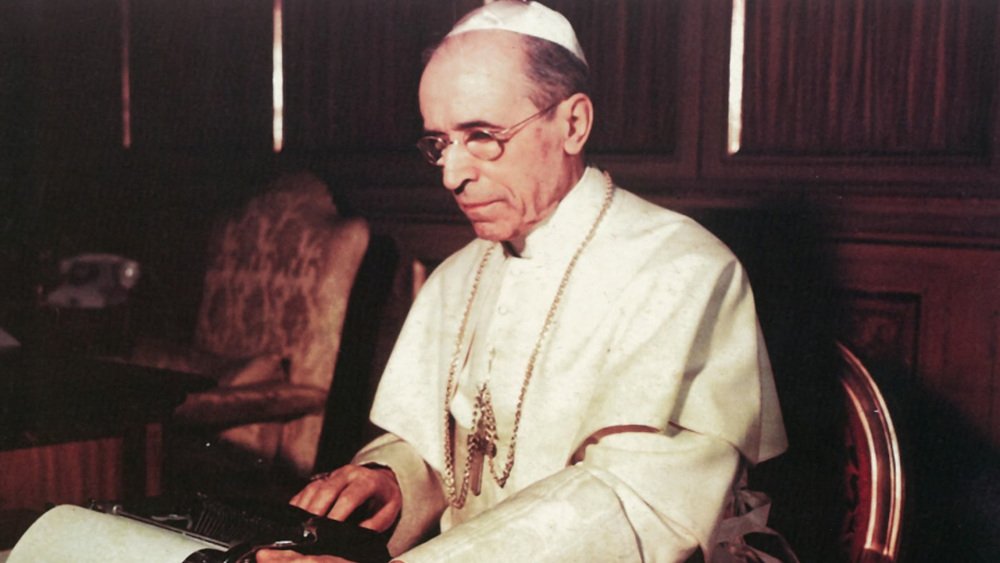
It was a lightning conclave that opened on March 1st, 1939, and closed the following day, March 2nd, with the white smoke announcing the election of Cardinal Eugenio Pacelli as the Roman Pontiff. For his papal name, he chose Pius XII. He was the successor to Pope Pius XI who had died on February 10 of that year.
On March 2nd, 1939, 62 Cardinals of the Holy Roman Church gathered in the Sistine Chapel, with Cardinal Gennaro Granito Pignatelli di Belmonte as Dean and Eugenio Pacelli as Camerlengo. There were three rounds of voting, making it the shortest conclave in recent Church history.
After the conclave, Cardinal Francesco Marchetti Selvaggiani, the Vicar General of Rome, said: “If the angels had voted, they would have elected Elia Dalla Costa (Archbishop of Florence), if the demons had voted, they would have elected me. Instead, it was men who voted.”
Pope Pius XII was elected on the day of his 63rd birthday. He was born on March 2nd, 1876, in Rome. He was the first Roman Pope elected since Clement X in 1670. From 1939 up to the present time, no Cardinal born in the Eternal City has been elected Pope.
Ordained a priest on April 2nd, 1899, he had a diplomatic training. Pope Benedict XV ordained him as a bishop on May 13, 1917 – the day of the first apparition of the Madonna at Fatima – and appointed him Apostolic Nuncio in Bavaria. In 1920 he became Apostolic Nuncio in Germany and in 1925 he took up this role in Prussia, as well. As Nuncio, he worked on the concordats with Bavaria and Prussia between 1924 and 1929.
Archbishop Eugenio Pacelli was created a cardinal by Pius XI in the consistory of December 16, 1929, and was assigned the presbyteral title of Saints John and Paul. On February 7, 1930, Pius XI chose him as Secretary of State. He also held the positions of Archpriest of the Vatican Basilica and President of the Fabric of St. Peter. In 1935, he was appointed Camerlengo of the Holy Roman Church.
Then, on March 2nd, 1939, he was elected Pope.
As Pontiff, he was immediately faced with World War II. He repeatedly and consistently called for peace, while working in silence for the salvation of Jews in Rome. He never left Rome during the war, earning him the title of defensor civitatis, defender of the city. He even visited the areas of Rome bombed by the Allies.
During his long pontificate, he wrote 40 encyclicals and appointed 56 cardinals in two consistories, including his immediate successor, Angelo Giuseppe Roncalli.
Pope Pius XII died in Castel Gandolfo on October 9, 1958.