“One of the greatest and most influential theologians of all time on the Chair of Peter put himself under the protection of a saint for whom there was no theology, only adoration.”
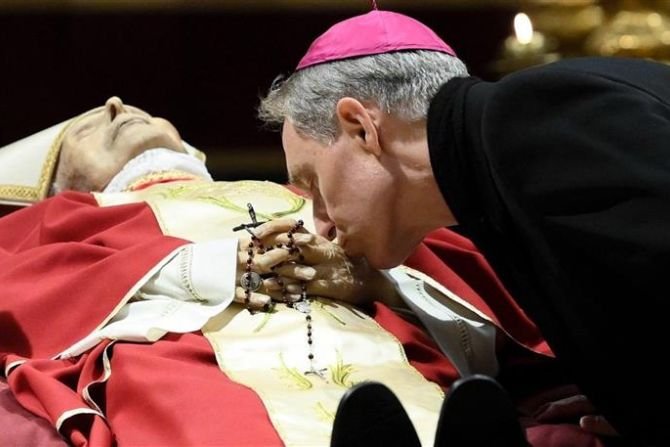
In his homily this morning at the Month’s Mind Mass for Benedict XVI’s in the Vatican Grottoes beside the tomb of his close friend and mentor, Archbishop Georg Gänswein recalled the Saint who deeply inspired the German Pope. It was an intimate ceremony with a few faithful, primarily people who had worked with Cardinal Ratzinger first and Pope Benedict later.
Gänswein was referring to Joseph Benedict Labre, who’s feast day falls on April 16, the day of his death and the birth of Joseph Ratzinger. Joseph as he was baptized and Benedict as he chose to call himself as pontiff found inspiration from the Saint with whom he shared a name.
“What a surprise, a mystery, a humility, but also a lesson,” said Gänswein. “Benedict XVI saw the Church and the life of the Church not as something to be dealt with according to political or ecclesiastical expediency, and because of this firmness and courage, he was often the object of harsh criticism, and there was no shortage of insulting words – of real insults. The meek and cautious priest did not escape his duty to remind how he, as the pope, did not have the power to change the revealed faith entrusted to the Church to proclaim and witness…
“Popes of the Middle Ages were expected to always have an “open ear” to the requests or desires of the emperors of that time. Pope Benedict saw his mission and commitment in reminding and, if necessary, even admonishing theologians and bishops not to succumb to dangerous theological currents but to remain in the unity of the Universal Church and faithful to the Depositum Fidei.
He knew that because of this attitude, there was a particular aversion to his pontificate. But at the same time, he had stirred up a great wave of conversion and vocations to the priesthood and contemplative life. Even his friends sometimes did not understand why he gave up the power given to the Petrine Ministry and did not want to rule with orders; in fact, he did not want to give orders. He trusted only in the “mild power of truth.” Without this, all reforms in the Church are built on sand. “Was this naive and out-of-touch idealism or the proper behaviour for a priest, a bishop, a pope?”
The distortions that have affected his person and the magisterium from different sides belong to the suspicions that he sympathised with a certain ecclesiastical anti-Judaism of the past. Far from it: Benedict XVI, already a Theologian and Bishop, took many steps forward in the relationship between the Church and Judaism. He scourged anti-Semitism as a stain on the Church and an attack on its very foundation. He did not tire of showing that the New Testament is connected with the Jewish tradition. The Old and New Testaments were, for him, one book. We know that a large part of his theological research and meditations was devoted to the person of Jesus Christ. And the most beautiful theological but also personal testimony is his book ‘Jesus of Nazareth’.”
The archbishop then spoke about Benedict Joseph Labre’s spirituality and how it echoes Pope Benedict’s spirituality. The secret of St. Joseph Benedict Labre’s supernatural life was, “A person must have three hearts united in one: a heart for the love of God, a heart for the love of one’s neighbor, and a heart that gives witness for the beauty of faith.” This was also the secret of Benedict XVI’s spiritual life. There is only one difference between the French saint – for whom there was no theology, only adoration – and the Bavarian pope for whom theology existed. It was precisely his theology that opened the door to worship for him.
Many priests, including Father Federico Lombardi, concelebrated the Mass. Also present were the Memores Domini, who assisted Benedict XVI during the years of his pontificate and later at Mater Ecclesiae Monastery, as well as his secretary Sister Birgit Wansing. At the end of the Mass, they held a moving moment of prayer at his tomb.
This story was first published by ACI Stampa, the Italian-language sister service of EWTN News.