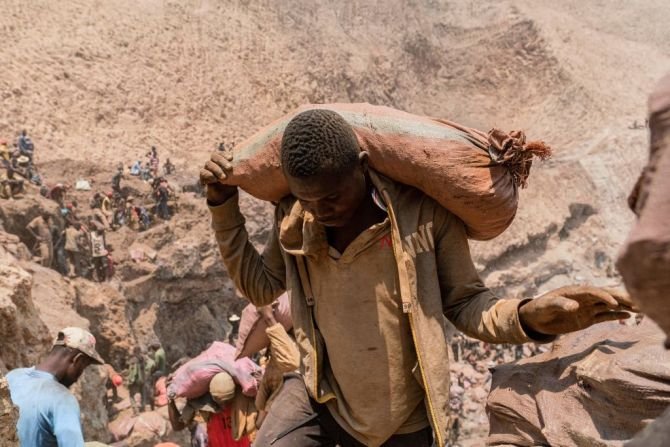
The Democratic Republic of Congo exports 70% of the worldʼs cobalt, a once-obscure element now in great demand because it’s needed to make lithium-ion batteries.
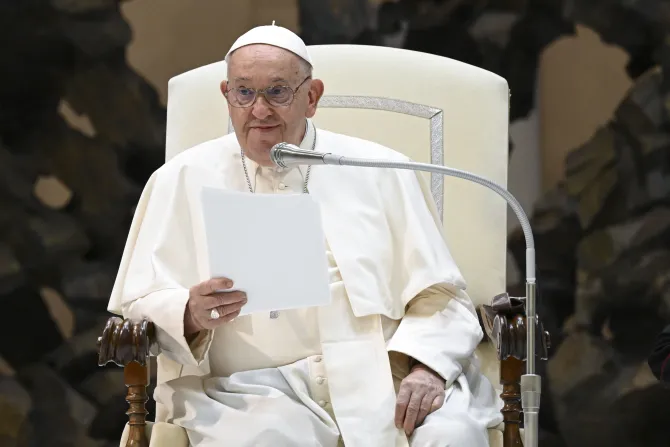
As part of his visit to Africa this week, Pope Francis met Tuesday with civil leaders of the Democratic Republic of Congo (DRC), one of the largest and poorest countries on the continent. Speaking with authorities including President Félix Tshisekedi, the pope denounced the practice of child labor in the country’s many mines, a widespread problem exacerbated by an ever-increasing global demand for cobalt, a vital component of rechargeable batteries.
“It is a tragedy that these lands, and more generally the whole African continent, continue to endure various forms of exploitation,” Pope Francis said.
“Situated in the heart of Africa, the Democratic Republic of the Congo is host to one of the great green lungs of the world, which must be preserved,” he continued. “As with peace and development, also in this area there needs to be an ample and fruitful cooperation that can permit an effective intervention without imposing external models” that are more useful to those who are helping than to those who are being helped.
The rich natural resources of the DRC, including diamonds, have been exploited for centuries, particularly while the Congo was a Belgian colony from 1908 to 1960. In the past few decades, however, the resource in the spotlight has been cobalt, an element that has risen from relative obscurity to global necessity as a vital component of lithium-ion batteries, which today power devices as small as smartphones and as large as electric cars.
Demand for cobalt has surged as countries in Europe and elsewhere make policy shifts away from fossil fuels and toward the use of electric vehicles. Some electric car makers, such as Tesla and General Motors, have in recent years announced research into the recycling of existing batteries, as well as moves away from lithium-ion batteries toward more environmentally friendly solid-state batteries. But progress has been slow, and the DRC still exports billions of dollars worth of cobalt a year, as well as vast quantities of other metals such as copper.
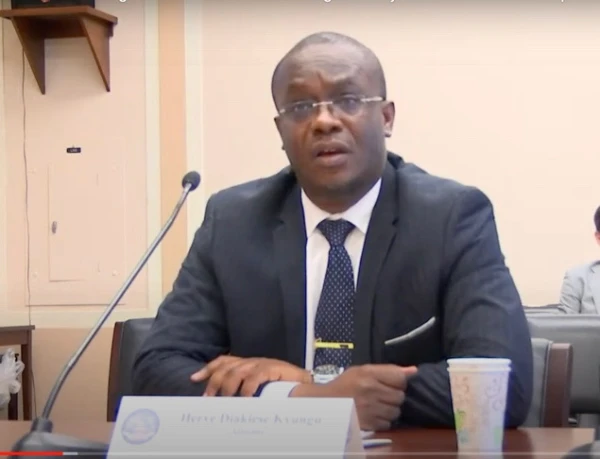
Congolese civil rights attorney Hervé Diakiese Kyungu testified at a July 2022 congressional hearing that children in DRC are often trafficked and exploited because of their small size and mine the cobalt with primitive tools or more often with their bare hands. An estimated 40,000 children work in these mines in DRC.
The DRC supplies more than 70% of the world’s demand for cobalt. Of that, 15% to 30% is extracted in artisanal mines, meaning they are small-scale operations that use dangerous, primitive methods. Almost all of the cobalt mines in DRC are owned by Chinese companies, and China, which manufactures myriad electronic goods, is the world’s largest importer of cobalt. Even in larger mines with marginally better working conditions, the salaries are small and the work is dangerous.
Father Rigobert Minani Bihuzo, a Catholic priest who has worked to expose child labor and human rights violations in the DRC’s mining sector, testified last year to the dangerous working conditions at the mines.
“They work seven days a week and more than 12 hours a day,” he said. Using tools like hammers, chisels, and spades, their working conditions are like that of slavery, he said. Injuries are common, and for those who are hurt or become sick, the lack of medical care means “the majority will die due to various untreated illnesses,” he said.
In addition to the toll on the workers in the country’s vast mining operations — which can include illnesses and birth defects — environmental concerns, such as water pollution from the mines, also threaten the Congolese people.
In his address to Congolese authorities, Pope Francis encouraged those present to undertake a “courageous and inclusive social renewal” to change the mining conditions in the country.
“The most precious diamonds of these lands are the sons and daughters of this nation; they need to have access to an education that enables them to make their innate talents shine brightly. Education is fundamental: It is the path to the future, the road to take for achieving the complete freedom of this country and of the African continent … yet many children receive no schooling,” the pope lamented.
“How many of them, instead of receiving a good education, are exploited! All too many of them die, subjected to servile labor in the mines. No effort should be spared to denounce and finally end the scourge of child labor.”
The topic of mining and exploitation was raised again on Thursday during the pope’s meeting with priests and religious in the Kinshasa Cathedral. A Congolese religious sister, offering testimony to the pope, described her country as “a land of martyrs, murders, and wars entertained and financed from outside.”
The sister told the pope: “Most Blessed Father, despite this picture of multiple injustices, the Congo remains a land blessed by God, a generous, prayer-loving people, filled with vitality and hope, as Your Holiness has surely observed. That is why we are not discouraged, because we believe in the risen Christ.”
Responding to her testimony, Pope Francis said he was reminded “how difficult it is to carry out your mission in a land rich in natural beauty and resources but wounded by exploitation, corruption, violence, and injustice.”
This article was originally published by EWTN News English.