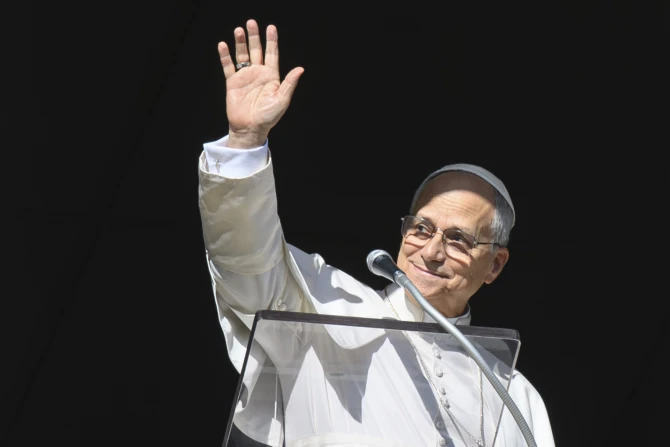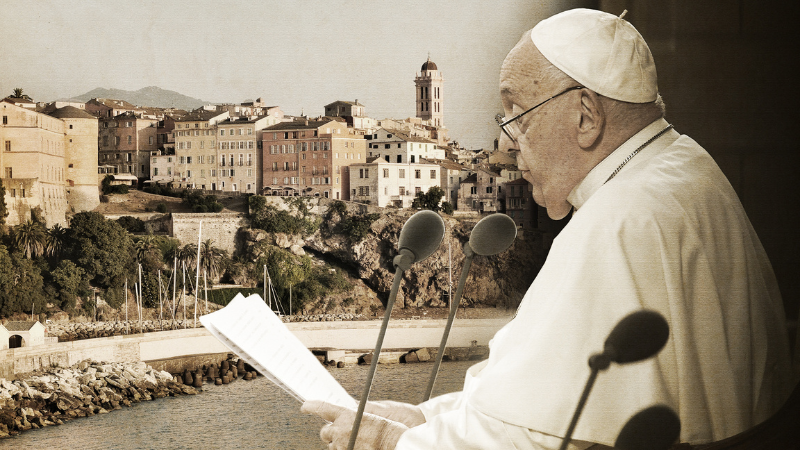
Pope Francis’ visit to the French island of Corsica was warmly welcomed by its residents.
Following the official reception, his first event took place at the Congress and Exhibition Center in Ajaccio. There, the Pope presided over the closing session of a Congress on “Popular Religiosity in the Mediterranean.” Father Louis El Rahi, the event’s organizer, explained that “popular piety” serves as a means of evangelization within the local Church.
“The term ‘religiosity,’” Father explained, “shows a transition from paganism to religion, and many Church traditions have pagan origins that have been evangelized. The term ‘popular’ doesn’t just mean ‘successful;’ it refers to something that belongs to the people—often the people of God—who have embraced and promoted these expressions of faith. The Church, in turn, has found elements of the Gospel and faith within these popular expressions.”
During his remarks, Pope Francis emphasized the importance of popular expressions of faith as a way to connect with secularized communities.
“The practice of popular piety,” the Pope said, “attracts and involves people on the threshold of faith, those who are not regular practitioners. Through it, they rediscover their roots and affections, as well as ideals and values that they find meaningful for their lives and society.”
Shortly after the initial gathering, the Holy Father visited the Cathedral of Our Lady of the Assumption, where he addressed priests and consecrated individuals. He urged them to listen to and remain close to those who come to the Church, so that those who have drifted away from God might find “guidance and comfort” through their support.
Following his remarks, the Pope prayed the Sunday Angelus. Outside the cathedral, a children’s choir joined the crowds in singing.
The day concluded with a Eucharistic celebration at Place d’Austerlitz, where various fraternities from the island gathered to fill the square.
The Pope wore rose vestments, used only twice in the liturgical year. One of these occasions is the Third Sunday of Advent, known as Gaudete Sunday, which means “Rejoice!” in Latin. In his homily, the pontiff urged the faithful to prepare for Christmas with a sense of “joyful expectation,” noting:
“It’s not easy to have joy. Christian joy is not carefree, superficial, or like carnival joy. It’s not like that. Rather, it’s a joy of the heart, rooted in a firm foundation.”
Before departing Ajaccio, the Pope held a brief meeting with French President Emmanuel Macron.
Adapted by Jacob Stein