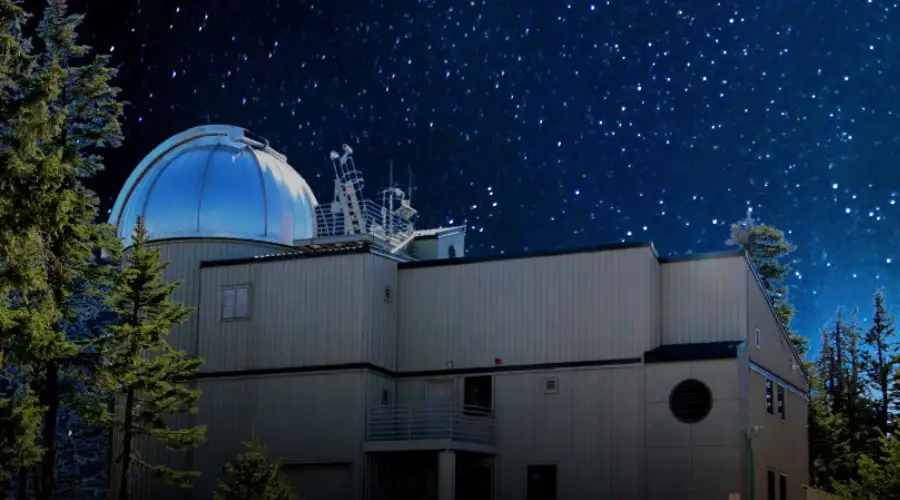
The Vatican Observatory, one of the oldest active astronomical observatories, has a telescope in southeastern Arizona in the United States.
The Vatican Advanced Technology Telescope (VATT) is located on Mount Graham in the city of Tucson, about 10,000 feet above sea level.
The VATT is part of the Mount Graham International Observatory, an exploration complex operated by the Vatican Observatory research group in collaboration with the University of Arizona.
Why is it in the U.S. and not at the Vatican?
In the 1890s, during the papacy of Leo XIII, the Holy See established an observatory, demonstrating to the world that the Catholic Church works hand in hand with science, but the telescope did not remain in Rome for long.
In the 1930s, Pope Pius XI moved the astronomical observatory to Castel Gandolfo, southeast of Rome.
A few decades later, light pollution forced the Vatican to look to Arizona, where sky conditions are among the best in the world for astronomical observations.
“In collaboration with the University of Arizona, we moved here in order to use their facilities,” said Fr. Paul Gabor, deputy director of the Vatican Observatory, in a recent interview with KGUN media.
So it was that the Vatican Observatory was established east of Tucson. By 1993, the Holy See had its own telescope, thanks to the collaboration of the house of studies and after an investment of some $4 million.
“We hope that not only now, but also in the future, we will be able to make astronomical observations from here and not need to move again to another location,” Fr. Gabor said.
The 1.8-meter telescope will soon celebrate 30 years of operation and important contributions to the scientific community.
Fr. Gabor added that the Vatican telescope is well known to astronomers, but few parishioners have visited it and may not know about the dozen Jesuits doing research at its facilities.
“While they spend time researching and teaching at the university, the priests travel to Mount Graham to make their observations at VATT,” he recounted.
According to the presbyter, the telescope will undergo an upgrade and be automated in 2024.
Automating the utility of the Vatican telescope will allow for multiple research projects each night, rather than just one, expanding its usefulness.
This article was originally published by ACI Prensa.