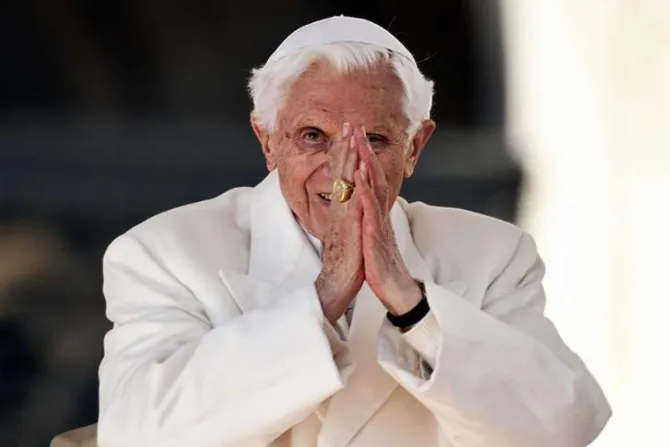
Some scholars and former students of Pope Emeritus Benedict XVI raised the prospect of the late pontiff’s canonization and recognition as a doctor of the Church.
The death of Pope Emeritus Benedict XVI prompted his former students and other Catholic scholars to reflect on his importance for the Catholic Church as a theologian, a scholar, and a preacher. Some even raised the prospect of the late pontiff’s canonization and recognition as a doctor of the Church.
“I don’t know anyone who has worked closely with him who does not recognize his holiness and his brilliance,” Father Joseph Fessio, SJ, the founder and editor of the San Francisco-based Ignatius Press, said Saturday. Fessio was a doctoral student under Benedict XVI when the future pope was known as Joseph Ratzinger, a professor and priest at the University of Regensburg.
George Weigel, a biographer of St. John Paul II who holds the William E. Simon Chair in Catholic Studies at the Ethics and Public Policy Center, praised the late pontiff as “one of the most creative Catholic theologians of modern times and arguably the greatest papal preacher since Pope St. Gregory the Great.”
“(N)o one I’ve ever met had a more lucid or orderly mind than Joseph Ratzinger,” Weigel added. “He believed that the truth of the Gospel was the truth of the world, and he bent every effort to help others understand that truth.”
Pope Emeritus Benedict XVI died on Saturday at the age of 95. He served as pope from 2005 to 2013, when he became the first pontiff in nearly 600 years to resign.
He was born in the German region of Bavaria on April 16, 1927. He grew up in the shadow of Nazi Germany, a regime he later deemed “sinister” and one that “banished God and thus became impervious to anything true and good.”
As a young priest, he served as a theological expert during the Second Vatican Council. As Cardinal Joseph Ratzinger, he served as archbishop of Munich and Freising and then was prefect of the Congregation for the Doctrine of the Faith under Pope John Paul II. In that role, he played a key part in preparing the Catechism of the Catholic Church and clarifying and defending Catholic teaching against erroneous theologians and dissenting activist groups.
After his death, accolades poured in from leaders and contributing authors to Ignatius Press, the primary English-language publisher of Pope Emeritus Benedict XVI’s works. These works include his bestseller “Jesus of Nazareth” and his earlier works like “Introduction to Christianity” and “The Spirit of the Liturgy.” Ignatius Press has published more than 80 books by Benedict XVI or about him.
Mark Brumley, president of Ignatius Press, said Benedict XVI was “a major figure” in the history of the Church and the world.
“He was one of the great theologians and churchmen of the 20th and early 21st centuries,” Brumley said. “Along with Pope John Paul II, he served the Lord and his people mightily by helping the Catholic Church faithfully embrace reform in continuity, rather than either radical rupture or an uncritical return to the past. He was a major force for evangelical fidelity and engagement with the modern world.”
“He was a man of God, a disciple of Jesus, and bearer of the Holy Spirit, who helped keep us on the right path,” Brumley said. “Thanks be to God for Joseph Ratzinger/Benedict XVI.”
In Fessio’s view, the late pontiff’s life showed heroic virtues and evidence he should be canonized.
“I don’t believe being pope is a proof of sanctity, nor is it sufficient grounds for canonization. But being Joseph Ratzinger is,” said the priest. Fessio went so far as to say he hoped for “santo subito,” an Italian phrase roughly meaning “sainthood now.” Many mourners of St. John Paul II invoked the phrase at his death in 2005.
Fessio added that he looks forward to seeing Benedict XVI declared a doctor of the Church. This special title uses “doctor” in the sense of the Latin word meaning “teacher.” The title is bestowed upon a saint whose writings are deemed to be of universal importance to the Church.
There are 37 official doctors of the Church including St. Gregory the Great, St. Augustine, St. Thomas Aquinas, St. John Chrysostom, St. Francis de Sales, St. Basil the Great, St. Catherine of Siena, St. Hildegard von Bingen, and St. Therese of Lisieux.
Peter Kreeft, a Boston College philosophy professor and author, said he considered Benedict “a shoo-in for saint and eventually a doctor of the Church.”
“Pope Benedict XVI was a gift of God, one of the very best teachers we have ever had, an equal to Gregory the Great, Leo the Great, and Leo XIII,” Kreeft said.
Father D. Vincent Twomey, SVD, said it “will come as no surprise” to him if Benedict XVI is named a doctor of the Church. Twomey, a friend and former doctoral student of the late pope, is a professor emeritus of theology at St. Patrick’s Pontifical University in Maynooth, Ireland.
The late pontiff, Twomey thought, will be remembered “above all for his literary and scholarly output.”
“His writings on a vast spectrum of theological and philosophical topics have a clarity and a depth that make his theology inspiring and therefore liberating,” Twomey said. “Future generations of all walks of life will find inspiration in his homilies and in his pastoral writings as pope; his encyclicals on love and hope must rank among the most outstanding ever to come from the pen of a pope.”
For Tracey Rowland, John Paul II Chair of Theology at the University of Notre Dame (Australia), Benedict XVI was “one of the most learned men ever to occupy the Petrine Office.”
“I believe that future generations will honor him with the title of Church Doctor,” she said. “His intellectual legacy is immense and at least on par with St. John Henry Newman, one of the intellectual heroes of his youth.”
“He never lost the faith of his Bavarian boyhood and he defended it intellectually on the stage of the world,” Rowland added. “He understood the theological roots of the cultural crisis of the Western world better than any world leader of his generation.”
Robert Royal, president of the Faith & Reason Institute, also praised the late pope.
“In his brilliance, imagination, humility, and steady faith, he resembled the Church Fathers, whom he loved and studied and brought to bear on our troubled age,” he said. “He belongs in their company and should be named a Doctor of the Church.”
“All of us must die, and the passing of most of us is of little consequence in the vast sweep of sacred history. But Pope Benedict’s death marks the end of a monumental life that changed the Church — and the world — and will continue to do so for many years to come,” Royal said.
These calls to recognize the late pontiff’s contributions echo the words of Cardinal Gerhard Müller, prefect emeritus of the Dicastery for the Doctrine of the Faith. In a Dec. 31 interview with the National Catholic Register, Müller called Benedict XVI a “true doctor of the Church for today” and a “great thinker.”
Tim Gray, president of the Denver-based theology graduate school the Augustine Institute, said Benedict XVI’s ministry complemented that of his friend and predecessor St. John Paul II.
“(H)e showed how the Second Vatican Council faithfully applied the Word of God and the gospel proclamation as the way for us to navigate the crisis of truth we now face,” he said. For Gray, the late pontiff’s writings exemplified the classic Christian description of theology as “faith seeking understanding.”
“He spoke of the hope that challenges us to give up comfort in order to embrace the cross, striving forward for the hope Christ has stored up for us in heaven,” Gray said. “I pray he may now realize the hope he cherished and the hope he challenged the Church to hold to above all others.”
This article was originally published by EWTN News English.