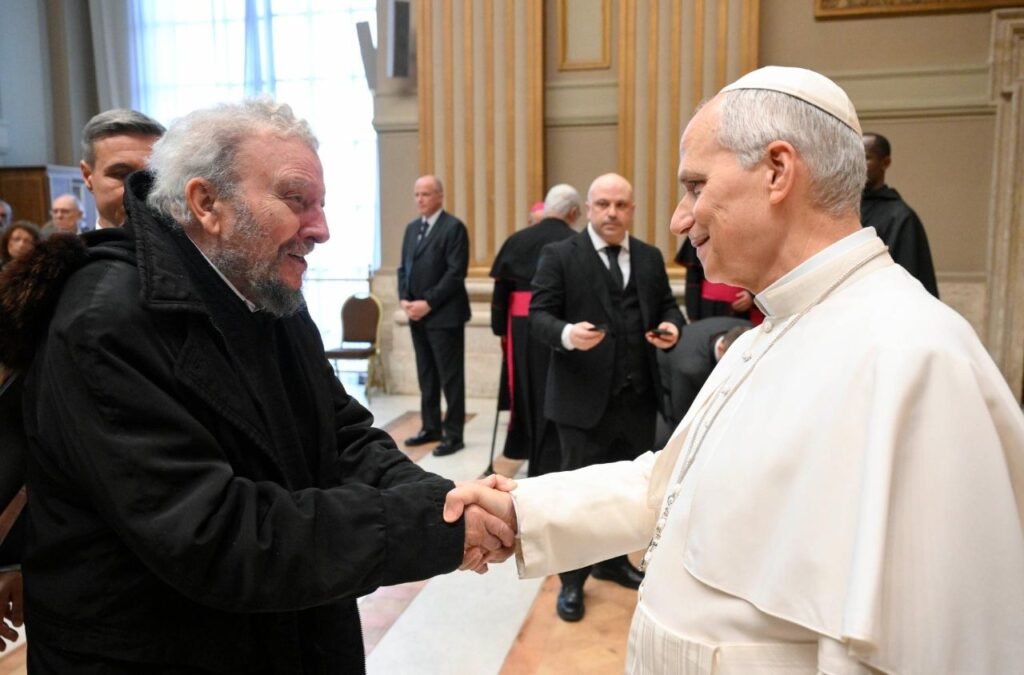
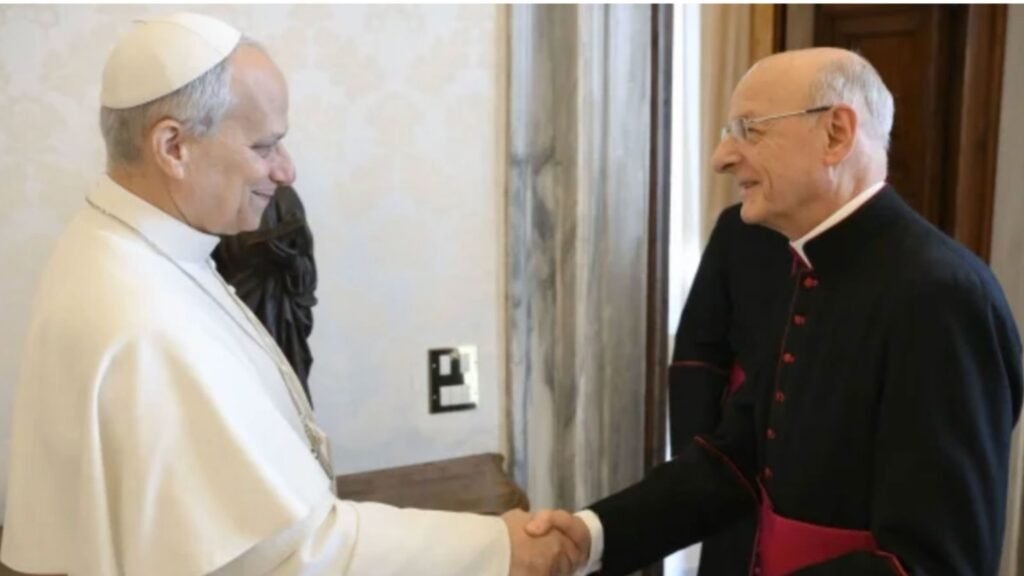
Pope Francis, in his weakness, is teaching the world about human frailty, Archbishop Vincenzo Paglia said Monday at a press conference for a Vatican summit on longevity.
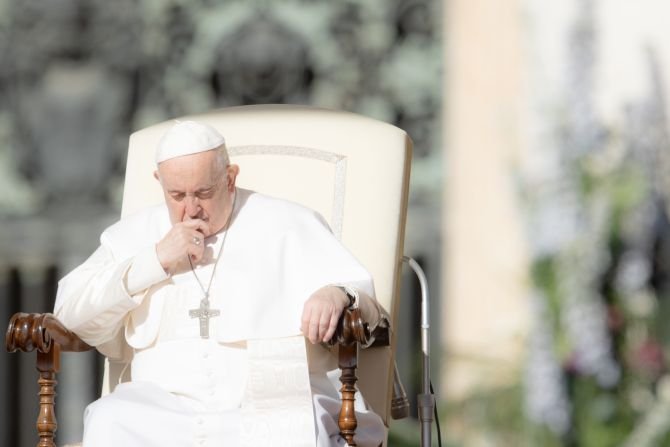
The pope has shown “that old age is also marked by frailty, and frailty should not be rejected. It is not to be … expelled like the devil,” the archbishop and president of the Pontifical Academy for Life said at the Holy See Press Office on March 24, one day after Pope Francis returned to the Vatican after 38 days in the hospital.
While Francis, in his illness, has lost his ability to speak at the moment, he is teaching us with his body “the importance of old people,” Paglia added. “Pope Francis reminds us that it is actually a voice that should be deafening: that of the frail, who remind us that we do not live forever.”
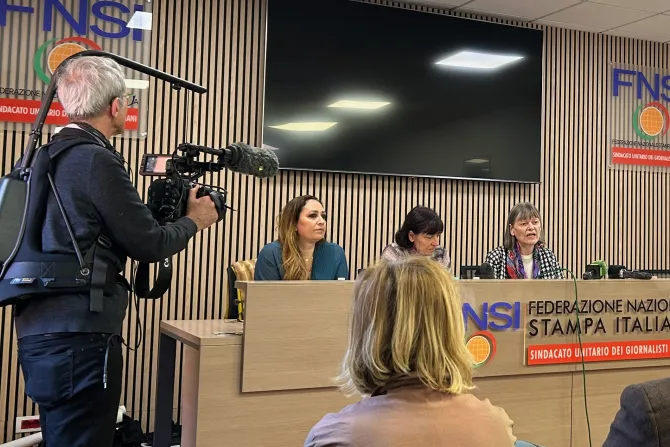
The Vatican’s Pontifical Academy for Life sponsored the first Vatican Longevity Summit on March 24 at the Augustinianum Conference Center in Rome to reflect with scientific and academic institutions on how to promote “a model of longevity that does not limit itself to extending the years of life but to enriching them in terms of quality, dignity, and sustainability, integrating science, ethics, and spirituality.”
Giulio Maira, a neurosurgeon who previously worked at Rome’s Gemelli Hospital, is participating in the summit. He told CNA after the press conference that “frailty is the ultimate expression of aging.”
“Unfortunately, when we get to an age beyond 65-70, we get there with a more fragile organism, with a greater vulnerability to diseases, germs, bacteria, viruses,” he noted. “The pope is the expression, the living example, of how even a serious illness can be faced with dignity, with courage, and with serenity. And this must be an example for everyone.”
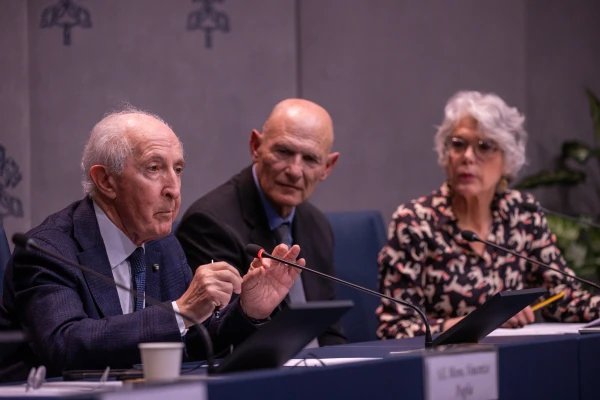
Pope Francis, Maira said during the press conference, has made it through the worst of a serious illness, and now, like everyone, needs to convalesce.
Reflecting on some of the popes of the last century and how they lived illness and old age, Paglia said: “We need to get out of an overly functionalist mindset.”
Francis, during his hospital stay, has taught us that everyone needs each other, the archbishop added in comments to CNA.
Venkatraman Ramakrishnan, winner of the 2009 Nobel Prize in chemistry and a participant in the summit on old age, said there are a few considerations when it comes to scientific research on longevity.
“The aim is not to get people to live much longer, but the aim is to have people live healthier lives, so more of their lives can be healthy,” he said. “It’s not entirely clear how we are going to achieve this because it may be that advances in longevity not only increase our health but also increase our lifespan.”
A second consideration is the imbalance of generations, a slow changeover of generations, and the effect it would have on the dynamic quality and creativity of a society, he added.
“If we all start living longer, what kind of society will we have? We already face a society where fertility rates are going down … so we may have a society which is very lopsided in that there are very few young people and very many old people, what would that mean?”
Ramakrishnan said economic disparity is also an important issue: “Whenever new medical advances are made, they are often first used in rich countries and only very slowly go to poor countries.”
This article was originally published on Catholic News Agency.