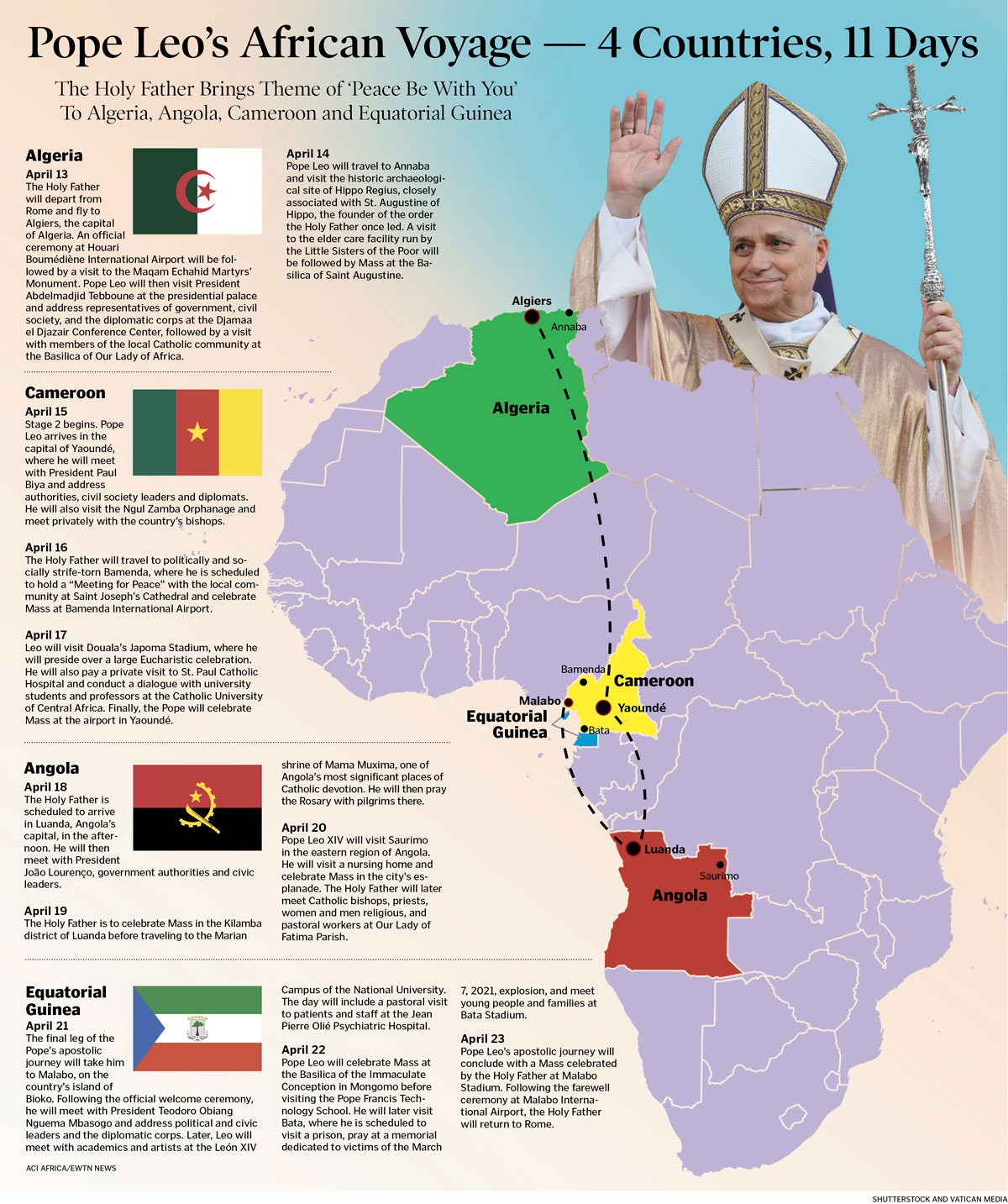
ANALYSIS: A closer look at the four countries on the Pope’s itinerary shows how the Church’s role — before and after independence — has shaped his visit.
In a recent Register interview, Archbishop José Avelino Bettencourt, apostolic nuncio to Cameroon and Equatorial Guinea, rightly referred to “multiple reasons on multiple levels” why Pope Leo XIV’s trip to four African countries from April 13-23 is so significant.
The future of the Church in Africa is a prime focus. Africa’s population is expected to reach 2.5 billion by 2050, a nearly 80% increase from today, and the Holy See is keenly aware of how this growth will shape pastoral priorities as well as the continent’s social and economic structures. According to the World Bank, one in three young people globally will be African within 25 years.
The broader historical context looms large, too, perhaps most explicitly so during Leo’s first stop in Algeria, when the Augustinian Pope will visit church ruins where St. Augustine served as the bishop of Hippo in the fifth century. What follows are three historic themes shaping Leo’s 10-day journey that help explain its resonance, as well as the widespread respect for the Catholic Church on the continent.
1. Missionary Orders Oriented Toward the Good of Local People
A huge misconception about the Catholic Church in Africa pertains to its relationship to colonialism.
Although the Church generally arrived with missionaries on roads “paved” by colonial powers — the French in Algeria and Cameroon, the Portuguese in Angola, the Spanish in Equatorial Guinea — religious orders and the Holy See functioned independently from colonial authorities when it mattered.
Missionary orders served local people, especially through health care and schools, beginning in the 19th century. The Vatican distinguished itself by opposing the slave trade, promoting Indigenous clergy, providing education and supporting national sovereignty.
Algeria is a fascinating example of how Catholic religious and bishops have prioritized local people. (Pope Leo XIV’s order, the Augustinians, founded in Italy in 1244, was dedicated to the Rule of St. Augustine from the start, but it did not establish itself in the saint’s homeland until 1933.)
Algeria’s first religious congregation, the Sisters of St. Joseph of the Apparition, was established in 1835 by a 37-year-old Frenchwoman, St. Emilie de Vialar, who crossed the Mediterranean on a French military ship with several other young nuns at the request of her brother, who was working with the colonial government and said that the people were desperate for medical help and education. The sisters immediately confronted a cholera epidemic and served Indigenous people as well as the French.
Three decades later, Bishop Charles Lavigerie of Nancy, France, was appointed archbishop of Algiers, Algeria’s largest city. He created shelters for Algerian Muslim orphans (over objections from French local officials) and then, in 1868, founded the Society of Missionaries of Africa, which expanded to Central and Eastern Africa, prioritizing local language acquisition and planting the Church where it was unknown. Bishop Lavigerie opposed proselytizing Muslims, convinced that charity and selflessness would distinguish Christianity.
In Angola, Catholic history goes back further, to the arrival in the late 15th century of Portuguese friars traveling with explorers. In 1491, they converted a local king and his son, who then helped convert the region. A Jesuit mission began in 1548 and proved more durable, but the order was expelled in 1759, when governments practicing the slave trade (Portugal, France and Spain) compelled Pope Clement XIV to suppress it.
The Congregation of the Holy Spirit, or Spiritans, significantly reanimated evangelization in Angola when they arrived in 1866. Spiritans also figure in the Catholic history of Cameroon, especially the coastal city of Douala, following the French takeover of German colonial territory after World War I. Under German governance, the Pallottine Fathers (formally, Society of the Catholic Apostolate) led missionary efforts. Forced out in 1916, the Pallottines returned to serve in Cameroon in 1964.
Today, more than 300 religious congregations are active in Cameroon, which has a population of about 30 million people, with a median age of 18 years.
Pope Leo’s final stop is Equatorial Guinea, the only Spanish-speaking country in Africa. As part of a treaty signed in 1778 between Portugal and Spain to settle Latin American border disputes, Portugal gave up the land comprising Equatorial Guinea, including five islands and a compact coastal mainland. Spain wanted the territory as a base for its transatlantic slave trade.
Spanish Claretians (formally, the Congregation of the Missionary Sons of the Immaculate Heart of Mary) have had the most powerful ongoing influence on the Church in Equatorial Guinea, which was the order’s first assignment, beginning in 1883. These missionaries opposed colonial brutality and the inhuman practices of planters. Because they created and staffed much of the education system, the Claretians fostered upward mobility.
Today, Catholics comprise some 75% of the country’s 1.9 million people — the average age is 22 — and the Claretians remain deeply engaged in pastoral life.
2. Catholic Support for Independence From Colonial Rule
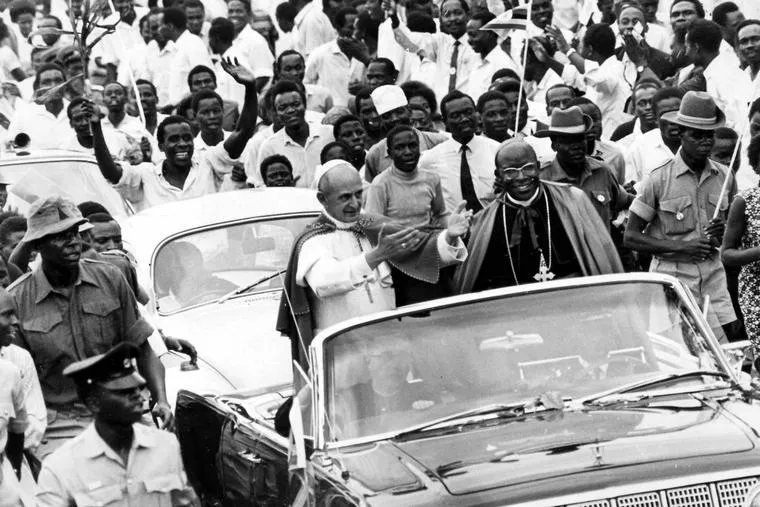
Cameroonian Archbishop Emeritus Cornelius Fontem Esua was a seminarian in Rome in 1969 when Pope Paul VI visited Uganda — the first papal visit to the African continent — and memorably declared, “You Africans are missionaries to yourselves.”
“It marked a new page in the history of the Church in Africa, now considered mature enough to stop being always on the receiving end. The Pontiff delivered a message of trust and hope,” the archbishop explained to the Register.
Recognizing the Holy See’s role in the decolonization process, heads of state from seven countries that achieved independence from the United Kingdom and Belgium between 1960 and 1962 — Uganda, Tanzania, Zambia, Rwanda, Burundi, Democratic Republic of the Congo and Nigeria — greeted the Pope at the airport. They would not have come out in force if the Holy See had been inextricably linked with colonial regimes.
Independence was gained through violence in Algeria (1954-62), Cameroon (1957-59) and Angola (1961-74), pitting the Church against its original sponsors in defense of local needs.
In Algeria, the role of French-born Archbishop Léon-Etienne Duval signifies the difference between the position of Church leaders coordinating with Rome and the attitude of many Catholics in the colonial establishment. Duval was appointed bishop of Constantine-Hippo (St. Augustine’s see) in 1946 and elevated to archbishop of Algiers in 1954. He was the main Church point man during the brutal war of independence fought between France and Algerian nationalists.
Duval denounced colonial repression and the torture of Arabs. He believed reconciliation was possible. He took dual Algerian and French citizenship even as most of the French Catholic population fled.
Duval’s support for decolonization influenced the Second Vatican Council. So did devout African Catholics such as Senegalese intellectual Alioune Diop (1910-1980), a founder of the Négritude movement who pressed the Church to live up to its universal identity against European political and military goals.
On his first day in Algeria, Pope Leo will visit the “Martyrs Memorial,” honoring mainly Algerian Muslims who died for independence.
In Angola, Church identity was closely entwined with Portuguese authorities for hundreds of years; the government helped finance early missionaries. But the Church successfully decoupled from the colonial project before a 14-year war (1961-1975) for independence erupted.
Maria Guadalupe Rodrigues explained the Church’s ability to avoid association with any warring faction as depending on three attributes of Catholicism: its transnational identity, spiritual dimension, and the Holy See’s internationally recognized sovereign status. These characteristics allowed the Church to “maintain its institutional unity while defining its Angolan identity.”
The Catholic Church was also deeply identified with Spanish colonial authorities in Equatorial Guinea, where Catholicism was the state religion. But immediately upon independence in 1968, although the process was not bloody, the first leader declared himself president for life, repressing, then banning, the Catholic Church.
A military coup in 1979 by the president’s nephew, Lt. Col. Teodoro Obiang Nguema Mbasogo, restored the Church (and executed his uncle). Forty-seven years later, Obiang is still the ruler. His reign is marked by corruption and a dramatic disparity in wealth, which the Church has been urged to challenge.
Cameroon achieved independence in two stages: French Cameroon became the independent Republic of Cameroon in 1960, while the British Southwest portion of the country joined in 1961 to form the Federal Republic of Cameroon.
3. Peacebuilding in the Face of Political Violence
After many years functioning largely as autonomous states, the Francophone-dominated government in the capital city of Yaoundé began imposing French teachers and judges on English-speaking schools and courts in Northwest and Southwest Cameroon, sometimes referred to as Ambazonia. In 2016, Anglophone teachers went on strike, and the military escalated the conflict with violence.
Archbishop Esua, whose archdiocese is in the conflict zone, recounted how the Church tried to mediate through dialogue.
“The Anglophone protesters presented their grievances, and the governor said he would carry the grievances to Yaoundé. He seemed understanding. We thought the problems were going to calm; the leaders of the strike left the meeting — but before they got home, their homes were attacked by the military,” he recalled. “That same night. It was the last straw.”
Tension remains; the English-speaking territory is impoverished, driving many people away to seek work and education. As in Equatorial Guinea, in Cameroon, a Catholic “forever president” has been in office for decades. Church leaders must remain impartial, but some of the most respected leaders are openly critical of the country’s stagnant economy and lack of human investment.
The 1990s are known as the “Black Decade” in Algeria, as the government battled Islamic insurgents and people were trapped in the middle. Despite being warned of danger, many Catholic missionaries remained with the people they served. Between 1992 and 1994, 19 brothers, sisters and priests — including a bishop — were murdered for practicing the faith. They were beatified on Dec. 8, 2018, at the Shrine of Our Lady of Santa Cruz in Oran.
When Leo traveled to Algiers in 2013 as prior general of the Augustinians, he visited the site where two of the 19 — both Augustinian sisters — were murdered as they attended Mass.
An insight into how some Muslims perceive the Catholic martyrs was expressed by professor Nadjia Kebour, who works in Rome at the Pontifical Institute for Arabic and Islamic Studies.
“I’m a Muslim, and I have lived the experience of terrorism in Algeria. During the dark decade in my beloved land, we lived together. We experienced this terror together, and so did the monks. We were all threatened, and so many souls were killed for no reason,” she explained.
In Angola, Portugal capitulated, and the country gained independence in November 1975, but that triggered a brutal civil war that lasted for 27 years. Between 500,000 and 800,000 people died. (Today, Angola’s population is 40 million, with a median age of 16.6 years.)
Providentially, bishops such as Archbishop Zacarias Kamwenho of Lubango emerged to help end the devastating war through the Inter-Ecclesial Committee for Peace in 2000. The Church was credited with tireless work for reconciliation, and to this day the effort to heal from the compounded conflicts is an explicit Catholic priority.
Pope Leo’s pilgrimage to these four countries is a pastoral visit consistent with the Church’s longtime, steady efforts to advance peace, especially in places fraught with far too much violence. Refocusing on Africa’s joyful spirituality and booming population with infinite potential will be positive chords throughout the intense journey.
This article was originally published by EWTN News English.