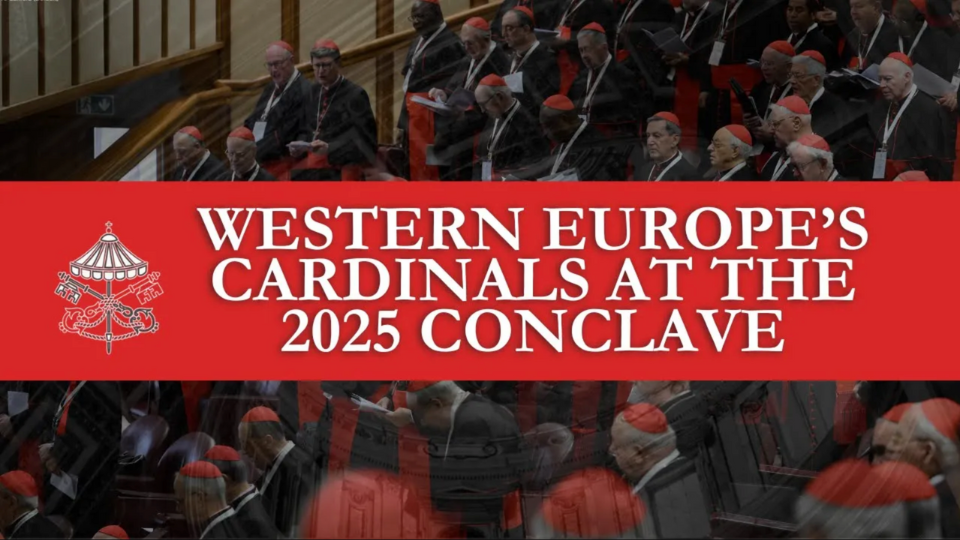
With over 100 cardinal electors present in the Vatican ahead of the Conclave, the Western European block stands out as the only group larger than the Italian contingent. The cardinals from Western Europe hail from countries grappling with demographic collapse, rising anti-Christian and anti-religious intolerance, challenges of immigration, and militant relativism.
SIGN UP FOR OUR NEWSLETTER HERE
Western European cardinals make up half of the European electors, with 27 electors and 46 non-electors. They come from 13 countries, with electors from 11 of them. The largest contingent comes from France and Spain, each with five electors, followed by Portugal with four, Germany with three, England with three, and Switzerland with two.
Among the French electors, the youngest is Conventual Franciscan Cardinal François Bustillo, 56, followed by Cardinal Jean-Marc Aveline, Archbishop of Marseille, who is 66. Other notable figures include Cardinal Dominique Mamberti, current head of the Apostolic Signatura—the Church’s highest court—at 73, Archbishop Emeritus of Lyon Cardinal Philippe Barbarin, 74, and Cardinal Christophe Pierre, Apostolic Nuncio to the United States, at 79.
Spain, the second largest contingent, also has five electors: Cardinal José Cobo Cano, Archbishop of Madrid, 59; Salesian Ángel Fernández Artime, 64; and three 79-year-olds—Cardinal Juan José Omella, Archbishop of Barcelona; Cardinal Antonio Cañizares Llovera, Emeritus of Valencia; and Cardinal Carlos Osoro Sierra, Emeritus of Madrid.
Portugal’s four electors include a noted poet, Cardinal José Tolentino Calaça de Mendonça, currently Prefect for Education. All four Portuguese electors were appointed by Pope Francis.
Germany’s three electors are well known internationally. Cardinal Rainer Maria Woelki of Cologne, 68, has faced criticism over his handling of abuse cases. Cardinal Reinhard Marx, Archbishop of Munich and Freising, 71, played a leading role in the controversial German Synodal Path, which was eventually rebuked by Pope Francis for its rejection of Church teaching. Cardinal Gerhard Müller, former Prefect of the Congregation for the Doctrine of the Faith, is a prominent critic of Pope Francis and the Synod on Synodality.
England also counts three electors. Dominican Cardinal Timothy Radcliffe, 79, is most known for preaching at the Synod on Synodality. Cardinal Arthur Roche, 75, Prefect for Divine Worship, is best known for implementing new restrictions around the Traditional Latin Mass. Cardinal Vincent Nichols, Archbishop of Westminster, is also 79.
Switzerland has two electors, including Cardinal Kurt Koch, 75, head of the Vatican Office for Christian Unity, renowned as a leader in ecumenical dialogue and Catholic-Jewish relations.
Other Western European countries with one elector each are Belgium, Luxembourg, Malta, the Netherlands, and Sweden. Belgium’s Archbishop Emeritus of Mechelen-Brussels, Cardinal Jozef De Kesel, is 77. Jesuit Cardinal Jean-Claude Hollerich, 66, Archbishop of Luxembourg, played a major role in the Synod on Synodality. Cardinal Mario Grech of Malta, 68, serves as the Synod’s Secretary General. Cardinal Wim Eijk, Archbishop of Utrecht in the Netherlands, 71, is noted for his defense of life and family. Carmelite Cardinal Anders Arborelius, 75, leads the Diocese of Stockholm in Sweden.
The Western European cardinals, representing traditional Catholic countries, have witnessed a decline in the Church’s influence and have expressed the urgent need to recapture a sense of Christian zeal in what many see as an increasingly pagan Europe.
Adapted by Jacob Stein