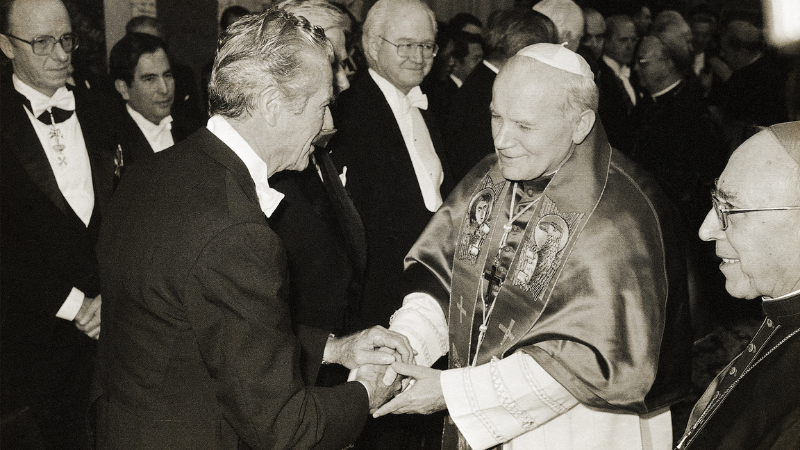
On July 25, 1968, St. Paul VI published Humanae Vitae, an encyclical on the regulation of birth and the dangers involved in the use of artificial contraceptive methods and their imposition as state policy. At the time the encyclical was rejected by many even within the Catholic Church.
The document, published at the beginning of the sexual revolution, continues to draw mixed reactions, which is why it’s necessary to take a closer look at five key points that allow us to better understand the encyclical, the context in which it was written, its prophetic message, and its validity even today.
1. It is ordinary, definitive, and irreformable magisterial teaching.
Various priests, theologians, and laypeople frequently claim the encyclical only belongs to the ordinary magisterium of a pope and that as such, its content could change with another pope who comes later. However, Humane Vitae has been reaffirmed by the pontiffs who succeeded Paul VI.
St. John Paul II went so far as to affirm that “what is taught by the Church on contraception does not belong to a matter freely disputable between theologians. Teaching the opposite is equivalent to misleading the moral conscience of the spouses.”
Furthermore, the Polish pope maintained that the Catholic doctrine on contraception belongs to the moral doctrine of the Church and that this has been proposed “with uninterrupted continuity” because it is “a truth that cannot be disputed.”
Therefore, the doctrine of an encyclical belongs to the ordinary magisterium, however, if it is exercised continuously and definitively, it is irreformable, even if it is not infallible.
2. Humanae Vitae is a prophetic encyclical.
Various notable Catholics have characterized the encyclical as “prophetic and still pertinent.”
In 1968, the discussion about the negative impact of artificial contraceptives was just in its infancy; however, the document not only meant a concrete response to the debate surrounding sexual ethics, “but it meant at the time, and still means, a refusal of the Church, clear and explicit, to bow to the proposals and demands of the sexual revolution,” as explained by the Spanish Bishops’ Conference.
In 2018, the late archbishop of Warsaw, Henryk Hoser, noted that the voice of St. Paul VI in Humanae Vitae has been shown to be prophetic about contraceptives, as he “predicted that their application would open the easy way to marital infidelity and the general decrease in births.”
Furthermore, the archbishop stressed that the encyclical is always relevant because conjugal love, “physical or spiritual, must combine these two dimensions” and that it must always be a love “free of selfishness.”
Similarly, Spanish priest Javier “Patxi” Bronchalo stated in 2022 that the document warned at the time about the increase in marital infidelity, moral degradation, the general loss of dignity of women, and ideological colonization through government policies.
3. The encyclical underwent significant changes before being published.
According to research by an Italian scholar at the Vatican Apostolic Archive, Humanae Vitae should have been originally published on May 23, 1968, but then St. Paul VI decided to publish it on July 25.
This measure was taken by the pope, despite the fact that the document was already printed in Latin under the title De Nascendae Prolis (Of Children to Be Born), because he considered that it was very dense in doctrine and that it was not pastorally adequate.
After some changes to the original document, Paul VI “took the entire pastoral section and added a series of very sensitive points that still reveal his imprint today.”
4. St. Paul VI consulted the bishops before publishing the encyclical.
Some accuse St. Paul VI of having published the encyclical Humanae Vitae without consulting the bishops. However, the Italian scholar’s research reveals the opposite. During the 1967 Synod of Bishops, the pope asked all prelates to share with him their position on the issue.
Of the almost 200 bishops participating in the synod, only 26 responded in the period from Oct. 9, 1967, to May 31, 1968. Of this group, 19 expressed themselves in favor of contraceptives and only seven against them.
Of these seven, the best known and most important were the venerable Archbishop Fulton Sheen and the then-archbishop of Krakow, Poland, Karol Wojtyla, who would become St. John Paul II, who always wanted to be remembered as “the pope of the family,” as Pope Francis stated during the canonization of the Polish pope in 2014.
The then-secretary of state, Cardinal Agostino Casaroli, said that “on the morning of July 25, 1968, Paul VI celebrated the Mass of the Holy Spirit, asked for light from on high and signed: He signed his most difficult signature, one of his most glorious signatures. He signed his own passion.”
5. Humanae Vitae promotes rational thinking about sexuality.
According to the Jesuit Bertrand de Margerie, being rational about sex does not evoke an indiscriminate and complete autonomy of the intimate life of the couple nor the use of artificial means to control births but rather the exercise of the virtue of chastity.
“The acquired virtue of chastity penetrates with reasonableness the exercise of sexual life when the latter is legitimate,” the Jesuit priest wrote, citing St. Thomas Aquinas in the Summa Theologica.
“By encouraging periodic continence and the regulation of births without artificial control, Paul VI rightly exalts a humble and complete rationalization of the sexual sphere subjected to the knowledge of human reason and to the control of freedom helped by grace,” the priest pointed out.
“He does not appeal to instincts,” the Jesuit explained, “which are common to men and to other animals and which are deprived of reason, but he appeals to man’s freedom, through which man resembles pure spirits such as angels are.”
This article was originally published by CNA.