Authoritarian regimes are among the main drivers of religious discrimination and persecution in 52 countries, according to an Aid to the Church in Need (ACN) report.
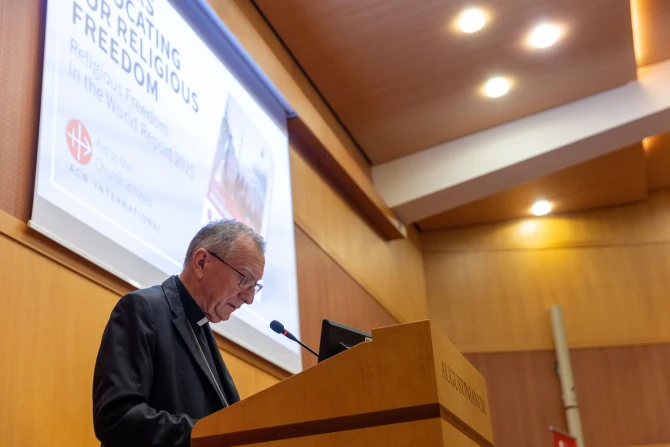
The pontifical foundation, alongside Vatican Secretary of State Cardinal Pietro Parolin, released the Religious Freedom in the World Report 2025 at the Vatican on Tuesday, highlighting the need for the Church to bear witness to the millions of people who face threats of persecution and violence.
The cardinal decried the “year on year” increase of violations affecting more than 5.4 billion people worldwide at the report’s launch and stressed the need for governments to acknowledge religious freedom as an “inalienable right,” as asserted by both the Second Vatican Council document Dignitatis Humanae and Article 18 of the U.N. Universal Declaration of Human Rights.
“Men and women everywhere deserve freedom from any form of compulsion in matters of faith — whether that be subtle social pressures or overt state mandates,” Parolin said at the Oct. 21 report launch at the Augustinian Patristic Pontifical Institute in Rome.
The 2025 biennial report, which provides a global overview of the state of religious freedom affecting all faith communities in 196 countries from January 2023 to December 2024, found that governments in 52 countries employ “systematic strategies to control or silence religious life.”
“In China, Iran, Eritrea, and Nicaragua, authorities use mass surveillance technologies, digital censorship, restrictive legislation, and arbitrary detention to suppress independent religious communities,” the ACN press release stated.
During the report launch, ACN Editor-in-Chief Marta Petrosillo said that authoritarian regimes present in parts of Latin America and Asia have attempted to “erase religious identity” by shutting down churches, preventing or banning religious education, and even renaming entire villages.
“In North Korea, the regime criminalizes all belief, punishing worship with imprisonment, torture, or even execution,” she said.
“In Nicaragua, the government has taken extreme measures to silence the Church — a religious group has lost its legal status, and public worship and religious services have been banned,” she added.
Other key factors driving religious freedom violations identified in the report include jihadism and religious nationalism across Africa and Asia, and armed conflicts, forced migration, and organized crime affecting countries in Africa, Asia, Europe, the Middle East, and the Americas.
ACN also noted the erosion of religious freedom in Europe and North America, reporting increased incidences of attacks on places of worship, assault of clergy, and disruption of religious services in France, Spain, Italy, Greece, and the U.S.
This article was originally published by CNA.