Two Vatican departments issued a joint statement Thursday on the “doctrine of discovery” and the dignity and rights due indigenous peoples.
The statement said the legal concept of the “doctrine of discovery” is “not part of the teaching of the Catholic Church” and historical research shows certain papal documents “written in a specific historical period and linked to political questions, have never been considered expressions of the Catholic faith.”
“In no uncertain terms, the Church’s magisterium upholds the respect due to every human being,” the document said. “The Catholic Church therefore repudiates those concepts that fail to recognize the inherent human rights of indigenous peoples, including what has become known as the legal and political ‘doctrine of discovery.’”
The joint Vatican statement was published March 30 by the Dicastery for Promoting Integral Human Development and the Dicastery for Culture and Education.
It said the Church is committed to listening to indigenous peoples and fostering efforts for reconciliation and healing. In this context the Church heard the need to address the so-called “doctrine of discovery,” it added.
People from indigenous communities in Canada had urged Pope Francis last year to rescind the “doctrine of discovery.”
“The legal concept of ‘discovery’ was debated by colonial powers from the sixteenth century onward and found particular expression in the nineteenth century jurisprudence of courts in several countries, according to which the discovery of lands by settlers granted an exclusive right to extinguish, either by purchase or conquest, the title to or possession of those lands by indigenous peoples,” the Vatican explained.
“Certain scholars have argued that the basis of the aforementioned ‘doctrine’ is to be found in several papal documents, such as the Bulls Dum Diversas (1452), Romanus Pontifex (1455) and Inter Caetera (1493),” it continued.
While the statement said these papal documents are not considered expressions of the Catholic faith, it added that “the Church acknowledges that these papal bulls did not adequately reflect the equal dignity and rights of indigenous peoples.”
“the Church is also aware that the contents of these documents were manipulated for political purposes by competing colonial powers in order to justify immoral acts against indigenous peoples that were carried out, at times, without opposition from ecclesiastical authorities,” the document said. “It is only just to recognize these errors, acknowledge the terrible effects of the assimilation policies and the pain experienced by indigenous peoples, and ask for pardon.”
The note also pointed out that there are numerous statements by the Church and popes upholding the rights of indigenous people, such as the 1537 bull Sublimis Deus by Pope Paul III, who wrote, “We define and declare [ … ] that [, .. ] the said Indians and all other people who may later be discovered by Christians, are by no means to be deprived of their liberty or the possession of their property, even though they be outside the Christian faith; and that they may and should, freely and legitimately, enjoy their liberty and possession of their property; nor should they be in any way enslaved; should the contrary happen, it shall be null and have no effect.”
The prefect of the Dicastery for Culture and Education, Cardinal José Tolentino de Mendonça, said in a separate note that the Vatican statement was part of an “architecture of reconciliation.”
He described the art of reconciliation as “the process whereby people commit to listening to each other, to speaking to each other and to growth in mutual understanding.”
The insights informing the statement, he added, are the fruit of a renewed dialogue between the Church and indigenous peoples.
“It is in listening to indigenous peoples that the Church is learning to understand their sufferings, past and present and our own failings. It is in cultural dialogue that we are committed to accompanying them in the search for reconciliation and healing. We have to live out the art of encounter,” the cardinal said.
The joint statement said “the Catholic Church strives to promote universal human fraternity and respect for the dignity of every human being” in fidelity to Christ’s mandate, and that is why Catholic popes throughout history “have condemned violence, oppression, social injustice, and slavery, including those committed against indigenous peoples.”
“There have also been numerous examples of bishops, priests, women and men religious and lay faithful who gave their lives in defense of the dignity of those peoples,” it said.
“At the same time,” it added, “respect for the facts of history demands an acknowledgement of the human weakness and failings of Christ’s disciples in every generation. Many Christians have committed evil acts against indigenous peoples for which recent popes have asked forgiveness on numerous occasions.”
According to the statement, in recent years, a renewed dialogue with indigenous peoples, including Catholic indigenous, has helped the Church to better understand their values, cultures, as well as past and present sufferings.
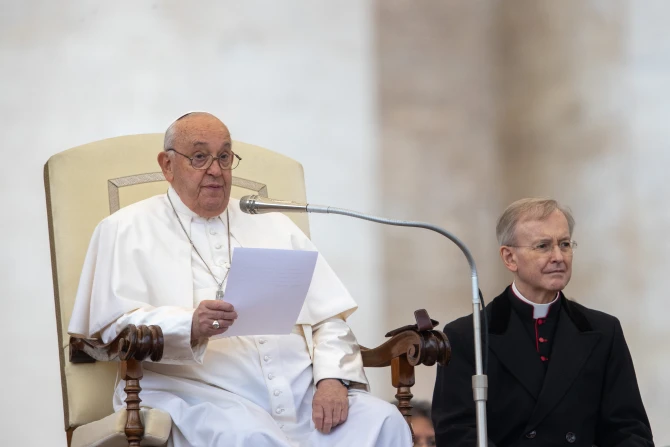
“As Pope Francis has emphasized, their sufferings constitute a powerful summons to abandon the colonizing mentality and to walk with them side by side, in mutual respect and dialogue, recognizing the rights and cultural values of all individuals and peoples. In this regard, the Church is committed to accompany indigenous peoples and to foster efforts aimed at promoting reconciliation and healing,” the document said.
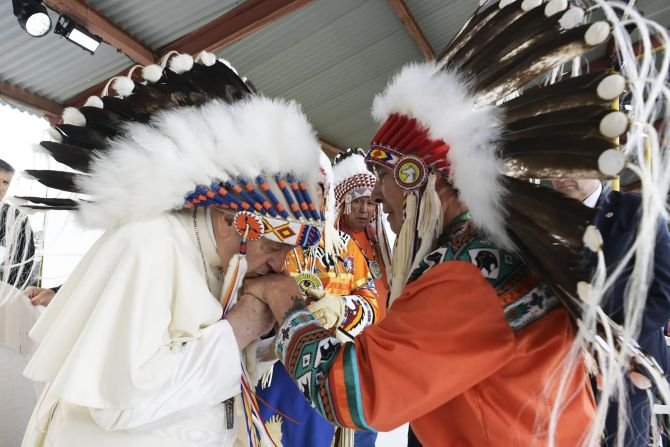
During a July 2022 visit to Canada, Pope Francis asked for forgiveness for the harm done to indigenous Canadians by Catholics.
“I express my deep shame and sorrow, and, together with the bishops of this country, I renew my request for forgiveness for the wrong done by so many Christians to the indigenous peoples,” the pope said in a July 27, 2022 address, citing the Catholic Church’s role in running many of the country’s government-sponsored residential schools for indigenous children.
The encounter with top government officials and representatives of the indigenous peoples in Canada was part of a week-long “penitential pilgrimage” in which Francis also publicly apologized for the harm done to indigenous Canadians and repeatedly expressed his shame and sorrow.