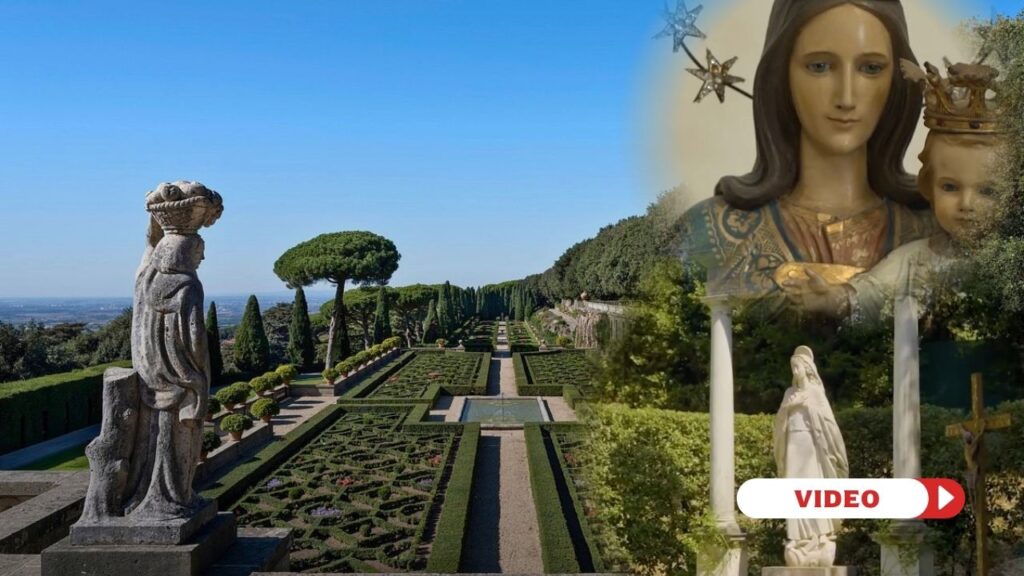
Castel Gandolfo is not officially a Marian shrine, yet it carries a deep Marian identity. From the celebration of the Assumption to the Madonnina of Borgo Laudato Si’, the Pope’s summer residence remains a place where prayer and devotion to Mary shape the life of the town.
The Assumption at Castel Gandolfo
While Castel Gandolfo is not a Marian shrine, it has a deep Marian identity. Every 15 August, the town comes alive as the Pope joins pilgrims and locals in celebrating the Assumption, one of the Church’s most important Marian solemnities.
Inside the church of St. Thomas of Villanova, the only pontifical parish outside the Vatican, a remarkable painting depicts the dogma at the heart of the feast.
“The painting dates back to the 1600s and depicts the Virgin Mary being assumed into heaven,” explains Irene Benedetti, historian and tour guide. “The apostles went to her tomb, but when they opened it, her body was no longer there. At that moment, Mary appeared in heaven, body and soul — which is precisely what the dogma teaches. This belief had always been present in the consciousness of Christians, and was later formally defined by the Church. It is a devotion that has always been connected to this church, also because the Mass of the Assumption is celebrated here by the Pope.”
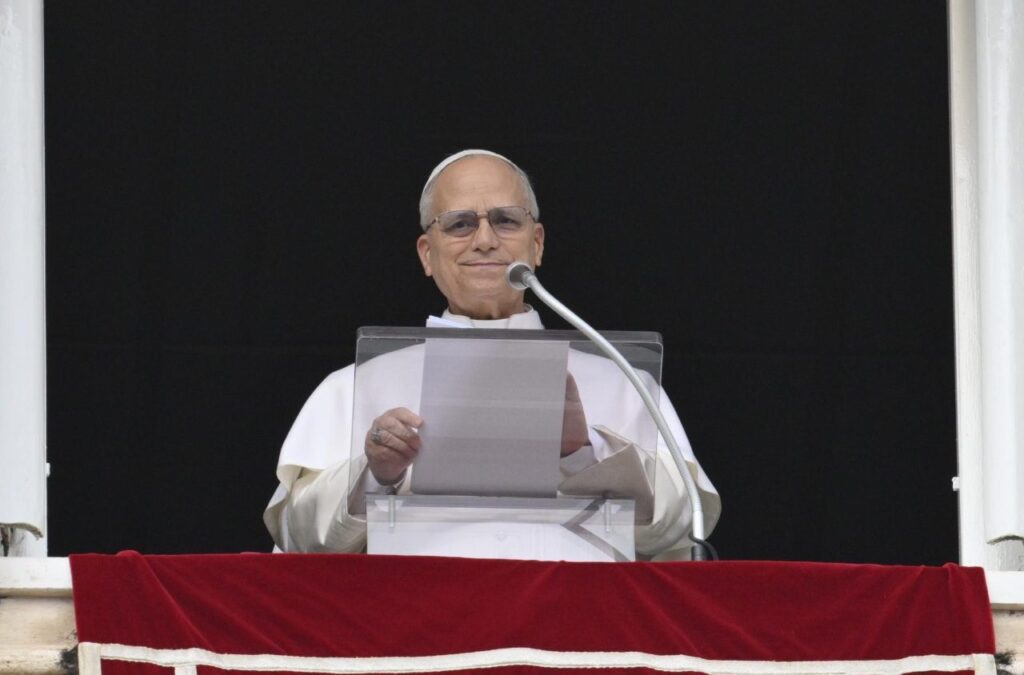
To the great joy of the town’s residents and the faithful, Pope Leo XIV restored the historic tradition of spending part of the summer at the official summer residence of the Pontiffs.
Last summer marked the first time Pope Leo celebrated the Assumption in Castel Gandolfo, an experience the parish priest recalled as deeply moving.
“From early this morning there were crowds of people here in the square, waiting,” says Father Tadeusz Rozmus, parish priest of the pontifical parish of St. Thomas of Villanova. “They remained in silence, in this expectation of the Pope’s arrival. When he appeared, the enthusiasm, the joy that erupted, it was something beautiful.”
Mary Assumed into Heaven, Our Destiny in Christ
In his homily, the Holy Father highlighted how celebrating the Assumption is another way to celebrate the Paschal Mystery of Jesus.
“When in this life we choose life, we are right to see in Mary, assumed into heaven, our own destiny,” Pope Leo XIV said. “She is given to us as the sign that the Resurrection of Jesus was no isolated event, no mere exception. In Christ, we, too, can swallow up death.”
Beyond being one of the pontifical parishes, the church also carries the name of a saint with special significance for the Pope: St. Thomas of Villanova. The 16th-century bishop, who lived during the time of the Council of Trent, was also an Augustinian. Pope Leo XIV even carries a relic of the saint in his pectoral cross.
The church holds special importance not only for the Augustinians, but also for the Salesians, who have served the parish for many years.
“The church has existed since around 1650, when it was built,” Father Rozmus explains. “At that time the Augustinians served here as a religious community until the Salesians were invited by Pope Pius XI in 1926. Since then, the Augustinians moved to Rome, to the parish of Saint Anne, and we have been here. So this connection between the Augustinians and the Salesians is, I think, something special.”
Mary Help of Christians and the Madonnina
Thanks to the different religious traditions connected to the church, another Marian devotion can be found inside: Mary Help of Christians, especially dear to Salesian spirituality.
“Another Marian devotion in the church is that of Mary Help of Christians,” Benedetti says, “because the priests serving here are Salesians and this devotion is particularly connected to their spirituality. The cult of Mary Help of Christians was greatly spread thanks to Don Bosco. There is also a statue of Mary Help of Christians in the church, whose feast is celebrated on 24 May — the same date on which the encyclical Laudato Si’ was published.”
Inspired by the vision of Pope Francis and his encyclical Laudato Si’, the Castel Gandolfo gardens now also offer visitors a space to pray and deepen their connection with Creation.
Manuel Dorantes, Management Director of Borgo Laudato Si’, explains: “People who care for the environment don’t necessarily care about the poor and issues of justice. People who care about justice don’t necessarily care about God or spirituality. They care about individuals. People who care about spirituality may not care about the environment. And so with Pope Francis, the Church’s angle with Laudato Si’ is that everything needs to be reconnected.”
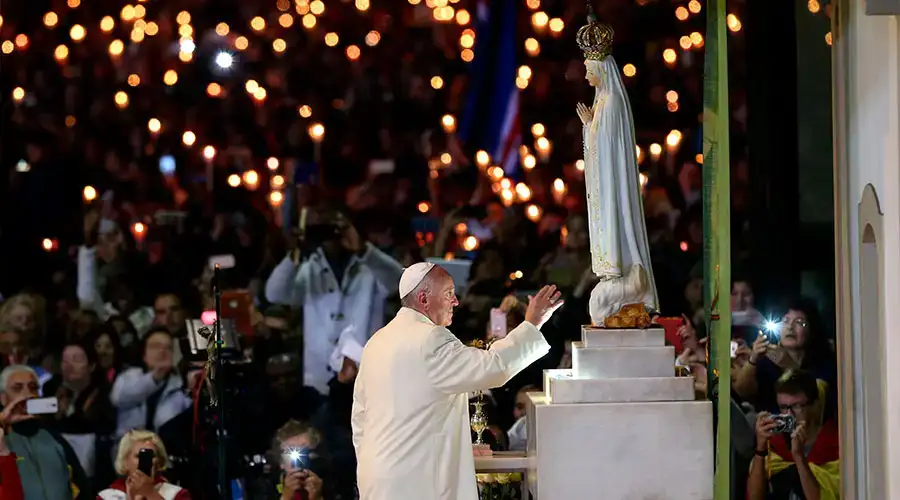
Open to the public, the gardens invite visitors to pray before the Madonnina, a statue of the Little Madonna where, according to tradition, various Popes have brought the burdens of the Church before Mary, Mother of the Church.
“The Madonnina is an image of Our Lady, the Immaculate Conception, that recalls the theology of Revelation, of the woman who crushes the serpent,” Dorantes says. “What an image is given to us! It reminds us that she is the new Eve. As we know, creation and what our forefathers, Adam and Eve, did in disobeying God led to the exploitation of human beings and of creation. Mary presides over this aspect of Borgo Laudato Si’. Mary, who is the Immaculate Conception, who steps over evil, who is the new Eve in creation, shows us a new path to take care of what God has given us.”
The Marian heart of Castel Gandolfo is quiet but profound. It lives in the Assumption, in the devotion of the pontifical parish, in the Salesian love for Mary Help of Christians, and in the prayer before the Madonnina — where the burdens of the Church are entrusted to the Mother of God.