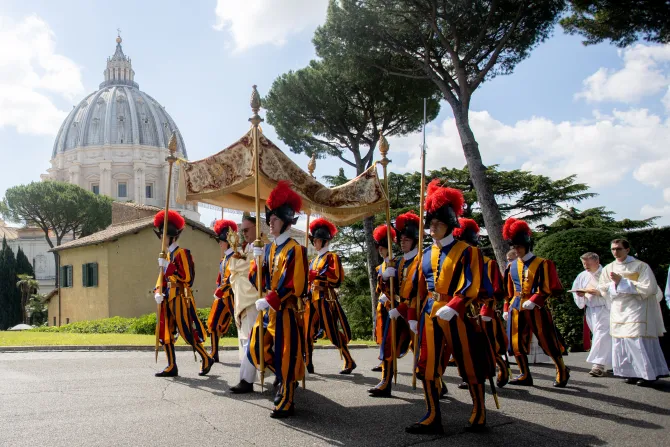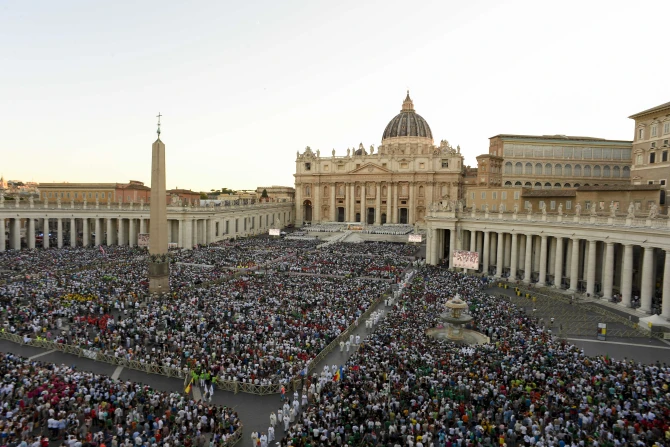
The Vatican has included a pilgrimage by the Society of St. Pius X (SSPX) on its official calendar for the 2025 Jubilee Year, despite the traditionalist Catholic group’s historically fraught relationship with the Holy See.
The SSPX, founded in 1970 by Archbishop Marcel Lefebvre in Ecône, Switzerland, to preserve traditional Catholic practices amid the reforms of the Second Vatican Council (1962–1965), will hold a solemn high Mass and a procession to the Basilica of St. John Lateran on Aug. 20.
In preparation for the pilgrimage to Rome, the SSPX began a novena to the Immaculate Conception from Aug. 11–19.
The SSPX, led by Superior General Father Davide Pagliarani, views the pilgrimage as an act of fidelity to “Eternal Rome,” emphasizing its commitment to traditional liturgy, as stated in a 2024 letter by U.S. District Superior Father John Fullerton.
“Our main focus is the priesthood and its greatest treasure: the holy sacrifice of the Mass,” the SSPX website states.
The group’s inclusion during a jubilee year of celebration and forgiveness held every 25 years reflects efforts of the Church over the years to reconcile with the group amid the SSPX’s canonically irregular status.
The SSPX’s troubled history with the Vatican began with Lefebvre’s dissent from Vatican II’s changes, particularly in ecumenism and collegiality, “which insisted that the Church be ruled primarily by the democratic process and bishops’ conferences, limiting the power of the pope as sole head of the universal Church as well as each individual bishop’s autonomy within his own diocese,” according to the group’s website.
Lefebvre’s 1988 consecration of four bishops without papal approval led to his excommunication and that of the bishops, deemed a “schismatic act” by Pope John Paul II, rendering the SSPX canonically illegitimate.
Although Pope Benedict XVI lifted the excommunications in 2009, the group remains outside full communion with the Church.
However, recent Vatican concessions signal openness to dialogue. Pope Francis granted SSPX priests the faculty to hear confessions validly in 2015 (extended indefinitely post-2016) and authorized diocesan oversight for valid SSPX marriages in 2017.
The inclusion of the SSPX’s pilgrimage in the jubilee calendar stops short of full regularization. However, Jimmy Akin of Catholic Answers told CNA in 2024 that the lifting of excommunications implies the SSPX is not in formal schism.
But the priests of the society are “celebrating Mass without the proper permissions, creating a canonically irregular situation,” Akin said.
Monsignor Camille Perl of the Pontifical Commission Ecclesia Dei noted in 1998 that Catholics should avoid SSPX Masses unless no alternatives exist due to the group’s “schismatic mentality.”
Akin pointed out, however, that the Code of Canon Law stipulates that Catholics “can participate in the Eucharistic sacrifice and receive holy Communion in any Catholic rite.” Since SSPX is using the approved 1962 rite of the Mass, “the faithful can attend it and receive holy Communion.”
“The fact it is being celebrated in a canonically irregular situation does not change this,” Akin said.
He pointed out that “every time a priest commits a liturgical abuse, it creates a canonically irregular situation” but that the Church “does not want the laity to have to judge which canonically irregular situations involve ‘too much’ of a departure from the law.”
Thus the faithful’s “right to attend and receive holy Communion in any Catholic rite is protected.”
The SSPX claims it now numbers 720 priests and close to half a million faithful spread throughout the world. It hosts a number of growing ministries, including retreats and summer camps for children.
SIGN UP FOR OUR NEWSLETTER HERE
This article was originally published on Catholic News Agency.