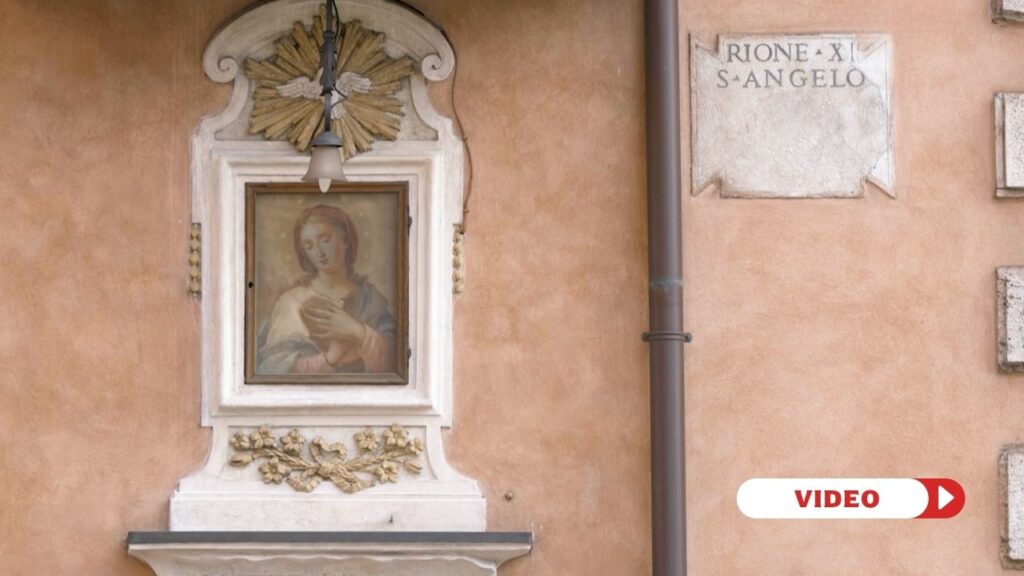
Rome’s streets, squares, and narrow alleyways are home to more than 500 Marian street shrines, known as the Madonnelle. Painted, frescoed, or sculpted, these sacred images have long been woven into the city’s spiritual and cultural identity, serving as places of prayer, gratitude, and quiet encounter.
Some passersby pause for a moment of reflection; others light candles or leave ex-votos in thanksgiving. Together, these small yet powerful signs of devotion form a living tradition that continues to shape daily life in the Eternal City.
Discovering the Madonnelle of Rome
EWTN Vatican correspondent Veronica Giacometti joined Fr. Giorgio Picu of Opera Romana Pellegrinaggi for a walking tour through Rome, beginning at a historic roadside shrine.
“We have chosen this spot… because here we find ourselves before an icon of the Madonna,” Fr. Picu explained, noting the Latin inscription entrusting one’s life to the Madonna of Mercy.
In centuries past, this location served as a place where travelers changed horses before continuing their journey. “When you set out on a journey, you never knew whether you would arrive or not,” he said. Entrusting oneself to Mary was both an act of devotion and a plea for protection.
“Searching for Mary Throughout Rome”
The abundance of these shrines has given rise to a well-known Roman expression.
“‘Searching for Mary throughout Rome’… is exactly the opposite” of looking for a needle in a haystack, Fr. Picu said. “There are too many.”
Indeed, Marian images can be found on nearly every corner, reflecting a deep-rooted الشعبي devotion that spans centuries.
Marian Images and the Life of the Church
In the Parione district, one particular shrine—the Madonna of Pentecost—offers a unique depiction of Mary among the Apostles.
“Here… we have the Madonna among the Apostles on the day of Pentecost,” Fr. Picu explained. The image highlights not only devotion to Mary, but also the action of the Holy Spirit and the birth of the Church.
It also serves as a reminder of Rome’s unique identity as the seat of the Successor of Peter, a presence that continues to shape the city’s spiritual character.
Three Shrines, One Square
In one Roman square, three distinct Marian images reveal different theological and artistic traditions.
- The Mater Dolorosa, a marble sculpture of the Sorrowful Mother, reflects the universal experience of suffering and loss.
- A Baroque Hodegetria portrays Mary pointing toward Christ, “the way, the truth and the life.”
- A mosaic inspired by Eastern spirituality illustrates the “descending and ascending path,” symbolizing the mystery of the Incarnation and humanity’s return to God through Mary.
Together, these works highlight the richness of Marian devotion across cultures and centuries.
Miraculous Madonnas and Living Faith
Many of Rome’s Madonnelle are also linked to miraculous events in popular tradition. Some are said to have wept or protected neighborhoods during times of crisis, including epidemics and natural disasters.
Fr. Picu described one such image: “This one moved its eyes and changed its gaze towards the faithful… before the Napoleonic laws arrived in Rome.”
The event, dated to 1794, is documented and remains a source of local devotion, reinforcing the belief in Mary’s protective presence over the city.
Quiet Witnesses of the Eternal City
While Rome is renowned for its grand basilicas and ancient monuments, it is often the smaller, easily overlooked details that speak most intimately to the faith of its people.
The Madonnelle, humble yet enduring, continue to watch over the city—silent witnesses to centuries of prayer, hope, and trust in the intercession of the Blessed Virgin Mary.
Meta description:
Explore Rome’s Madonnelle—over 500 Marian street shrines that reveal centuries of devotion, miracles, and the enduring presence of Mary in the Eternal City.
Adapted by Jacob Stein