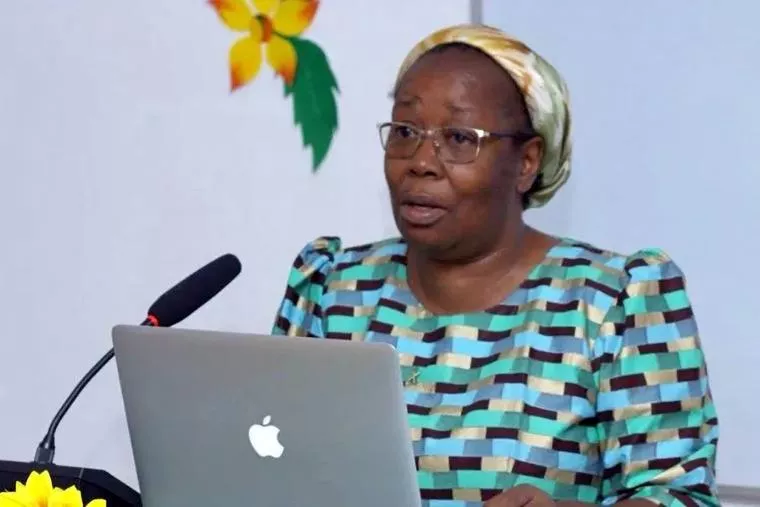
Congolese Sister Josée Ngalula did not participate in drafting the controversial section of the final report, despite being a member of the study group.
The lone African member of a Vatican study group that published a controversial text on homosexuality in its final report did not participate in its drafting, raising further questions about the document’s representativeness and relevance.
Sister of St. Andrew Josée Ngalula, a Congolese theologian and member of Synod Study Group 9, told the Register that she “refuses to enter into the debate regarding homosexual persons” because “this is not a major pastoral issue in my community.”
“I leave it to those for whom this is a ‘major’ issue to discuss it among themselves,” she said via email in her native French.
Instead, Sister Josée said she focused “solely” on the text’s consideration of active non-violence — addressed in a separate section of the report — which was consistent with her “African context, shaped by wars and various other circumstances that inflict human suffering and challenge the conscience.”
The revelation that Sister Josée, a member of the International Theological Commission who has previously spoken out against “the ideology of sexual orientation,” did not contribute to the controversial section places further scrutiny on the text and its drafting process.
The text in question, a section of the study group’s “final report” that focused on the “experiences of people of faith with same-sex attractions,” has been criticized for downplaying the sinfulness of homosexual relations and for questioning whether Church teachings on sexual morality can ever be considered definitive.
“This is simply false,” said the Dutch Cardinal Wim Eijk in a commentary for the Register. “The intentions with which God created the human person in the context of marriage and sexuality are universal truths, established once and for all, that human beings can know spontaneously through natural moral law, and can be found in Sacred Scripture.”
Process Under Scrutiny
Prior to Sister Josée disclosing that she did not participate, the drafting process of Study Group 9’s treatment of homosexuality has already been criticized for being inconsistent with synodality, which encourages listening widely.
For instance, the section on homosexuality included criticism of the Catholic apostolate Courage International in the testimony of a man who identifies as gay, but no members of Courage were themselves consulted in drafting the report.
“Since no Courage representative was involved in the process, the study group became problematic and seems to contradict what synodality intends: the greater engagement of all relevant voices,” Father Brian Gannon, Courage International’s executive director, recently told the Register.
Additionally, several members of Study Group 9, which was originally charged with proposing a synodal method for addressing “controversial doctrinal, pastoral, and ethical issues,” are known for promoting controversial approaches to moral theology, including on sexual issues.
Italian moral theologian Father Maurizio Chiodi, for instance, has argued that contraception can be morally permissible for married couples in some circumstances based on Amoris Laetitia (“The Joy of Love”), and that homosexual relationships “under certain conditions” could be “the most fruitful way” for those with same-sex attractions to form good relationships; moral theologian and Jesuit Father Carlo Casalone has suggested that moral absolutes taught by the Church must be subjected to the interpretation of conscience; and Cardinal Carlos Castillo Mattasoglio of Lima, Study Group 9’s coordinator, has been hailed by LGBTQ-advocacy groups as “open” to changes on the issue.
The other members of Study Group 9 include Archbishop Filippo Iannone, an Italian canon lawyer whom Pope Leo XIV made the prefect of the Dicastery of Bishops; Father Piero Coda, a dogmatic theologian and the secretary-general of the International Theological Commission; and Stella Morra, a fundamental theologian who teaches at the Pontifical Gregorian University in Rome.
The study group’s final report does not indicate which of its seven members participated in the drafting of different sections of the 32-page document. The synod office did not respond to questions from the Register seeking clarity on the matter.
African Voices Absent?
Although she did not contribute to the controversial section on homosexuality, Sister Josée has spoken out on the topic before. While in Rome in October 2023 for the Synod on Synodality, she described campaigns to legitimize same-sex relations as “against my African culture and against the Bible.”
“I will never support an opinion that encourages these ideologies of sexual orientation: never, never,” she told the Register at the time.
Regarding the 2026 final report, Sister Ngalula did not respond to follow-up questions about whether the section on homosexuality is weakened by not including a perspective from Africa, given that it proposes solutions that seem universal in nature, such as “deepening our understanding” of “the meaning of homosexuality from the perspective of biblical anthropology.”
But the Congolese theologian’s refusal to contribute to the section on homosexuality underscores the significant divide between African Catholics and those Catholics in the West advocating for greater acceptance of same-sex relations.
At the Synod on Synodality session in 2023, African participants and others pushed back against perceived efforts to soften the Church’s prohibition of same-sex relations, and the term “LGBTQ” was left out of the final report. Later that year, Pope Francis’ document authorizing blessings of persons in same-sex couples, Fiducia Supplicans (“Supplicating Trust”), sparked outrage across the African continent, prompting several clarifications from the Vatican.
African theologians and prelates have suggested that if synodality does not adequately incorporate the perspectives of Africa and the global south, it “runs the risk of being reduced to a slogan.”
“Will the south be allowed to speak? Will the north listen to the south?”, the Nigerian theologian and Dominican Father Anthony Akinwale asked rhetorically in the lead-up to the 2024 synod session.
More broadly, the synodal processes have raised concerns about the possibility of highly-engaged lobbying groups manipulating the process and disproportionately shaping perceptions of what faithful Catholics believe.
Along with all the final documents of the Synod’s study groups, Group 9’s report will be reviewed by relevant Vatican dicasteries and the General Secretariat of the Synod to draw up “operative proposals” at the Holy Father’s request, according to Vatican News. Pope Leo XIV will then evaluate the proposals emerging from the study groups and “may,” the Vatican says, “approve them.”
This article was originally published by EWTN News English.