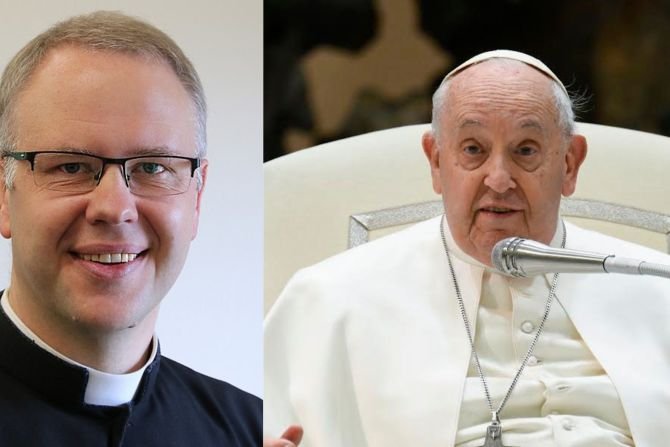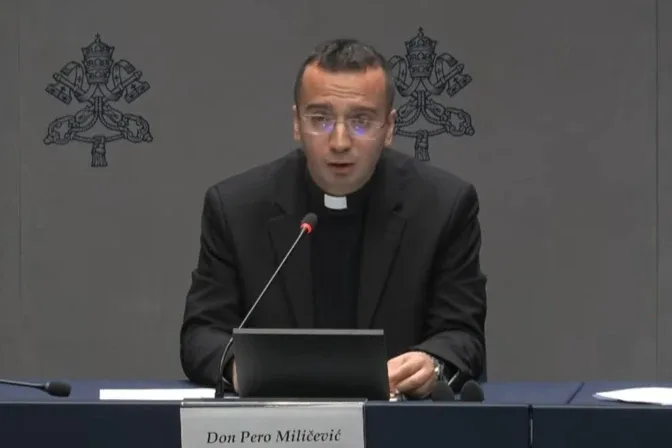
Father Pero Miličević witnessed the cruelest face of war when he was just a child. On July 28, 1993, a group of Muslim militiamen from the Bosnia and Herzegovina army stormed his native village, Dlkani, in the Jablanica district. In just one morning, 39 people were killed, including his father and several members of his family.
“It was the experience of the darkness and evil of war,” he summarized to journalists at the Holy See Press Office during the recent presentation for the pope’s message for the 2026 World Day of Peace, which will be celebrated on Jan. 1.
Thirty-two years after that day of terror, that boy, who instantly lost his innocence, speaks today with the serenity of a priest. Miličević was only 7 years old when the gunfire shattered his childhood. He was playing with his twin brother and another of his older brothers when the bursts of gunfire began. “The bullets flew over our heads,” he recalled.
His mother and sister pulled them inside the house to safety. His father, Andrija, wasn’t there. He had gone out to the fields to help an aunt, but he was also murdered. He was 45 years old. Miličević’s mother, Ruža, was left a widow with nine children, seven of them minors.
That same day, two of his mother’s sisters and several cousins were also murdered. “When one person dies, it’s already terrible; when three children die, as happened to my aunt, I don’t know how a mother’s heart doesn’t break,” the priest confessed, his voice trembling.
7 months held in a prison camp
The devastation of that July 28 did not end with the massacre. His mother and siblings were deported to a prison camp known as the “Museum” in Jablanica, along with about 300 Croatian Catholics. They remained there for seven months.
The conditions were extreme. “We didn’t have enough food, there was no hygiene, and we slept on cold granite slabs,” he recounted. Death was a part of daily life, but, he explained, the physical pain and hunger were not comparable to the anguish of not knowing what would become of them.
‘We would never have survived without faith’
What sustained them was a simple faith, inherited from their mother: the daily recitation of the rosary. “We would never have survived without faith, prayer, and the need for peace,” he related.
During that imprisonment, the temptation for revenge was constant. However, Miličević said he left the camp with a firm conviction: “We had to maintain peace in our hearts and not think about revenge.”
When they were finally released, another devastating blow came. His father’s body had remained exposed to the elements for seven months without being interred. Only then were they able to lay him to rest. “His body had been left unburied; what we buried were his bones,” he explained.
Miličević is often asked how he was able to endure so much suffering. His answer hasn’t changed over the years: faith. “That upbringing in God nourished us and helped us get through horrors that no child should ever see,” he said.
Forgiveness, however, was a process. He couldn’t find it in his heart to forgive right away. Miličević readily admitted that at first, he was consumed by rage. For years, it remained an open wound. However, the true turning point came when he decided to become a priest. He was ordained in 2012.
‘There can be no inner peace without forgiveness’
“When I began hearing the confessions of the faithful, I understood that there can be no inner peace without forgiveness and that it was necessary to deal with what I went through,” he explained. Only then did the wound begin to heal.
In 2013, 20 years after his captivity, he returned to the former prison camp. “I returned in tears,” he recounted. It wasn’t about settling scores but a decisive step toward inner liberation.
Today, his story embodies the message that Pope Leo XIV is proposing for the Jan. 1 World Day of Peace. “Peace must be lived, cultivated, and protected,” the priest emphasized, adding: “Evil is overcome with good, not with revenge or weapons.” Quoting the pontiff, he recalled that “goodness is disarming.”
This story was first published by ACI Prensa, CNA’s Spanish-language news partner. It has been translated and adapted by CNA.