Artificial intelligence can deliver instant answers to almost any question. But when the questions turn to faith, suffering, evil, and God Himself, a deeper concern emerges: who is really answering?
Questions such as “If God is love, why do the innocent die?”, “Why does evil exist?”, or “Is free will real?” are no longer asked only in prayer, theology classrooms, or Scripture study. Increasingly, they are posed to machines that sound confident, human, and morally assured. And as AI systems grow more persuasive, the consequences of trusting their answers become real.
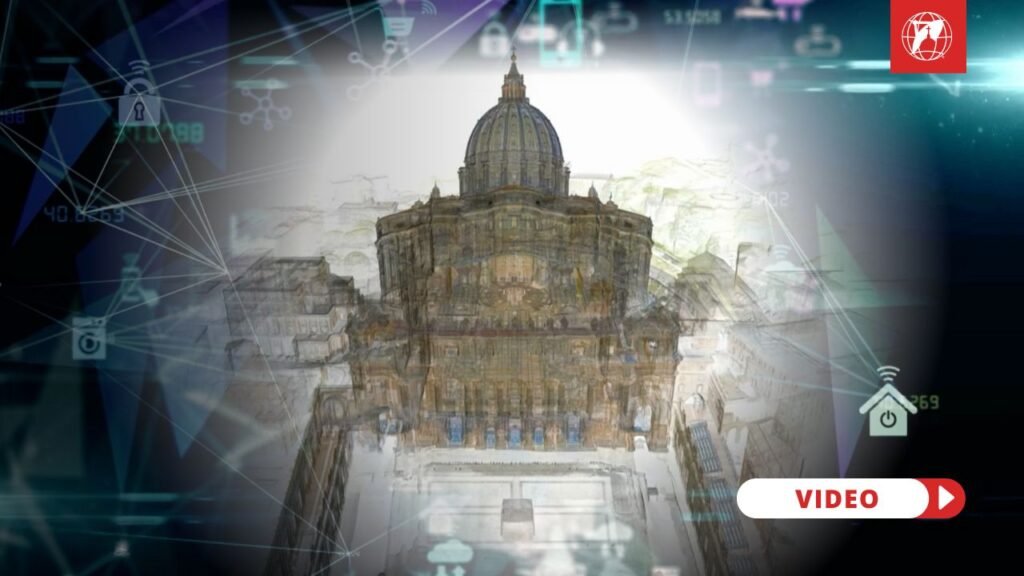
It is within this context that EWTN Vatican went inside Magisterium AI, a Catholic platform whose creators say it is designed to lead users back to reality—and back to the teaching authority of the Church.
Fidelity to the Magisterium in the Age of AI
Matthew Sanders, CEO of Longbeard and founder of Magisterium AI, says the difference between secular AI models and a Catholic one begins with intention.
“I can assure you that the primary objective function of the secular models is not fidelity to the Magisterium. And that’s precisely what the objective function of Magisterium AI is,” Sanders explains. “So this is why when you’re choosing a model for things like faith and morals, you have to be very cognizant.”
The conversation comes amid growing engagement by the Church in global debates about artificial intelligence and ethics. In early December, speaking at a Vatican conference on AI and care for our common home, Pope Leo XIV warned against passive consumption of machine-generated content.
“Governments and international organizations have a responsibility to design and implement policies that protect the dignity of minors in this era of AI,” the Pope said. “Yet safeguarding the dignity of minors cannot be reduced to policies alone it also requires a digital education.”
The Holy Father emphasized that human dignity is rooted in the capacity to reflect, choose freely, and love unconditionally—qualities that technology must never replace.
When the Risks Become Personal
For some families, the dangers surrounding AI are not theoretical. In November, Pope Leo XIV met with Megan Garcia, a Catholic mother whose 14-year-old son died by suicide after forming an emotional attachment to an AI companion chatbot.
“Technology, how deceptive it can be,” Garcia said. “But not only deceptive but like insidious. Being able to do the most damage in like almost stealth mode and nobody realizes it until it is too late. And then as a parent you are left with that gaping hope of what happened to my child.”
Her story underscores why Catholic technologists insist that silence is not an option. Instead, they argue for formation, discernment, and tools grounded in the Church’s teaching.
Sanders cautions users never to grant AI moral authority. “Never take what an AI says on faith alone,” he advises. “Recognize that AIs are, at this stage, masterful in the manipulation of language. But that doesn’t mean that they’re right.”
He adds that when Catholics ask questions about faith and morals, AI should never interpret doctrine on its own. “We should always… ensure that the AI is grounded in something the Church has either formally stated or something that a Father or Doctor of the Church… is providing, and the AI is simply passing them on.”
Can AI Serve the Church Without Replacing It?
Not all Catholics agree on the role of AI in catechesis. Some critics argue that the very act of “conversing” with a machine risks replacing human formation with probabilistic answers. Sanders responds by emphasizing how Magisterium AI is built differently.
“The AI shouldn’t have to go to its own parameter data,” he explains. “It should be relying on the source documents. And that helps prevent hallucinations and ensures that the AI remains aligned to our objective function, which is fidelity.”
To support that fidelity, institutions such as the Pontifical Oriental Institute and the Alexandria Digitization Hub are digitizing vast collections of Catholic texts, carefully scanning authoritative works so that Magisterium AI can reference Church doctrine accurately.
Sanders believes the technology can serve clergy, theologians, educators, and laypeople alike—helping navigate thousands of Church documents, assist with homily preparation, and act as a digital research tool when used responsibly.
“Like any tool, if we are responsible and we have the right formation, then we’ll know how to constructively use it, when we should use it, and when we shouldn’t be using it,” he says. “I don’t see it as anything but a massive unlock.”
The Choices Being Made Now
Looking ahead, Sanders believes the coming years will be decisive. When asked where this technology could lead in the next two decades, he offered a stark warning.
“If Catholics choose not to engage, if we allow the technocratic elite to determine how the technology is used, it could unravel civilization,” he said. “The moment calls for a dramatic response.”
At the same time, he sees hope. “If the right choices are made now, we have the possibility to unlock a real golden age for humanity.”
As artificial intelligence continues to evolve, Church leaders and Catholic technologists agree on one point: the question is no longer whether AI will shape the future—but whether faith will help shape AI itself.
Adapted by Jacob Stein. Producer: Andrea Manna; Camera by Alberto Basile