The Synod on Synodality’s study group on “Women’s Participation in the Life and Leadership of the Church” has issued its final report, calling for expanded leadership roles for women in the Church.
The final report of the Synod on Synodality’s study group “Women’s Participation in the Life and Leadership of the Church” raises the possibility of “reformulating” certain competencies and functions of priests, deacons, and bishops to give women greater responsibility in the Church, while noting that the issue of the female diaconate “is not ripe.”
“It is necessary to reflect in particular on the reformulation of the areas of competence of ordained ministry,” states the final report of the group that studied women’s participation in the life and governance of the Church, published by the Vatican on Tuesday in Italian and English.
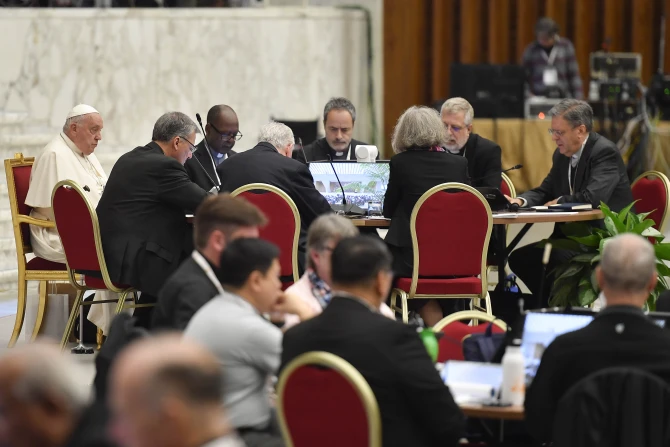
This is one of the 10 groups established by Pope Francis in 2024 after the first session of the Synod on Synodality.
The work and report of this group were coordinated by the Vatican’s Dicastery for the Doctrine of the Faith. In the document, this team expresses openness to “the possibility of new ministries — including those of community leadership — for lay men and women, and for men and women religious.”
The 86-page report, whose publication was authorized by Pope Leo XIV, notes an “unease” regarding forms of “machismo” and “clericalism” within the Church and therefore proposes a redefinition of governing power that provides new leadership positions for women.
In this regard, it emphasizes that “redefining these areas of competence could pave the way for the recognition of new spaces of responsibility for women in the Church.”
Regarding the female diaconate, the report states that the issue “is not yet ripe” and refers to the work carried out by previous commissions — the second of which issued an opinion against it — without reaching a definitive judgment.
The proposals now circulated are also not definitive. They have been submitted to the pope for his consideration.
More than a hierarchical ‘concession’
The text argues that it is necessary to “overcome the conception of women’s active participation in the life and governance of the Church as a ‘concession’ from hierarchical authority.”
According to the document, women’s involvement should not be understood as a mere functional substitution but as a reality linked to baptismal dignity, since women are “holders of a right in this regard, inasmuch as they are baptized and bearers of charisms.”
The document also states that “there is no reason or impediment preventing women from exercising leadership roles in the Church” and emphasizes that “the mere fact of being a woman does not, in itself, prevent women from assuming leadership roles in the Church.”
From an ecclesiological perspective, the study group participants consider it necessary “to overcome the artificial separation between genders and roles, considering the shared dignity of all creatures created in the image and likeness of God.”
In this vein, the group emphasizes that priority must be given “to the order of being with respect to that of doing,” recalling that participation in the mission of the Church is based, above all, on baptism and the gifts of the Holy Spirit present in the people of God.
The report notes that the discernment of these charisms belongs to the bishop, who can recognize them through a mandate, delegating [a function], or the institution of a specific ministry. However, it cautions that this process “is not a solitary decision” but must also involve the ecclesial community.
Role of the laity in the exercise of the bishop’s ministry
From a theological and canonical perspective, the document clarifies that the lay faithful do not participate in holy orders, although they can collaborate in the exercise of the bishop’s ministry.
In this context, the authors emphasize that both Pope Francis and Leo XIV put this guideline into practice by appointing women to positions of authority in the Roman Curia, which constitutes “a model for reflection.”
“The recent appointments of women to positions of responsibility in some dicasteries constitute a prophetic sign of both symbolic and practical significance. They represent a first step towards opening new spaces for participation, recognizing that the capacity for governance and discernment is not the exclusive prerogative of the male gender,” the study group emphasizes.
Warning about clericalism
The document warns, however, that attitudes marked by “clericalism” still persist. In this regard, it points out that “women, even in positions of responsibility, sometimes have difficulty participating and being heard on equal terms with their male colleagues, especially in interactions with ordained ministers.”
At the same time, it notes that the authority proper to the clergy derives mainly from their relationship with the Eucharist and from their mission to safeguard the unity of the community, although this “does not exclude that a power to guide communities may be conferred, at least in some cases, also on lay faithful.”
The report adds that the pope’s primatial authority can also be delegated to baptized individuals who have not received holy orders, as established by the apostolic constitution Praedicate Evangelium. Therefore, the document concludes that “there appear to be no obstacles to extending this approach to the local level in dioceses as well.”
Women’s participation is ‘a true sign of the times’
However, the report also observes signs of change. Many women perceive increasing recognition from male leaders who have understood that their participation “is not a concession or an adaptation to passing cultural trends but a true sign of the times.”
This new awareness, the document adds, could become “a prerequisite for lasting structural transformation.”
The synod’s secretary-general, Cardinal Mario Grech, stated in the report’s summary that “courage, accompaniment, and patience will be necessary to introduce gradual changes” in order to preserve ecclesial communion and build communities that fully value the gifts and charisms of men and women.
This story was first published by ACI Prensa, the Spanish-language sister service of EWTN News. It has been translated and adapted by EWTN News English.