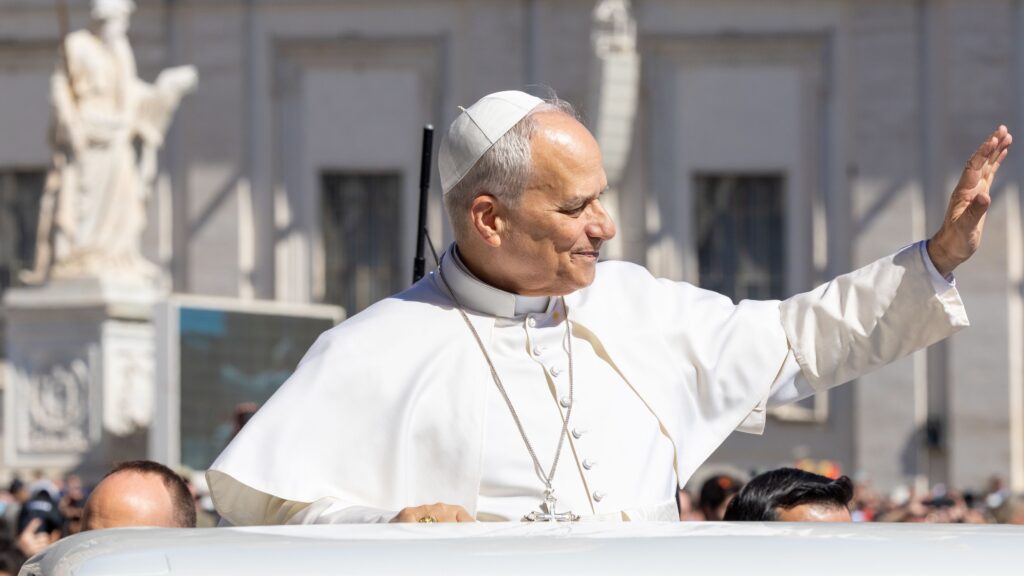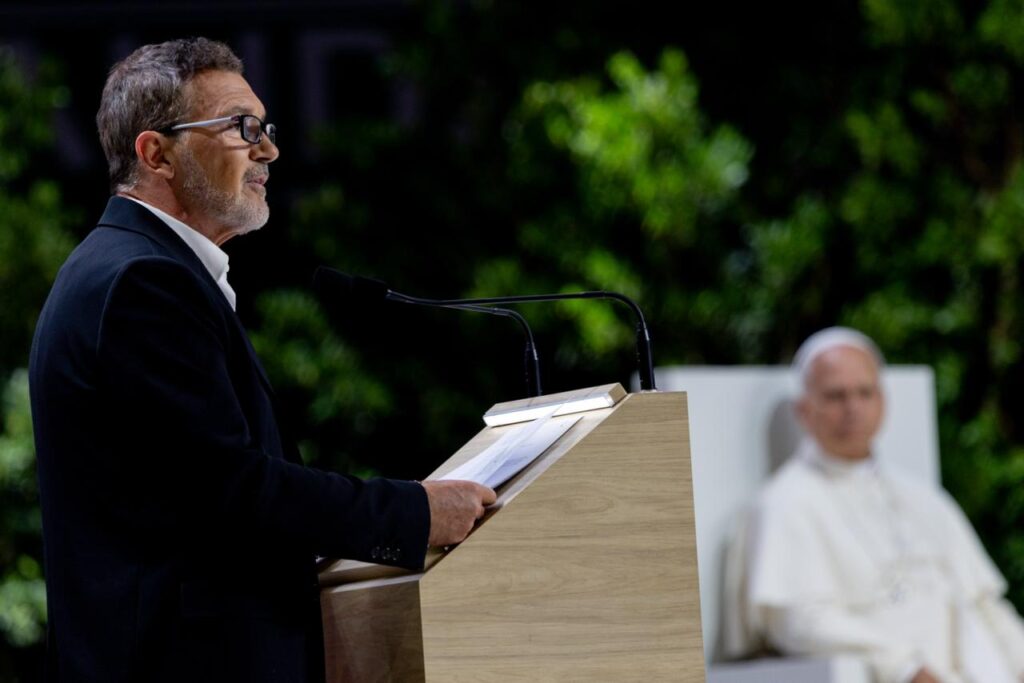
Actor joins Pope Leo XIV at Madrid gathering on culture, art, economics, and sports during the pope’s apostolic visit to Spain.
MADRID — This cityʼs Movistar Arena became a kind of modern “Court of the Gentiles” on Sunday, where faith and contemporary art met to explore the mystery of the human person under the guidance of Pope Leo XIV.
The gathering brought together leading figures from Spanish culture with an international profile, including actor Antonio Banderas. Sports were represented by legendary badminton player Carolina Marín, a three-time world champion, while academia was represented by José María Coello de Portugal, vice rector for planning, coordination, and institutional relations at the Complutense University of Madrid.
Representatives of labor unions and employers’ organizations also presented the pope with their concerns and challenges, with the aim of working together to build a society oriented toward the common good and capable of overcoming fragmentation and polarization.
Their presence was itself a sign that encounter remains possible even in a divided society.
The historic meeting reflected the theme of the first papal trip to Spain in 15 years — “Lift up your gaze” — and Pope Leo XIV’s call to weave networks among different social actors, showing that beyond legitimate differences there is a firm desire to build strong, cross-sector alliances to face the challenges of the future.
One of the highlights of the event was Banderas’ address, in which he recited a text on the bond between faith and culture.
“I confess that I am a victim of God’s spell,” the actor said, looking directly at the pope.
Banderas, who the previous day had directed the cast of the musical “Godspell” in a special performance during a prayer vigil with young people in Madrid’s Plaza de Lima, also evoked the popular piety of his native Málaga and the Holy Week processions that marked his childhood.
In his remarks, Banderas stressed art’s ability to raise deep questions.
“In a world that at times is overly simplified, art helps us recover the depth and the soul that is trying to be stolen by artificial intelligence,” he said.
Earlier, Cardinal José Cobo, archbishop of Madrid, presented Pope Leo XIV as a reference point in the fight against extremism. Along those lines, the pope made clear that the Church has stood, from its earliest days, on the side of culture and art, fostering the encounter of different sensibilities in a shared search for transcendence.
The Church’s “longing” to remain in dialogue with the contemporary world
“The Church, conscious both of her successes and her failures throughout history, longs to remain in dialogue with the contemporary world,” Pope Leo said.
In his address, the pope invited the world today not to dismiss the Church’s “centuries-old experience,” which he said has always “proposed paths for a dignified life and the common good.” In that context, he recalled St. Paul VI, who before the United Nations noted that, whatever one’s opinion of the Roman Pontiff, his mission is well known.
Pope Leo also cited his encyclical “Magnifica humanitas,” published May 25, 2025, to return to a central question: “What does it mean to be truly human?”
To that question, he offered a clear answer: “The Church shares with humility, but also with firmness, what she has discovered through the experience of faith: that Jesus Christ responds to the great questions about human life and its fullness, already in this world and unto its fulfillment in eternity.”
To face these questions, the pope proposed a form of social dialogue that he compared to the art of weaving networks, based on “encounter, listening, dialogue, and respect.” The approach is not new to his visit to Spain. It was already present in his episcopal coat of arms and has been confirmed since his election as Roman Pontiff — a word meaning “bridge builder” — as one who builds a bridge first with God and then with people, societies, and cultures.
In concrete terms, he explained that “weaving networks” means that “the university does not live with its back turned to the world of work or renounce the truth; that business activity does not see the employee as just another factor in the equation of its interests; that art does not have only the elites as its goal; that sport is not reduced to spectacle or turned into mere business; that technological progress takes into account the elderly, the poor, and those who have no voice.”
In that context, the pope — a mathematician by training — recalled with admiration the great classics of Spanish literature, citing Lope de Vega, St. Teresa of Ávila, St. John of the Cross, and Calderón de la Barca. He also recalled the serenity of the prose of St. Thomas Aquinas, from whom the Church has inherited the beautiful hymns of Corpus Christi, the solemnity celebrated Sunday.
For the pope, weaving networks also means “serving in a disinterested way,” as men and women moved by faith have done throughout the centuries by founding hospitals, schools, and charitable initiatives. He therefore invited participants to ask honestly whether Europe could have forged its identity “without the spiritual imprint that has marked its history.”
“This is not a provocation, but an invitation to consider whether eternity, which broke into time and space through the incarnation of Jesus Christ, can once again be reconciled with everyday life,” he said. “Is it really possible to believe that Europe — which we love so much — would be itself without the imprint of faith? Why fear that eternity might permeate daily life?”
Finally, the pope said Christ restores the common good to its central place as an arbiter that “calms the greed of some and nourishes the hope of others, while desiring to save them all.”
Follow the LIVE updates from EWTN News for Pope Leo’s Trip in Spain.
This story was first published by ACI Prensa, the Spanish-language sister service of EWTN News. It has been translated and adapted by EWTN News English.