COMMENTARY: In his first days as Pope, Leo XIV has signaled continuity over rupture, rooted his vision in patristic tradition, and issued a bold call to young people: ‘Do not be afraid.’
SIGN UP FOR OUR NEWSLETTER HERE
Pope Leo XIV’s first few days have been met with widespread enthusiasm and excitement, not least because the Holy Father himself is confident, at ease, and seems to enjoy being pope.
He told the cardinals they had asked him “to carry that cross and to be blessed with that mission.” At least for now, the blessing is more apparent than the cross.
After the initial impressions of the Holy Father’s first days — and the global reaction — there are now second impressions that suggest where Pope Leo might be headed.
Citation Signals
In Rome, the citations matter. Pope Leo XIV has lavished praise on his immediate predecessor, as all popes are expected to do. Pope St. John Paul did so in October 1978, even though Blessed John Paul I had been pope for only 33 days.
Yet Leo XIV has also carefully cited Pope Benedict XVI, as well as John Paul II and St. Paul VI. In taking the name Leo — in honor of Pope Leo XIII, he said — he reaches even farther back into Catholic history.
For those who might set one pontificate against another, Pope Leo is encouraging the opposite, to see continuity across them. And he seems intent on reminding Catholics that the Church did not begin with Vatican II in the 1960s, even as he remains committed to its vision.
The Augustinian order, to which Pope Leo belongs, has an academic specialty in the Church Fathers (“patristics”), fitting for “son[s] of St. Augustine,” as the Holy Father called himself at his first appearance on the balcony. The Augustinian university in Rome specializes in patristics.
Pope Leo XIV cited St. Augustine in his address and blessing urbi et orbi (“to the city and the world”), St. Ignatius of Antioch in his homily at his Mass with the cardinals, and St. Gregory the Great in his first Regina Caeli address. It would not be a surprise if he instructed his staff to prepare patristic references for his addresses, to which he would add his own.
Patristic study has been neglected in recent decades, partly because the genuine renewal in biblical studies has absorbed a great deal of scholarly energy and attention, and those resources are not infinite. Patristics is meant, though, to be a complement to the study of Scripture. Pope Leo will be reminding the Church of that.
Be Not Afraid!
Papal remarks are carefully prepared, so departures from the text and spontaneous remarks are noteworthy — reflecting what might have priority in the papal mind.
On his first Sunday as pope, Leo offered an extemporaneous homily at the Mass he celebrated at the tomb of St. Peter. Speaking of the mission of the Church and vocations, he said, “Take courage! Without fear! Many times in the Gospel Jesus says: ‘Do not be afraid.’”
A short while later, while delivering his first Regina Caeli address from the balcony of St. Peter’s, he departed from his prepared text — which was focused on priestly and religious vocations — to add: “And to young people, I say: Do not be afraid! Accept the invitation of the Church and of Christ the Lord!”
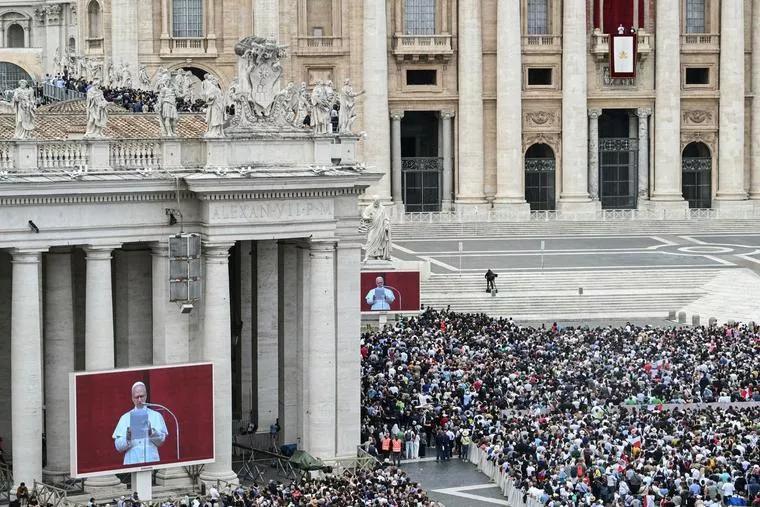
That was a direct echo of John Paul’s inaugural “Be not afraid!” in 1978. It became the signature theme of the entire pontificate; Leo would have intended that homage by quoting him spontaneously. Certainly, the immense throng of some 100,000 immediately recognized it, giving a roar of approval.
At his own inaugural homily on April 24, 2005, Pope Benedict XVI concluded by quoting, and then reinterpreting, the “Be not afraid!” It became the most quoted passage of Benedict’s immensely rich pontificate:
“And so, today, with great strength and great conviction, based on long personal experience of life, I say to you, dear young people: Do not be afraid of Christ! He takes nothing away, and he gives you everything. When we give ourselves to him, we receive a hundredfold in return. Yes, open, open wide the doors to Christ — and you will find true life. Amen.”
Benedict took John Paul’s “Be not afraid” and applied it to the life of each disciple, especially young people, not only the great political and economic systems of which John Paul spoke. Pope Leo XIV has now applied it more specifically to the vocational dimension of youth.
To Visit the Blessed Mother
“Tomorrow, I wish to go and pray to Our Lady, that she may watch over all of Rome,” said Pope Francis on his first appearance as pope on the balcony. The next day he would go to visit the icon of Mary, Salus Populi Romani, at St. Mary Major. He would return more than 100 times during his pontificate, finally choosing to be buried adjacent to the image.
It is unlikely any pope will match that record, but Leo might have contributed to fixing it as a tradition. John Paul, a few weeks after his election, made a visit to the Marian shrine of Mentorella. Pope Leo XIV went on Saturday to the shrine of the Mother of Good Counsel about an hour outside of Rome, a shrine entrusted to the Augustinian Fathers, which the Holy Father has been visiting for decades.
With John Paul and Leo on either side of the Marian pilgrim Francis, a short pilgrimage to a Marian shrine may well become a tradition for newly elected popes.
The American Taboo
Americans are fittingly joyful and proud that a son of Chicago has become pope. But the very widespread idea that it was particularly unimaginable needs to be corrected. A poor knowledge of Church history serves no one.
The New York Times headline read, “Pope Leo XIV overcame an old taboo — being American.” There were dozens of such headlines, in both the secular and Catholic media.
There was no taboo, certainly not an old one.
The Mayflower sailed in 1620, so the possibility of a U.S. pope — as opposed to a Polish or German one — is relatively recent. While canon law does not require the conclave to choose a cardinal from within their number, it has been the practice since 1389. It would be nearly 500 years before the first U.S. cardinal, John McCloskey of New York, was created 150 years ago in 1875.
Eligible for the conclave of 1878, he did not participate because he could not reach Rome in time.
The second U.S. cardinal was James Gibbons of Baltimore. Cardinal Gibbons happened to be in Rome when Pope Leo XIII died in 1903, so he became the first American to participate in a conclave — which elected St. Pius X. Any “American taboo” in 1903 would have been a taboo on one man!
When Pius X died in 1914, Cardinal Gibbons and Cardinal William O’Connell did not reach Rome in time to participate in the conclave. Likewise, the U.S. cardinals did not arrive in time for the 1922 conclave. No Americans, no taboo on their election.
The conclave of 1939 was the first to include multiple Americans — three to be exact. It elected Pope Pius XII.
Still, given that it had been 400 years since any non-Italian had been elected pope, it could be said of any other country that there was a “taboo.” Only since the election of John Paul II in 1978 — after the Italian elected before him died suddenly — has it been a practical option to choose another nationality.
There have been three conclaves since — 2005, 2013 and 2025. The first elected Pope Benedict XVI, of which there was no equal in the conclave of any nationality. In 2013, there was serious attention given to Cardinal Seán O’Malley of Boston — it was not unimaginable that he could have been elected instead of Pope Francis. In 2025, a cardinal from the United States was in fact elected.
So much for the “taboo.”
There is not a taboo now — but there never has been, much less an old one.
This articles was originally published on NCRegister.
HOW TO SEE THE HOLY FATHER POPE LEO XIV: EWTN TRAVEL JUBILEE APP