Art has always revealed something about how a society understands the human person, the world and humanity’s place within it. During the Renaissance, that relationship underwent a profound transformation.
The rediscovery of classical culture and the rise of Humanism brought renewed attention to human experience, reason and dignity. Yet within the Catholic world, this new emphasis on the human person did not necessarily mean turning away from God.
Instead, some of the greatest artists and patrons of the Renaissance sought to place humanity within a fundamentally Christian vision of creation.
A new way of seeing the world
One of the most important artistic developments of the Renaissance was linear perspective.
Prof. Lydia Salvucci, Full Professor in the Faculty of History and Cultural Heritage of the Church, explains that the difference between medieval and Renaissance art cannot be reduced simply to a change in artistic technique.
Perspective represented “a new way of thinking.”
Using mathematical and geometric principles, Renaissance artists attempted to reproduce on a flat surface the way the human eye perceives three-dimensional space. The result placed greater emphasis on the experience of the person looking at the work.
Masaccio’s frescoes in the Brancacci Chapel in Florence offer a striking example.
Although the composition reflects a new attention to the human point of view, Salvucci notes that its ultimate focus remains Christ.
“We can speak of a Christ-centered vision,” she explained. “Yes, it is a human-centered approach, but it remains fundamentally centered on Christ.”
Christ occupies the center of the composition, with the lines and figures of the scene arranged in relationship to him.
Humanity had moved into sharper focus, but Christ had not disappeared.
Leonardo and the dignity of the human person
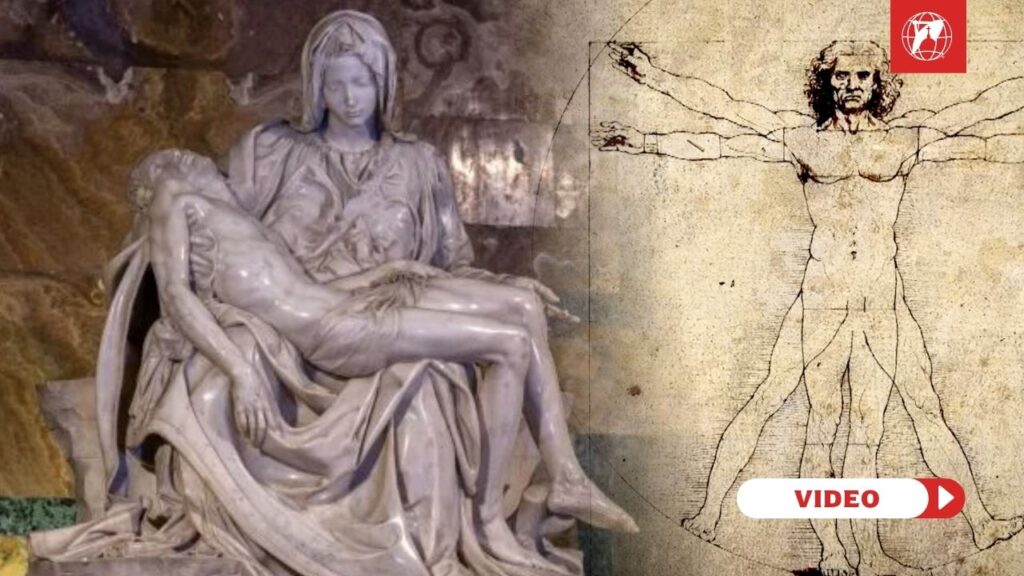
The same tension between humanity, geometry and transcendence can be seen in one of the Renaissance’s most recognizable images: Leonardo da Vinci’s Vitruvian Man.
Leonardo places the human body within a circle and a square, geometric forms whose symbolic meanings long predated the Renaissance and had already been incorporated into medieval and Christian culture.
For Salvucci, the image can therefore be approached through a theological lens as well as an artistic one.
The extended human figure can recall the form of a church, while the body itself evokes a Christian understanding of Christ and the Church as his Mystical Body.
The Renaissance fascination with human proportions, in this reading, does not necessarily stand in opposition to Christianity. The dignity and beauty of the human body can instead point toward a theological understanding of humanity created by God and perfected in Christ.
From Florence to Rome
Humanism first flourished particularly strongly in Florence, where the study of classical literature and human nature helped provide the intellectual foundations of the Renaissance.
But when these ideas reached Rome, they encountered a city unlike any other.
Art historian Dr. Elizabeth Lev draws a distinction between Florence, which could be understood as a city built according to a human scale, and Rome, whose enormous monuments testified to the ambitions of ancient emperors.
Ancient Rome had produced buildings designed to communicate power, permanence and even the divinization of its rulers. Christianity had emerged in direct confrontation with that worldview: the martyrs gave their lives rather than accept the claim that men could become gods.
By the 15th century, however, the Church could look differently at the material remains of antiquity.
Christians did not need to accept pagan theology in order to recognize the extraordinary achievements of Roman art, engineering and architecture.
A new question emerged: Could such cultural ambition be placed at the service of Christianity?
The popes who rebuilt Christian Rome
For Renaissance popes, the answer was visible throughout the city.
Popes became major patrons of artists, architects, scholars, musicians and intellectuals. Their commissions would eventually help transform Rome into one of the great centers of Renaissance culture.
Cardinal Gianfranco Ravasi, president emeritus of the Pontifical Council for Culture, points to the artistic landscape of Rome — beginning with St. Peter’s Basilica — as evidence of the enormous influence of papal patronage.
These projects were not conceived merely as decoration.
They expressed a vision of Christianity through beauty, monumentality and the visible manifestation of divine glory.
Two members of the della Rovere family were particularly important to this transformation: Pope Sixtus IV and his nephew Pope Julius II.
Lev compares their ambitions for Rome with those of the great builders of antiquity. But the goal was now fundamentally different.
Sixtus IV invested in roads, bridges, hospitals, aqueducts and churches, helping create a city capable of welcoming Christian pilgrims.
Churches such as Santa Maria del Popolo confronted visitors arriving in Rome with a new Christian monumental language that could stand alongside the surviving achievements of antiquity.
The Renaissance pope could therefore look back to ancient Rome while remaining conscious that the city was now the See of Peter.
This was Christian Humanism expressed on an urban scale.
Beauty as a proclamation of faith
The Church’s great Renaissance projects consequently became more than demonstrations of artistic skill or institutional prestige.
Beauty itself could become a means of proclaiming the Gospel.
That transformation was not limited to painting, sculpture and architecture. It could also be heard.
Cardinal Ravasi points to the development of sacred polyphony as another example of the Church’s cultural creativity.
Gregorian chant had developed within earlier architectural environments, its single melodic line filling the vertical spaces of medieval churches. Renaissance architecture offered different possibilities.
As musical voices increasingly intertwined in polyphonic compositions, sacred music acquired another powerful language of expression.
The Roman tradition associated with Giovanni Pierluigi da Palestrina would become one of the defining achievements of Catholic sacred music.
Architecture, painting and music were therefore part of the same broader cultural transformation.
A Renaissance centered on Christ
The Renaissance undeniably placed renewed emphasis on the human person. Artists became fascinated by the body, perspective, proportion, emotion and the visible world.
But within Christian Humanism, attention to humanity could ultimately lead beyond humanity itself.
The human person was not understood simply as an autonomous center of reality, but as a creature whose dignity, creativity and beauty found their fullest meaning in relationship with God.
In the churches, paintings and music of Renaissance Rome, the Church sought to demonstrate precisely that.
The human person had entered the center of the picture — but Christ remained the point toward which the lines converged.
Adapted by Jacob Stein.