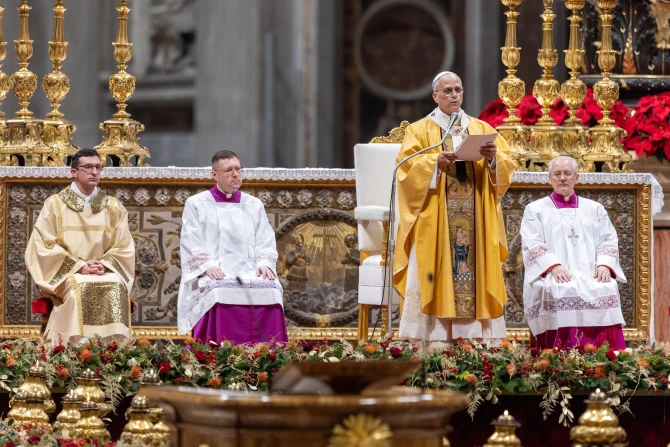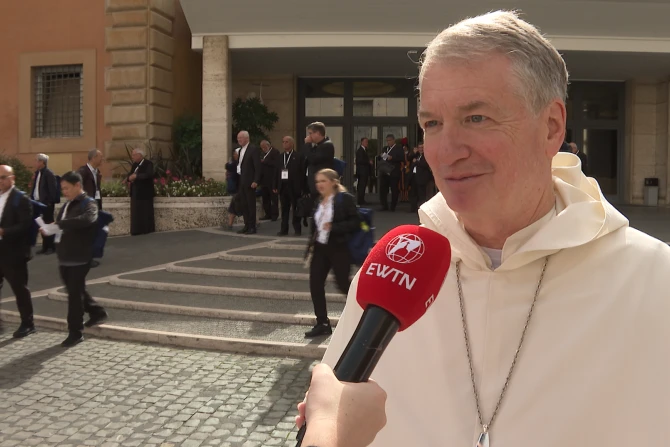
We cannot “reinvent the Catholic faith” or “teach a different Catholicism in different countries,” Australian Archbishop Anthony Fisher, OP, of Sydney and a delegate at the Synod on Synodality said in an interview this week.
As the synodal assembly debates part 3 of the Instrumentum Laboris on “places,” the bishops and laypeople are considering questions such as the future of synodality and the role and authority of national bishops’ conferences, the archbishop told “EWTN News Nightly” on Oct. 15 in an interview to be broadcast Friday.
Should bishops’ conferences “have the authority to teach a different Catholicism in different countries or to decide a different liturgy in different countries or different Mass for different countries? Do they bring their own local culture to questions in the area of morals, for instance?” Fisher told “EWTN News Nightly” Associate Producer Bénédicte Cedergren.
“Could we, for instance, envision a Church where you have ordination of women in some countries but not in other countries, or you have same-sex marriages in some countries but not in other countries, or you have an Arian Christology in some countries and a Nicene Christology in others?” he continued. “You might guess, I think no.”
The Dominican archbishop leads one of Australia’s largest archdioceses by number of Catholics. Sydney serves around 590,000 Catholics and has a population of nearly 5.3 million people.
As one of 15 bishops on the ordinary council of the Synod of Bishops for the Synod on Synodality, Fisher attended the first session of the synodal assembly in October 2023 and is back in Rome this month for the second session.
After three years of consultations at the local and universal level, at the end of this month the Catholic Church will conclude a process of discernment about how to become more synodal and more missionary.
Fisher told “EWTN News Nightly” he is “very concerned” that Catholics “hold on to the deposit of faith, the apostolic tradition, that we don’t imagine, in the vanity of our age, that we are going to reinvent the Catholic faith or the Catholic Church.”
“In fact, this is a tremendous treasure that we’ve received from generation after generation before us, all the way back to Our Lord Jesus Christ and his apostles. And we are here to transmit that faithfully to the next generations after us,” he said.
The archbishop acknowledged that our understanding of the deposit of faith has developed over time and will continue to develop, and added that he thinks it is an exciting feature of the Church that “we’ve managed to have a great variety of cultures and different ways of praying and different ways of evangelizing, and yet we hold together as one in Christ.”
“But it is the one faith, and it’s important to me, coming from the peripheries of the Church in Australia, about as far away as you can be from Rome in the world,” he said, that “it’s the one Church, it’s the one faith and we want to keep celebrating that even amidst our cultural diversity.”
Changes being debated
Fisher said one of the important questions the synod is debating this week is what is “the scope and what are the limits of the local and the cultural” in the universal Catholic Church.
The Synod on Synodality is discussing the third and final part of the Instrumentum Laboris, or working document, Oct. 15–18. The last week of the gathering, which ends Oct. 27, will be dedicated to drafting and revising the final document.
In paragraph 91 of the third part, the document notes that there are structures such as parish councils, deaneries, and dioceses already regulated in canon law that “could prove to be even more suitable for giving a synodal approach a concrete form.”
“These councils can become subjects of ecclesial discernment and synodal decision-making …,” the document continues. “Therefore, this is one of the most promising areas on which to act for a swift implementation of the synodal proposals and orientations, leading to changes with an effective and rapid impact.”
A little further in the same part of the working document, it also says: “Episcopal conferences are fundamental instruments for creating links and sharing experiences between the Churches and for decentralizing governance and pastoral planning.”
“From all that has been gathered so far during this synodal process, the following proposals emerge: (a) recognition of episcopal conferences as ecclesial subjects endowed with doctrinal authority, assuming sociocultural diversity within the framework of a multifaceted Church and favoring the appreciation of liturgical, disciplinary, theological, and spiritual expressions appropriate to different sociocultural contexts,” the text says in paragraph 97.
Interculturality in the Church
In the context of these ideas, Fisher said he thinks “we need to have the same faith, the same morals, the same Church order, and essentially the same liturgy.”
“But we do make space for the different ritual traditions in the Church and for different cultural adaptations and for different ways of evangelizing in different places,” he added.
The archbishop noted that in his Archdiocese of Sydney, for example, they have many different Catholic ritual traditions, such as the Maronites, Melkites, Chaldeans, Ukrainians, and Syro-Malabars.
“We know they bring different spiritualities … a different Mass and different prayer forms, but also often a different understanding of synodality, of the roles of bishops, of the way you choose bishops, they have different canon law and a different Church order while still being part of the one Catholic Church,” he underlined.
“And it is part of the excitement of the Church, I think, that you can go to a Maronite Mass and it’s very different, and yet you also know it’s the same thing: It’s the Lord coming to us under the elements of bread and wine, but he’s really present, his humanity and divinity, for us.”
Bénédicte Cedergren, an associate producer for “EWTN News Nightly,” contributed to this report.
This article was originally published on Catholic News Agency.