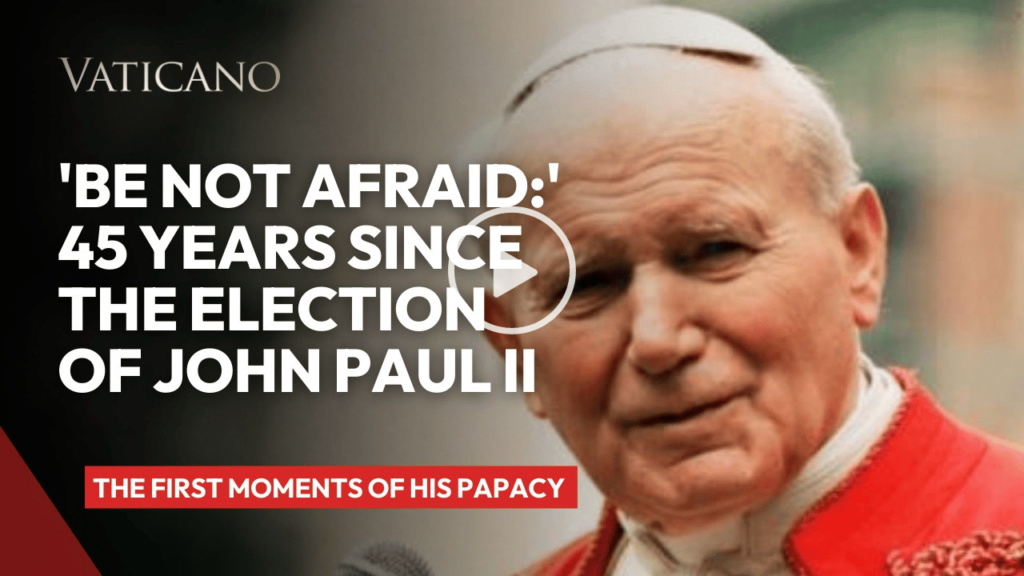
On October 16, 1978, 45 years ago, at 6.18 p.m., white smoke billowed from the chimney of the Sistine Chapel. After half an hour, Cardinal Pericle Felici announced, with the words, “Habemus Papam!” (We have a Pope!), the election of Cardinal Karol Wojtyla, under the name of John Paul II, as the 264th Pope.
Initially, the 58th Archbishop of Krakow wanted to call himself Stanislaus I in honor of the patron saint of Poland. Instead, Wojtyła chose John Paul in memory of his predecessor, Albino Luciani, who passed away after only 33 days into his Pontificate. Standing on the loggia of St. Peter’s Basilica, the newly elected Pope said, in Italian, “I do not know if I can explain myself well in your Italian language. Correct me if I make mistakes.”
His Life Before His Papacy
Karol Józef Wojtyla was born in the Polish town of Wadowice, a small city 50 kilometers from Krakow, on May 18, 1920. He was the youngest of three children born to Karol Wojtyla and Emilia Kaczorowska.
He was baptized on June 20, 1920. Upon graduation from high school in Wadowice, he enrolled in Krakow’s Jagiellonian University in 1938. The Nazi occupation forces closed the university in 1939, and Wojtyla had to work in a quarry to earn his living. In 1942, he began courses in the clandestine seminary of Krakow. After the Second World War, he continued his studies in the major seminary of Krakow and was ordained to the priesthood on November 1, 1946.
Shortly afterward, Cardinal Sapieha, Archbishop of Krakow, sent him to Rome, where he finished his doctorate in theology. Upon returning to Poland, he became chaplain to university students. On July 4, 1958, he was appointed titular Bishop of Ombi and auxiliary of Krakow by Pope Pius XII. In 1964, he was appointed Archbishop of Krakow by Pope Paul VI, who made him a cardinal in 1967.
Wojtyla took part in the Second Vatican Council, where he made an important contribution to the drafting of the Constitution on the Church in the Modern World Gaudium et spes.
The Cardinals elected him Pope in the Conclave on October 16, 1978. On October 22, he solemnly inaugurated his Petrine ministry as the 263rd successor to the Apostle Peter. His Pontificate, one of the longest in the history of the Church, lasted nearly 27 years.
The Modern Papacy and Missionary Spirit
John Paul II exercised the papacy with a tireless missionary spirit. He made 104 pastoral visits outside Italy and 146 within Italy.
On October 5, 1995, Pope John Paul II visited the United Nations Headquarters in New York to mark the 50th anniversary of the organization’s founding. His speech focused on the importance of freedom for human flourishing.
The Pope said, “A presupposition of a nation’s rights is certainly its right to exist. Therefore, no one, neither a state or another nation, nor an international organization, is ever justified in asserting that an individual nation is not worthy of existing.”
A Further Testament to the Pope’s Pastoral Vision
As bishop of Rome, he visited 317 of the city’s 333 parishes.
He had more meetings than any of his predecessors with the People of God and the leaders of Nations. More than 17,600,000 pilgrims participated in the General Audiences held on Wednesdays.
His love for young people brought him to establish the World Youth Days. The 19 WYDs celebrated during his Pontificate brought together millions of young people from all over the world. At the same time, his care for the family was expressed in the World Meetings of Families, which he initiated in 1994.
John Paul II often encouraged the young to open their hearts and minds to Christ.
The Fruits of His Papacy
He gave an extraordinary impetus to Canonizations and Beatifications. He celebrated 147 beatification ceremonies during which he proclaimed 1,338 Blesseds and 51 canonizations in which a total of 482 Saints were declared.
He considerably expanded the College of Cardinals, creating 231 Cardinals in nine consistories, and called six meetings bringing together the entirety of the College of Cardinals.
He organized 15 Assemblies of the Synod of Bishops, six of which were Ordinary General Assemblies.
His most important Documents include 14 Encyclicals, 15 Apostolic Exhortations, 11 Apostolic Constitutions, and 45 Apostolic Letters.
He promulgated the Catechism of the Catholic Church in the light of Tradition as authoritatively interpreted by the Second Vatican Council.
The Death of John Paul the Great
On April 2, 2005, at 9.37 p.m., while Saturday was drawing to a close and the Lord’s Day was fast approaching, the Octave of Easter and Divine Mercy Sunday, John Paul II, departed this world for the house of the Father.
From that evening until April 8, the date of the late Pontiff’s funeral, more than three million pilgrims came to Rome to pay homage to the mortal remains of the Pope. Some of them waited for up to 24 hours to enter St. Peter’s Basilica.
(Adapted by Jacob Stein)