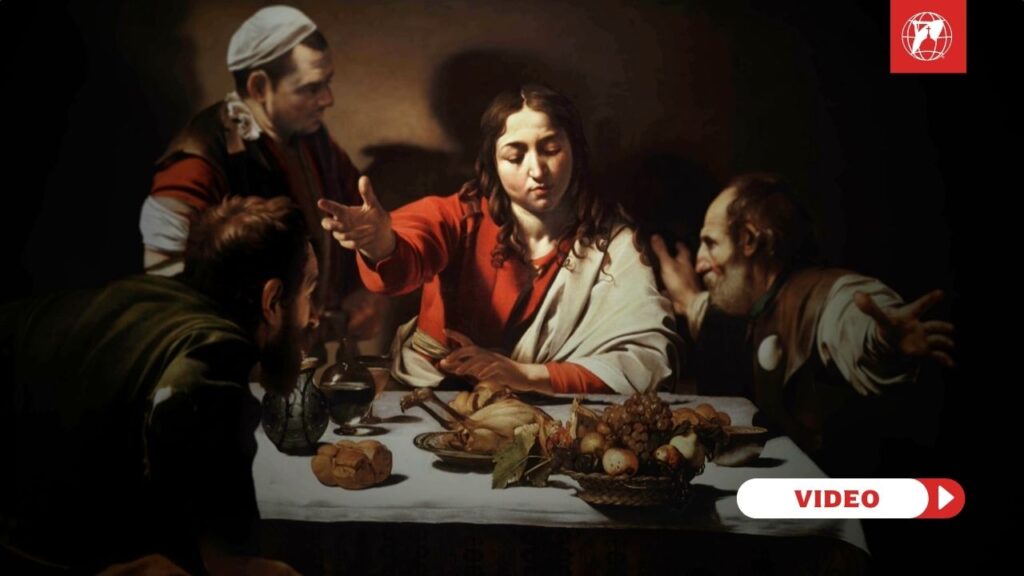
ROME — More than four centuries after his death, Michelangelo Merisi da Caravaggio continues to captivate millions with paintings that confront viewers with some of Christianity’s deepest questions: faith and doubt, grace and sin, light and darkness.
An exhibition in Rome, “Caravaggio e i Maestri della Luce” (“Caravaggio and the Masters of Light”), explores how the revolutionary painter used dramatic contrasts of light and shadow not simply as artistic techniques, but as profound theological symbols rooted in Catholic spirituality.
Hosted at the Historical Museum of the Infantry of the Italian Army, the exhibition traces Caravaggio’s artistic and spiritual vision through works inspired by Scripture, the saints, and the ordinary people who became the faces of his sacred art.
Light as a symbol of divine grace
For curator Alberto Bertuzzi, Caravaggio’s use of light reaches far beyond aesthetics.
“It is not a meaning that concerns only light,” Bertuzzi explained. “Light represents divine grace, faith itself, and faith becomes the fundamental point alongside light.”
That symbolism becomes even more striking when viewed alongside the artist’s turbulent personal life.
“When studying Caravaggio or reading about his life, one thing immediately stands out: there is a profound contrast,” Bertuzzi said.
“He was a violent man, someone prone, we could say, to anger; a man who committed acts that were recorded by the authorities of the time. And yet his paintings reveal an immense faith.”
The influence of St. Philip Neri
Much of Caravaggio’s religious imagination developed in the spiritual climate created by St. Philip Neri, who died only months after the young artist arrived in Rome from Milan.
According to Bertuzzi, the connection between the two is unmistakable.
“Caravaggio is very close to the spirituality of St. Philip Neri, which at the time was deeply felt in Rome, especially among ordinary people, the poor, and the common folk.”
The saint emphasized that holiness was attainable for everyone, an idea reflected throughout Caravaggio’s paintings.
“He strongly connects religion with the people, making the saints become human, so that people can recognize that they too are called to holiness,” Bertuzzi said. “And light takes on the meaning of divine grace.”
Saints with ordinary faces
Unlike many artists of his time, Caravaggio rejected idealized depictions of biblical figures.
Instead, he painted saints, apostles, and martyrs with the faces of ordinary people.
Canon lawyer and art law specialist Fabiola Lacagnina said this realism lies at the heart of Caravaggio’s enduring appeal.
“His subjects are drawn from everyday life; they are not idealized models or figures that represent a kind of perfection.”
“Instead, we encounter people who could come straight from daily life — fruit sellers, fishmongers, merchants. They are real people, and Caravaggio draws inspiration from them in all their human fragility.”
The exhibition highlights this humanity by presenting Caravaggio’s works as part of a spiritual journey rather than simply an artistic collection.
From doubt to faith
Lacagnina explained that visitors progress through the exhibition almost as participants in a pilgrimage.
“The deeper meaning is really that of a journey of faith.”
“One enters almost as a non-believer, as someone unfamiliar with the faith, and then experiences a faith that gradually grows stronger.”
For her, that journey reaches its climax with Caravaggio’s famous “The Incredulity of Saint Thomas.”
The Gospel scene depicts the Apostle Thomas placing his hand into Christ’s wounded side after refusing to believe in the Resurrection without physical proof.
Bertuzzi believes the painting captures one of Christianity’s central tensions.
“Incredulity is the lack of faith.”
“How does one come to believe? One must see, one must verify that things are truly as they are, but then faith disappears.”
“It is precisely from this tension between faith, the need for faith, and the impossibility of basing faith solely on reason that this painting emerges.”
The exhibition presents the work as a visual meditation on doubt giving way to belief, as Thomas moves from shadow into the light of the risen Christ.
A revolutionary use of light
Caravaggio’s dramatic lighting was not achieved by imagination alone.
Bertuzzi recounted a remarkable episode that revealed how the artist created his distinctive effects.
After Caravaggio fled Rome in 1606 following the killing of Ranuccio Tomassoni, his landlord sought payment of unpaid rent.
“The woman who had rented him the studio wanted the unpaid rent back,” Bertuzzi explained.
“The judge ordered the guards to enter Caravaggio’s studio and seize his works.”
The discovery surprised everyone involved.
“Everyone was astonished when they discovered that the roof had been broken open.”
“Caravaggio had broken the roof to let the light come down and illuminate his models from above, a truly revolutionary way of using light.”
Rome remains the heart of Caravaggio’s legacy
Although Caravaggio never founded a formal artistic school, his influence spread rapidly across Europe.
His paintings were copied, imitated, and even forged during his lifetime, inspiring generations of artists known as the Caravaggeschi.
Because most of his masterpieces were created in Rome, the Eternal City remains the center of his artistic legacy.
Salvatore Lacagnina, executive producer of the exhibition’s organizing company Navigare S.r.l., said the international audience reflects Caravaggio’s universal appeal.
“About 70% of the visitors coming to see the exhibition are foreign visitors, which shows that Caravaggio is a universally recognized name.”
“But Caravaggio’s beating heart is in Rome, and so this exhibition that we wanted to create here in Rome was also a way of thanking him for everything he gave to this city.”
For Fabiola Lacagnina, the exhibition’s ultimate purpose extends beyond art history.
“My personal hope is that they leave asking themselves a few more questions and perhaps, through their doubts, come to explore the faith more deeply.”
Adapted by Jacob Stein