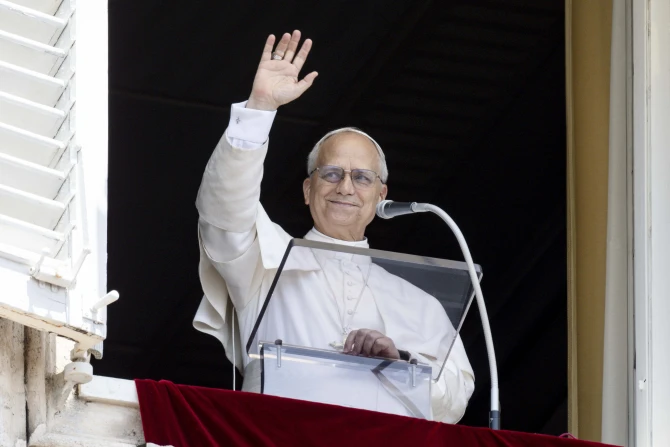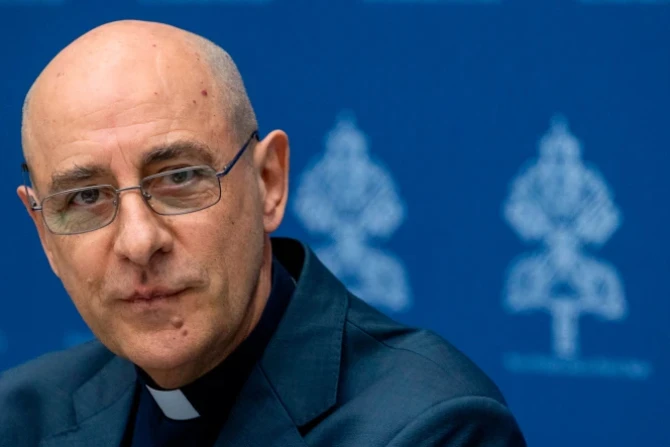
Cardinal Victor Fernández, the prefect of the Dicastery for the Doctrine of the Faith, announced that the female diaconate will be the subject of a more in-depth study under the impetus of the proposals sent to the commission assigned to this task. He also stated that this question, although Pope Francis considers it not “mature,” is not a “closed issue.”
To delve deeper into the differences between holy orders and authority in order to be able to entrust laywomen with leadership functions in the Church is, according to Fernández, the objective of the work of the group he leads at the Synod on Synodality to reflect on the role of women in the Church at the request of the Holy Father.
Fernández made the statement during a meeting on Thursday afternoon with about 100 members, guests, and experts participating in the synod to hear their questions and proposals regarding the work of group 5.
This meeting was called at the initiative of the cardinal in response to some members being frustrated by his absence from a meeting scheduled for last week.
According to reports and the audio shared after the meeting, Fernández emphasized that the majority of women want to “be heard and valued,” are asking to “have authority” and to be able to develop their charisms without specifically requesting the female diaconate, since they do not want to be “clericalized.”
“I am thinking of women theologians who in some parts of the world have no opportunity for development or real freedom for theological work … of women who have gifts for leading communities … or of women who have great capacity to advise like the best of consultants or spiritual directors but who are not accepted because they don’t have holy orders,” he added.
The cardinal was also asked about the possibility of this matter being the main theme of the next synod. “I don’t know what the procedures are for proposing the next themes, it’s not my job, but perhaps it will be one of the themes proposed” at the end of this synod, he replied.
Fernández also noted that “the experience of the Amazon” is “very important” for this study because of the existence, he said, “of an experience of communities led by women without any priests.”
“This experience is very important for us and we have already consulted some women” who belong “to groups of laypeople who constantly visit the communities.”
The idea of the ministries, he continued, “is not a decision of the bishop who chooses a woman friend for an important position, but there is a need in the community and that there is in some persons a gift that responds to that need.”
“We must be careful with this so as not to create a structure that ultimately remains dependent on [having] authority,” he said.
In this regard, the DDF prefect said it is possible to “have a significant consensus” regarding the leadership roles of women in the Church while noting that “very concrete steps will be taken in this regard.”
“If it turns out that in the past women preached during the celebration of the Eucharist or exercised authority without having been ordained deacons, does this count for less?” the cardinal asked the members of the synod.
With the aim of carrying out a more open consultation following a “synodal style,” the Argentine cardinal renewed his invitation to send contributions and proposals to the Vatican dicastery.
“Honestly, we need to receive ideas and proposals because we try to interpret the needs and possibilities that women see, but not being a woman I don’t have their experience. So we need to understand where we can go on these concrete paths for women’s empowerment.”
To do this, the cardinal said that “the help of concrete proposals with which we can take real steps forward is really needed. What I’ve heard today seemed very, very interesting to me and it has opened my mind a little to other ideas.”
“I’m not known in the Church for being a closed-minded medieval, am I? So you can be sure that I have an open heart to see where the Holy Spirit leads us and we move forward,” he added.
The female diaconate will be studied ‘more intensively’
Although the female diaconate has been removed from the central debates of the synod, the cardinal insisted that those who “are convinced that it is necessary to go deeper” into this question can also send their considerations to the commission chaired by Cardinal Giuseppe Petrocchi to further explore the subject.
He said that this body, established by the Holy Father in 2020, will resume its work with even “more effort” under the impetus of the proposals sent by the members of the synodal assembly and from other parts of the world.
Also, regarding Pope Francis’ position on the question of the diaconate, which he said was “not mature,” Fernández pointed out that this does not mean that Francis wants to “close the issue.”
This reflection will also continue, according to the cardinal, because “the conclusions of the commission’s work are not without ambiguity and there are historians who say that in the past there were cases of women being ordained as deaconesses,” while other historians claim that it was “a blessing and not a true ordination.”
This story was first published by ACI Prensa, CNA’s Spanish-language news partner. It has been translated and adapted by CNA.