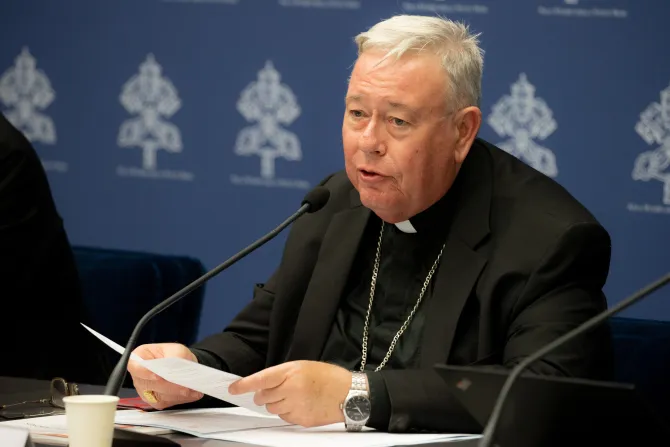
In an interview with the French newspaper La Croix on Thursday, Cardinal Jean-Claude Hollerich, SJ, discussed the European elections and the dwindling influence of Christianity on politics.
Hollerich is archbishop of Luxembourg, a member of the Council of Cardinals that advises Pope Francis, and a key figure at the Synod on Synodality, where he serves as relator general.
“This is a political consequence of the decline of Christianity and Catholicism in Europe because it is a fact that Christians in Europe are now a minority and will become even more so in the coming years,” he said, explaining the current political position of Christians in Europe.
This decline had led to a “lack of ideas” and a lack of politicians of the caliber of Robert Schuman and Alcide De Gasperi — two staunch Catholics and founders of the European Union.
“Today we have politicians. Politicians have no convictions: They read polls and adapt what they think to them. This is a huge mistake that I see at both national and European levels,” the cardinal said.
Compelling political argumentation has faded into the background, he added. “Today, those who govern us no longer have a backbone.”
Hollerich went on to say that other “ideals” — such as ecology and climate change — are supported by a large part of the population, which he also shared because “they are a necessity in order to save humanity.”
Climate change must be tackled, the cardinal said, because it otherwise “will kill just as many people as war.”
Regarding the Church’s role in dealing with political and social issues, Hollerich said it should engage the world in a dialog based on the Second Vatican Council.
The archbishop of Luxembourg said that some “ideals, such as globalization, are supported by a small bourgeois, rich, and intellectual minority. As far as the various socialist parties are concerned, in many countries they have begun to promote social reforms rather than social welfare reforms.”
Nevertheless, the cardinal said he continues to see Christians as a resource for the future of the European Union and compared their current situation with that of the minority of Soviets during the Russian Revolution. Despite their quantitative inferiority, they succeeded in implementing their idea.
Concerning the upcoming European elections, the cardinal stated: “We have become accustomed to the European Union. We are no longer aware of the advantages of this political institution and the will behind it.”
Hollerich also warned against a return to fascism. “It’s already here. I don’t want to snub Italy, but the ruling party there is post-fascist,” he said. “That scares me, especially as I come from a family where everyone was in the resistance. As a young boy, I heard stories from the Second World War.”
On the subject of abortion, the cardinal condemned “rich society” for finding no other solution than “killing unborn children.” He warned: “History will judge us.”
This article was originally published in CNA Deutsch, CNA’s German-language news partner, and has been translated and adapted by CNA.
This article was originally published on Catholic News Agency.