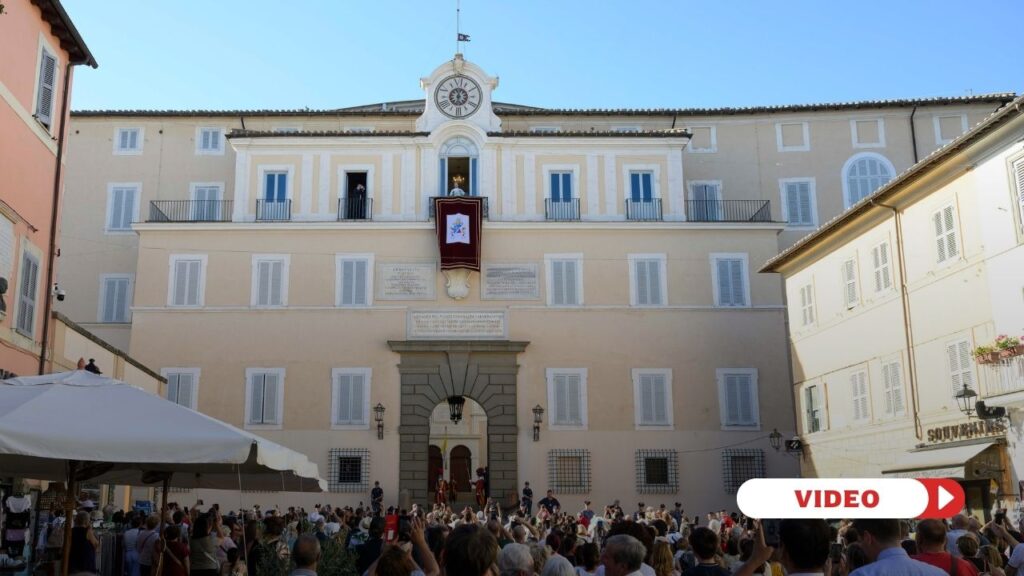
For four centuries, Castel Gandolfo has been more than a summer escape for the Popes. Overlooking Lake Albano, this historic town has served as a place of rest, prayer, work, and close connection between the papacy and local families.
A Papal Tradition Born in 1626
Nestled in the lush hills overlooking Lake Albano, just a short distance from Rome, Castel Gandolfo has been home to the Popes’ summer residence for 400 years.
The tradition began with Pope Urban VIII, who established the practice of leaving Rome during the oppressive summer heat for the cooler hills above the city.
As historian and tourist guide Irene Benedetti explains, “It is a beautiful anniversary. Historians recount that the first time Pope Urban VIII arrived here, cannon salutes fired at dawn in Rome to announce, on 10 May 1626, his journey. A procession of carriages followed the Pontiff, in what later came to be known as the ‘papal train,’ at a time when the train was still far from being invented.”
For the people of Castel Gandolfo, the Pope’s arrival was always a moment of celebration. Luciano Pagnanelli, historian and resident of Castel Gandolfo, recalls: “As the Pope approached Castel Gandolfo, the townspeople and the local priors, seeing the large cloud of dust approaching in the distance, would begin firing small ceremonial fireworks as a sign of joy to welcome the Holy Father.”
From Abandonment to a Renewed Papal Presence
After the fall of the Papal States in 1870 and the annexation of the papal territories by the newly unified Kingdom of Italy, the papal residence remained vacant and neglected for more than 60 years.
Pagnanelli explains: “The Barberini Villa had not yet been acquired; everything was in a state of abandonment. Only Cardinal Merry del Val, the Secretary of State of Pope Pius X, came to the palace two or three times. But the Popes did not return until the time of Pius XI.”
Everything changed with the Lateran Pacts of 1929, which granted the papal residence extraterritorial status under the Holy See.
Today, the 55-hectare estate stands on the site of the ancient villa of Emperor Domitian, chosen for its unique microclimate. A rare blend of natural, historical, and environmental heritage, it is now also the heart of an ecological project launched in 2023 by Pope Francis: the Borgo Laudato Si’, inspired by his 2015 encyclical Laudato Si’.
This green area has since become a weekly place of refuge for Pope Leo XIV, who spends time here playing tennis, swimming, and riding horses. And he is not the first Pope to do so.
“Pope Leo does like all his predecessors, including Urban VIII, who travelled on horseback, but also Clement XIV, Ganganelli, who also rode on horseback,” Pagnanelli says. “Inside the palace, there are tapestries that bear witness to this.”
A Town That Lived Alongside the Popes
In 2016, Pope Francis transformed the Apostolic Palace into a museum, which is why, during the first year of his pontificate, Pope Leo XIV stayed at Villa Barberini.
Dozens of local families have lived in Castel Gandolfo for generations, serving as custodians of invaluable memories of the Popes. Through their accounts, visitors can glimpse the daily routines of the Pontiffs and the way they cared for the town.
Benedetti recalls the closeness of St. John XXIII to local families: “It is they who, in a sense, also enrich us and communicate this relationship with the various pontiffs, for example John XXIII. He would enter homes, lift the lids of the pots, and go into the kitchen to see whether the family was in need or not — whether they could feed all the members of the household. And if not, he would personally help them.”
For the people of Castel Gandolfo, this bond is part of their identity. Pagnanelli says: “We have always lived alongside the Popes. Just think that, during the time of Pope Clement XI Albani, the people of Castel Gandolfo were regarded almost as members of the Pope’s own household.”
The “Second Vatican”
Castel Gandolfo is not just a historic residence. It has always been an oasis of prayer, reflection, and work. Here, Popes have come to rest, write, and seek the silence needed to govern the Church.
Father Manuel Dorantes, Administrative and Management Director of Borgo Laudato Si’, recalls that St. John Paul II used to call Castel Gandolfo the “second Vatican,” because it was not simply a place of rest.
“John Paul II used to call this place the second Vatican, because this is where a lot of things happen also,” Dorantes explains. “It’s not just that he comes here for rest. That is also, I think, a narrative that needs to be expanded on. The Pope didn’t just come here to rest. Most of the summers throughout history, at least for the last 100 years, the Vicar of Christ, the Successor of Peter, comes here.”
For 400 years, the papal summer residence in Castel Gandolfo has watched over the hills above Rome. Its walls, history, and beauty continue to tell the story of the papacy and the Church.